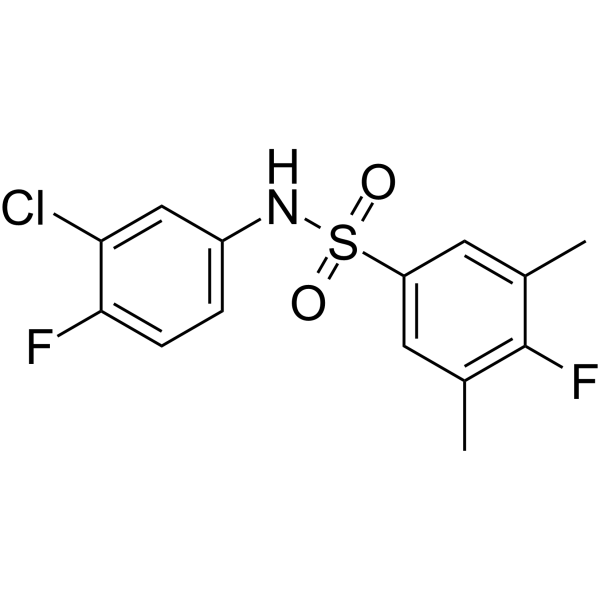
Physicochemical Properties
| Molecular Formula | C14H12CLF2NO2S |
| Molecular Weight | 331.77 |
| CAS # | 666699-46-3 |
| Appearance | White to light yellow solid powder |
| SMILES | S(C1C=C(C(=C(C=1)C)F)C)(=O)(=O)NC1C=CC(=C(C=1)Cl)F |
| HS Tariff Code | 2934.99.9001 |
| Storage |
Powder-20°C 3 years 4°C 2 years In solvent -80°C 6 months -20°C 1 month |
| Shipping Condition | Room temperature (This product is stable at ambient temperature for a few days during ordinary shipping and time spent in Customs) |
Biological Activity
| Targets | MEK1 MEK2 ERK1 ERK2 |
| ln Vitro | TERT activator-1 (0-10 μM; 0-4 hours) specifically activates TERT transcription through the MEK/ERK/AP-1 pathway in MRC-5 cells and alters the chromatin state of the TERT promoter region [1]. |
| ln Vivo | TERT activator-1 (6 mg/kg; intraperitoneal injection; 1-6 weeks) alleviates senescence and promotes adult neurogenesis in naturally aged mice[1]. |
| Cell Assay |
Real Time qPCR[1] Cell Types: MRC-5 human fibroblasts cells Tested Tested Concentrations: 0, 0.05, 0.1, 0.5, 1, 5 and 10 μM Incubation Duration: 4 h Experimental Results: Reduced the mRNA levels of TERT. |
| Animal Protocol |
Animal/Disease Models: C57BL/6 mice aged 10-12 weeks old[1] Doses: 6 mg/kg Route of Administration: Intraperitoneal injection (i.p.); 1 week Experimental Results: Significantly increased the level of TERT protein. Reduced aging genetic traits including cell-cycle arrest and PML body. Suppressed p16Ink4a and other senescence-associated secretory phenotype (SASP) components. Induced signatures of organism growth and natural killer cell activation. Increased in the levels of mBDNF in adult hippocampus. Animal/Disease Models: Naturally aged C57BL/6 mice aged 20-21 months old[1] Doses: 6 mg/kg Route of Administration: Intraperitoneal injection (i.p.); 3 times a week; 6 months Experimental Results: Improves hippocampal-dependent cognitive function. Enhances neuromuscular function. Did not result in any overt adverse consequences. |
| References |
[1]. TERT activation targets DNA methylation and multiple aging hallmarks. Cell. 2024 Jul 25;187(15):4030-4042.e13. |
Solubility Data
| Solubility (In Vitro) | DMSO : ≥ 100 mg/mL (~301.41 mM) |
| Solubility (In Vivo) |
Solubility in Formulation 1: ≥ 2.5 mg/mL (7.54 mM)(saturation unknown) in 10% DMSO 40% PEG300 5% Tween-80 45% Saline (add these co-solvents sequentially from left to right, and one by one),clear solution. For example, if 1 mL of working solution is to be prepared, you can add 100 μL of 25.0 mg/mL clear DMSO stock solution and add it to 400 μL PEG300, mix well; then add 50 μL Tween-80 to the above system, mix well; then continue to add 450 μL of normal saline to make up to 1 mL. Preparation of normal saline: Dissolve 0.9 g of sodium chloride in ddH₂O and make up to 100 mL to obtain a clear and transparent normal saline solution. Solubility in Formulation 2: 2.5 mg/mL (7.54 mM) in 10% DMSO 90% (20% SBE-β-CD in Saline) (add these co-solvents sequentially from left to right, and one by one),suspension solution; with sonication. For example, if 1 mL of working solution is to be prepared, you can add 100 μL of 25.0 mg/mL clear DMSO stock solution and add it to 900 μL of 20% SBE-β-CD saline solution and mix well. 2 g SBE-β-CD (sulfobutyl ether β-cyclodextrin) powder is diluted to 10 mL of saline and completely dissolved until clear and transparent. Solubility in Formulation 3: ≥ 2.5 mg/mL (7.54 mM)(saturation unknown) in 10% DMSO 90% Corn Oil (add these co-solvents sequentially from left to right, and one by one),clear solution. For example, if 1 mL of working solution is to be prepared, you can add 100 μL of 25.0 mg/mL clear DMSO stock solution and add it to 900 μL corn oil and mix well. (Please use freshly prepared in vivo formulations for optimal results.) |
| Preparing Stock Solutions | 1 mg | 5 mg | 10 mg | |
| 1 mM | 3.0141 mL | 15.0707 mL | 30.1414 mL | |
| 5 mM | 0.6028 mL | 3.0141 mL | 6.0283 mL | |
| 10 mM | 0.3014 mL | 1.5071 mL | 3.0141 mL |