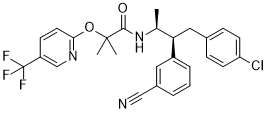
Taranabant (aslo known as MK-0364) is a novel, highly potent and selective cannabinoid 1 (CB1) receptor inverse agonist being investigated as a potential treatment for obesity due to its anorectic effects. It has a binding Ki of 0.13 nM for the human CB1R in vitro, meaning that it inhibits both the binding and functional activity of different agonists. In mice, taranabant improves intestinal transit and lessens abdominal pain. The discovery was made by Merck & Co. Merck stopped the phase III clinical trials in October 2008 because of a high frequency of central side effects, primarily anxiety and depression.
Physicochemical Properties
| Molecular Formula | C27H25CLF3N3O2 |
| Molecular Weight | 515.9545 |
| Exact Mass | 515.159 |
| Elemental Analysis | C, 62.85; H, 4.88; Cl, 6.87; F, 11.05; N, 8.14; O, 6.20 |
| CAS # | 701977-09-5 |
| Related CAS # | Taranabant racemate; 701977-00-6; Taranabant ((1R,2R)stereoisomer); 701977-08-4 |
| PubChem CID | 11226090 |
| Appearance | White to off-white solid powder |
| Density | 1.3 |
| Boiling Point | 634.2ºC at 760 mmHg |
| LogP | 6.704 |
| Hydrogen Bond Donor Count | 1 |
| Hydrogen Bond Acceptor Count | 7 |
| Rotatable Bond Count | 8 |
| Heavy Atom Count | 36 |
| Complexity | 776 |
| Defined Atom Stereocenter Count | 2 |
| SMILES | ClC1=CC=C(C[C@@H](C2=CC=CC(C#N)=C2)[C@@H](NC(C(C)(OC3=CC=C(C=N3)C(F)(F)F)C)=O)C)C=C1 |
| InChi Key | QLYKJCMUNUWAGO-GAJHUEQPSA-N |
| InChi Code | InChI=1S/C27H25ClF3N3O2/c1-17(34-25(35)26(2,3)36-24-12-9-21(16-33-24)27(29,30)31)23(14-18-7-10-22(28)11-8-18)20-6-4-5-19(13-20)15-32/h4-13,16-17,23H,14H2,1-3H3,(H,34,35)/t17-,23+/m0/s1 |
| Chemical Name | N-[(2S,3S)-4-(4-chlorophenyl)-3-(3-cyanophenyl)butan-2-yl]-2-methyl-2-[5-(trifluoromethyl)pyridin-2-yl]oxypropanamide |
| Synonyms | MK-0364; MK 0364; MK0364 |
| HS Tariff Code | 2934.99.9001 |
| Storage |
Powder-20°C 3 years 4°C 2 years In solvent -80°C 6 months -20°C 1 month |
| Shipping Condition | Room temperature (This product is stable at ambient temperature for a few days during ordinary shipping and time spent in Customs) |
Biological Activity
| Targets | hCB1R ( IC50 = 0.3 nM ); GnRHR ( rCB1R = 0.4 nM ); hCB1R ( Ki = 0.13 nM ); rCB1R ( Ki = 0.27 nM ) |
| ln Vitro | Taranabant (MK-0364) binds to CB1R in rats or humans with IC50 values of 0.3 and 0.4 nM, respectively.This results in Ki values of 0.13 and 0.27 nM, respectively. With IC50 values of 290 and 470 nM, respectively, and Ki values of 170 and 310 nM, respectively, taranabant binds to the human or rat CB2R. About 1000 times more selective than CB2R, CB1R has a higher selectivity ratio[1]. For the treatment of obesity, taranabant (MK-0364) is a novel acyclic cannabinoid-1 receptor inverse agonist. Taranabant's IC50 values for CB1R and CB2R by substituted amides are 0.3±0.1 nM and 290±60 nM, in that order. Taranabant is an inverse agonist of CB1R that has very little ability to bind proteins covalently. Taranabant is a CB1R inverse agonist that is incredibly strong and selective (900-fold over CB2), with an affinity that is more than 500 times higher than the original lead. Taranabant is found to be an inverse agonist (EC50=2.4±1.4 nM) in a functional assay of cyclic-AMP production[2]. |
| ln Vivo | In C57BL/6N mice, taranabant (MK-0364) inhibits food intake for two hours and overnight, as well as overnight weight gains. This effect is dose-dependent. Taranabant is found to significantly inhibit both 2-h and overnight food intake (36 and 69% reductions, respectively; P<0.05 and P<0.00001, respectively), as well as overnight body weight gains (48 and 165% reductions, respectively; P<0.01 and P<0.00001, respectively), at doses of 1 and 3 mg/kg (p.o.). In diet-induced obese (DIO) rats, taranabant has a dose-dependent effect that inhibits food intake and weight gain, with an acute minimum effective dose of 1 mg/kg[1]. In three species (dog, 0.2 mg/kg iv, 0.4 mg/kg po, F=31%; t1/2=14 h; rhesus monkey, 0.2 mg/kg iv, 0.4 mg/kg po, F=31%, t1/2=3.6 h), taranabant (MK-0364) exhibits a good pharmacokinetic profile. It also has good brain exposure (1 mg/kg iv, brain and plasma concentrations of 0.11 and 0.18 μM at 1 h, respectively). |
| Enzyme Assay | In order to conduct the binding assay, different concentrations of Taranabant (MK-0364) are incubated with 0.5 nM [3H]CP 55,940, 1.5 μg of recombinant human CB1R-CHO membranes (or 0.1 μg of human CB2R-CHO membranes), 0.5 mg/mL fatty acid-free bovine serum albumin (BSA), 1× proteinase inhibitor mix, and 1% DMSO. Filtration is used to stop the reaction after a one-hour incubation period at 37°C. The filter plate is then washed to separate the bound from the free radioligand. Roughly 10% of the total added radiolabel is the total specifically bound radiolabel. Nonlinear curve fitting is used to determine the inhibitory IC50 values, from which Ki values are derived. In the recombinant human CB1R-CHO membranes, the CB1R density (Bmax=5 pmol/mg based on [3H]CP 55,940 binding) is comparable to that found in rat brain membranes (3-5 pmol/mg)[1]. |
| Animal Protocol | Mice: The mice used are male C57BL/6N wild-type mice. For oral administration to mice later on, MK-0364 is dissolved or dispersed (by sonication) as a fine, homogenous suspension in 0.225% methylcellulose/10% Tween 80 in water. After weighing each mouse, male mice (n = 12 per group, age 23 weeks, mean body weight 34.14±0.53 g) are given either vehicle (0.225% methylcellulose/10% Tween 80 in water) or Taranabant (1 or 3 mg/kg) by oral gavage, about 30 minutes before the start of the dark phase of the light cycle. After dosing, mice are fed unlimited amounts during the dark phase. Five minutes prior to the start of the dark phase of the light cycle, a preweighed aliquot of a very appetizing medium-high fat diet (25% kcal from sucrose, 32% kcal from fat, 4.41 kcal/g) is placed in the cage's food hopper. It is then weighed two and eighteen hours later. In addition, all mice are weighed 18 h after the onset of the dark phase of the light cycle. In this crossover design study, the vehicle and 1-mk/kg groups receive their doses first. Following a four-day washout period, 3 mg/kg of taranabant is administered to the previous vehicle group, while the previous 1-mg/kg group receives a vehicle dose. Rats: Male Sprague-Dawley DIO rats are randomly assigned to groups (n=6 rats/group) for the purpose of administering compound and vehicle doses in acute experiments. To ascertain the impact on overnight body weight gain, rats are weighed 17 hours after dosing. Oral taraditabant at 0.3, 1, and 3 mg/kg p.o. is given to DIO rats one hour prior to the onset of the dark cycle at 3:00 PM. 10% Tween 80 in water is the vehicle, and 2 mL/kg is the dosage volume. Over the course of eighteen hours, powdered food is served in food cups that are continuously weighed at 5-minute intervals. A computerized system is used to record the data. |
| References |
[1]. Antiobesity efficacy of a novel cannabinoid-1 receptor inverse agonist, N-[(1S,2S)-3-(4-chlorophenyl)-2-(3-cyanophenyl)-1-methylpropyl]-2-methyl-2-[[5-(trifluoromethyl)pyridin-2-yl]oxy]propanamide (MK-0364), in rodents. J Pharmacol Exp Ther . 2007 Jun;321(3):1013-22. [2]. Discovery of N-[(1S,2S)-3-(4-Chlorophenyl)-2- (3-cyanophenyl)-1-methylpropyl]-2-methyl-2- {[5-(trifluoromethyl)pyridin-2-yl]oxy}propanamide (MK-0364), a novel, acyclic cannabinoid-1 receptor inverse agonist for the treatment of obesity. J Med Chem . 2006 Dec 28;49(26):7584-7. |
| Additional Infomation |
Taranabant is a stilbenoid. Drug Indication Investigated for use/treatment in obesity. Obesity |
Solubility Data
| Solubility (In Vitro) | DMSO: ≥ 42 mg/mL (~81.4 mM) |
| Solubility (In Vivo) |
Solubility in Formulation 1: ≥ 2.5 mg/mL (4.85 mM) (saturation unknown) in 10% DMSO + 40% PEG300 + 5% Tween80 + 45% Saline (add these co-solvents sequentially from left to right, and one by one), clear solution. For example, if 1 mL of working solution is to be prepared, you can add 100 μL of 25.0 mg/mL clear DMSO stock solution to 400 μL PEG300 and mix evenly; then add 50 μL Tween-80 to the above solution and mix evenly; then add 450 μL normal saline to adjust the volume to 1 mL. Preparation of saline: Dissolve 0.9 g of sodium chloride in 100 mL ddH₂ O to obtain a clear solution. Solubility in Formulation 2: ≥ 2.5 mg/mL (4.85 mM) (saturation unknown) in 10% DMSO + 90% Corn Oil (add these co-solvents sequentially from left to right, and one by one), clear solution. For example, if 1 mL of working solution is to be prepared, you can add 100 μL of 25.0 mg/mL clear DMSO stock solution to 900 μL of corn oil and mix evenly. (Please use freshly prepared in vivo formulations for optimal results.) |
| Preparing Stock Solutions | 1 mg | 5 mg | 10 mg | |
| 1 mM | 1.9382 mL | 9.6909 mL | 19.3817 mL | |
| 5 mM | 0.3876 mL | 1.9382 mL | 3.8763 mL | |
| 10 mM | 0.1938 mL | 0.9691 mL | 1.9382 mL |