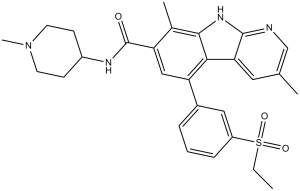
TAK-901 (TAK901) is a novel and potent inhibitor of Aurora A/B kinases with potential antitumor activity. It inhibits Aurora A/B with IC50s of 21 nM and 15 nM, respectively, and shows little/no activity against JAK2, c-Src or Abl. TAK-901 displayed potent in vitro antiproliferative activity and high in vivo antitumor efficacy by binding to and inhibiting the activity of Aurora B, leading to a decrease in the proliferation of tumor cells that overexpress Aurora B.
Physicochemical Properties
| Molecular Formula | C28H32N4O3S | |
| Molecular Weight | 504.64 | |
| Exact Mass | 504.219 | |
| CAS # | 934541-31-8 | |
| Related CAS # |
|
|
| PubChem CID | 16124208 | |
| Appearance | Off-white to light yellow solid powder | |
| Density | 1.3±0.1 g/cm3 | |
| Boiling Point | 761.7±60.0 °C at 760 mmHg | |
| Flash Point | 414.5±32.9 °C | |
| Vapour Pressure | 0.0±2.6 mmHg at 25°C | |
| Index of Refraction | 1.685 | |
| LogP | 3.65 | |
| Hydrogen Bond Donor Count | 2 | |
| Hydrogen Bond Acceptor Count | 5 | |
| Rotatable Bond Count | 5 | |
| Heavy Atom Count | 36 | |
| Complexity | 884 | |
| Defined Atom Stereocenter Count | 0 | |
| InChi Key | WKDACQVEJIVHMZ-UHFFFAOYSA-N | |
| InChi Code | InChI=1S/C28H32N4O3S/c1-5-36(34,35)21-8-6-7-19(14-21)23-15-22(28(33)30-20-9-11-32(4)12-10-20)18(3)26-25(23)24-13-17(2)16-29-27(24)31-26/h6-8,13-16,20H,5,9-12H2,1-4H3,(H,29,31)(H,30,33) | |
| Chemical Name | 5-(3-(ethylsulfonyl)phenyl)-3,8-dimethyl-N-(1-methylpiperidin-4-yl)-9H-pyrido[2,3-b]indole-7-carboxamide | |
| Synonyms |
|
|
| HS Tariff Code | 2934.99.9001 | |
| Storage |
Powder-20°C 3 years 4°C 2 years In solvent -80°C 6 months -20°C 1 month |
|
| Shipping Condition | Room temperature (This product is stable at ambient temperature for a few days during ordinary shipping and time spent in Customs) |
Biological Activity
| ln Vitro | TAK-901 lowers cellular histone H3 phosphorylation and causes polyploidy in accordance with Aurora B suppression. It also shows time-dependent, tight-binding inhibition of Aurora B, but not Aurora A. TAK-901, with effective concentration values ranging from 40 to 500 nM, suppresses cell proliferation in a variety of human cancer cell lines. Many kinases are inhibited when a large panel of kinases is examined in biochemical experiments. TAK-901, however, only weakly inhibits a few kinases in intact cells, such as FLT3 and FGFR2, aside from Aurora B [1]. | ||
| ln Vivo | TAK-901 shows strong action against many human solid tumor types in mouse xenografts, and it completely resolves the A2780 form of ovarian cancer. Additionally, TAK-901 showed strong efficacy against a number of leukemia models. TAK-901 produces pharmacologic effects that are correlated with its retention in tumor tissue and consistent with suppression of Aurora B[1]. | ||
| Animal Protocol |
|
||
| References |
[1]. Biological characterization of TAK-901, an investigational, novel, multitargeted Aurora B kinase inhibitor. Mol Cancer Ther. 2013 Apr;12(4):460-70. |
||
| Additional Infomation |
TAK-901 has been used in trials studying the treatment of Lymphoma, Myelofibrosis, Multiple Myeloma, Myeloid Metaplasia, and Advanced Solid Tumors, among others. Aurora B Serine/Threonine Kinase Inhibitor TAK-901 is a small-molecule inhibitor of the serine-threonine kinase Aurora B with potential antineoplastic activity. Aurora B kinase inhibitor TAK-901 binds to and inhibits the activity of Aurora B, which may result in a decrease in the proliferation of tumor cells that overexpress Aurora B. Aurora B is a positive regulator of mitosis that functions in the attachment of the mitotic spindle to the centromere; the segregation of sister chromatids to each daughter cell; and the separation of daughter cells during cytokinesis. This serine/threonine kinase may be amplified and overexpressed by a variety of cancer cell types. |
Solubility Data
| Solubility (In Vitro) |
|
|||
| Solubility (In Vivo) |
Note: Listed below are some common formulations that may be used to formulate products with low water solubility (e.g. < 1 mg/mL), you may test these formulations using a minute amount of products to avoid loss of samples. Injection Formulations (e.g. IP/IV/IM/SC) Injection Formulation 1: DMSO : Tween 80: Saline = 10 : 5 : 85 (i.e. 100 μL DMSO stock solution → 50 μL Tween 80 → 850 μL Saline) *Preparation of saline: Dissolve 0.9 g of sodium chloride in 100 mL ddH ₂ O to obtain a clear solution. Injection Formulation 2: DMSO : PEG300 :Tween 80 : Saline = 10 : 40 : 5 : 45 (i.e. 100 μL DMSO → 400 μLPEG300 → 50 μL Tween 80 → 450 μL Saline) Injection Formulation 3: DMSO : Corn oil = 10 : 90 (i.e. 100 μL DMSO → 900 μL Corn oil) Example: Take the Injection Formulation 3 (DMSO : Corn oil = 10 : 90) as an example, if 1 mL of 2.5 mg/mL working solution is to be prepared, you can take 100 μL 25 mg/mL DMSO stock solution and add to 900 μL corn oil, mix well to obtain a clear or suspension solution (2.5 mg/mL, ready for use in animals). Injection Formulation 4: DMSO : 20% SBE-β-CD in saline = 10 : 90 [i.e. 100 μL DMSO → 900 μL (20% SBE-β-CD in saline)] *Preparation of 20% SBE-β-CD in Saline (4°C,1 week): Dissolve 2 g SBE-β-CD in 10 mL saline to obtain a clear solution. Injection Formulation 5: 2-Hydroxypropyl-β-cyclodextrin : Saline = 50 : 50 (i.e. 500 μL 2-Hydroxypropyl-β-cyclodextrin → 500 μL Saline) Injection Formulation 6: DMSO : PEG300 : castor oil : Saline = 5 : 10 : 20 : 65 (i.e. 50 μL DMSO → 100 μLPEG300 → 200 μL castor oil → 650 μL Saline) Injection Formulation 7: Ethanol : Cremophor : Saline = 10: 10 : 80 (i.e. 100 μL Ethanol → 100 μL Cremophor → 800 μL Saline) Injection Formulation 8: Dissolve in Cremophor/Ethanol (50 : 50), then diluted by Saline Injection Formulation 9: EtOH : Corn oil = 10 : 90 (i.e. 100 μL EtOH → 900 μL Corn oil) Injection Formulation 10: EtOH : PEG300:Tween 80 : Saline = 10 : 40 : 5 : 45 (i.e. 100 μL EtOH → 400 μLPEG300 → 50 μL Tween 80 → 450 μL Saline) Oral Formulations Oral Formulation 1: Suspend in 0.5% CMC Na (carboxymethylcellulose sodium) Oral Formulation 2: Suspend in 0.5% Carboxymethyl cellulose Example: Take the Oral Formulation 1 (Suspend in 0.5% CMC Na) as an example, if 100 mL of 2.5 mg/mL working solution is to be prepared, you can first prepare 0.5% CMC Na solution by measuring 0.5 g CMC Na and dissolve it in 100 mL ddH2O to obtain a clear solution; then add 250 mg of the product to 100 mL 0.5% CMC Na solution, to make the suspension solution (2.5 mg/mL, ready for use in animals). Oral Formulation 3: Dissolved in PEG400 Oral Formulation 4: Suspend in 0.2% Carboxymethyl cellulose Oral Formulation 5: Dissolve in 0.25% Tween 80 and 0.5% Carboxymethyl cellulose Oral Formulation 6: Mixing with food powders Note: Please be aware that the above formulations are for reference only. InvivoChem strongly recommends customers to read literature methods/protocols carefully before determining which formulation you should use for in vivo studies, as different compounds have different solubility properties and have to be formulated differently. (Please use freshly prepared in vivo formulations for optimal results.) |
| Preparing Stock Solutions | 1 mg | 5 mg | 10 mg | |
| 1 mM | 1.9816 mL | 9.9081 mL | 19.8161 mL | |
| 5 mM | 0.3963 mL | 1.9816 mL | 3.9632 mL | |
| 10 mM | 0.1982 mL | 0.9908 mL | 1.9816 mL |