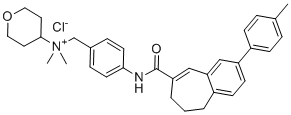
TAK-779 (TAK779) is a novel, potent and selective nonpeptide antagonist of CCR5 [C-C chemokine receptor type 5 (CCR5) receptor] and CXCR3 with potential anticancer, immunomodulatory and antiinflammatory activities. It efficiently and selectively inhibits R5 HIV-1 in MAGI-CCR5 cells, with EC50 and EC90 of 1.2 nM and 5.7 nM, respectively, and inhibits CCR5 with a Ki of 1.1 nM. It may be possible to treat HIV infection with TAK-779. The incidence and severity of experimental autoimmune encephalomyelitis were decreased by TAK-779 treatment. It significantly reduced the migration of leukocytes carrying CD4+, CD8+, and CD11b+ markers to the central nervous system (CNS). TAK-779 had no effect on T cell production of IFN-gamma, T cell expression of CXCR3, or the proliferation of anti-myelin oligodendrocyte glycoprotein T cells. TAK-779 also had no effect on antigen-presenting cells' IL-12 production, T cells' induction of CCR5, or the ability of myelin oligodendrocyte glycoprotein-specific T cells to spread experimental autoimmune encephalomyelitis.
Physicochemical Properties
| Molecular Formula | C33H39CLN2O2 |
| Molecular Weight | 531.127968072891 |
| Exact Mass | 530.27 |
| Elemental Analysis | C, 74.63; H, 7.40; Cl, 6.67; N, 5.27; O, 6.02 |
| CAS # | 229005-80-5 |
| Related CAS # | 229005-80-5 (Cl); 263765-56-6 (cation) |
| PubChem CID | 183789 |
| Appearance | White to beige solid powder |
| LogP | 8.171 |
| Hydrogen Bond Donor Count | 1 |
| Hydrogen Bond Acceptor Count | 3 |
| Rotatable Bond Count | 6 |
| Heavy Atom Count | 38 |
| Complexity | 769 |
| Defined Atom Stereocenter Count | 0 |
| SMILES | C[N+](C1CCOCC1)(CC1C=CC(NC(=O)C2CCCC3=CC=C(C4C=CC(C)=CC=4)C=C3C=2)=CC=1)C.[Cl-] |
| InChi Key | VDALIBWXVQVFGZ-UHFFFAOYSA-N |
| InChi Code | InChI=1S/C33H38N2O2.ClH/c1-24-7-11-27(12-8-24)28-14-13-26-5-4-6-29(22-30(26)21-28)33(36)34-31-15-9-25(10-16-31)23-35(2,3)32-17-19-37-20-18-32;/h7-16,21-22,32H,4-6,17-20,23H2,1-3H3;1H |
| Chemical Name | dimethyl-[[4-[[3-(4-methylphenyl)-8,9-dihydro-7H-benzo[7]annulene-6-carbonyl]amino]phenyl]methyl]-(oxan-4-yl)azanium;chloride |
| Synonyms | TAK-779 Chloride; TAK779; TAK 779 |
| HS Tariff Code | 2934.99.9001 |
| Storage |
Powder-20°C 3 years 4°C 2 years In solvent -80°C 6 months -20°C 1 month Note: Please store this product in a sealed and protected environment, avoid exposure to moisture. |
| Shipping Condition | Room temperature (This product is stable at ambient temperature for a few days during ordinary shipping and time spent in Customs) |
Biological Activity
| Targets | MIP-1α-CCR5 ( IC50 = 1 nM ); MIP-1β-CCR5 ( IC50 = 1 nM ); RANTES-CCR5 ( IC50 = 1.4 nM ); MCP-1-CCR2b ( IC50 = 27 nM ); R5 HIV-1 (Ba-L) ( EC50 = 1.2 nM ); R5 HIV-1 (Ba-L) ( EC90 = 5.7 nM ); R5 HIV-1 (Ba-L) ( EC50 = 3.7 nM ); R5 HIV-1 (Ba-L) ( EC90 = 12.8 nM ); R5 HIV-1 (KK) ( EC50 = 1.6 nM ); R5 HIV-1 (KK) ( EC90 = 20.8 nM ); R5 HIV-1 (HHA) ( EC50 = 3.2 nM ); R5 HIV-1 (HHA) ( EC90 = 7.5 nM ); R5 HIV-1 (CTV) ( EC50 = 3.5 nM ); R5 HIV-1 (CTV) ( EC90 = 27 nM ); mCXCR3( IC50 = 369 nM ) | |
| ln Vitro |
|
|
| ln Vivo |
|
|
| Enzyme Assay |
The beta-chemokine receptor CCR5 is considered to be an attractive target for inhibition of macrophage-tropic (CCR5-using or R5) HIV-1 replication because individuals having a nonfunctional receptor (a homozygous 32-bp deletion in the CCR5 coding region) are apparently normal but resistant to infection with R5 HIV-1. In this study, we found that TAK-779, a nonpeptide compound with a small molecular weight (Mr 531.13), antagonized the binding of RANTES (regulated on activation, normal T cell expressed and secreted) to CCR5-expressing Chinese hamster ovary cells and blocked CCR5-mediated Ca2+ signaling at nanomolar concentrations. The inhibition of beta-chemokine receptors by TAK-779 appeared to be specific to CCR5 because the compound antagonized CCR2b to a lesser extent but did not affect CCR1, CCR3, or CCR4. Consequently, TAK-779 displayed highly potent and selective inhibition of R5 HIV-1 replication without showing any cytotoxicity to the host cells. The compound inhibited the replication of R5 HIV-1 clinical isolates as well as a laboratory strain at a concentration of 1.6-3.7 nM in peripheral blood mononuclear cells, though it was totally inactive against T-cell line-tropic (CXCR4-using or X4) HIV-1[1]. Binding Assays[1] CHO-K1 and CCR5-expressing CHO (CHO/CCR5) cells (5 × 10⁴ cells per 100 μl) were cultured in a microtiter tray. After a 24-h incubation at 37°C, culture medium was replaced with the binding buffer [Ham’s F-12 medium containing 20 mM Hepes and 0.5% BSA (pH 7.2)]. Binding reactions were performed at room temperature for 40 min in the presence of [125I]-RANTES (specific activity: 2,000 Ci/mmol; Amersham Pharmacia) and various concentrations of the test compound. The binding reaction was terminated by washing out the free ligand with cold PBS, and the cell-associated radioactivity was counted by Top-count scintillation counter. Binding assays for other receptors, CCR1, CCR2b, CCR3, CCR4, and CXCR4, were carried out in a similar way. Ca2+ Mobilization Assays. [1] CHO/CCR5 cells (5 × 10⁶ cells/ml) were suspended in the assay buffer (5 mM KCl/147 mM NaCl/0.22 mM KH2PO4/1.1 mM Na2HPO4/5.5 mM glucose/0.3 mM MgSO4/1 mM MgCl2/10 mM Hepes, pH 7.4). The cells were loaded with 5 μM Fura-PE3AM at 37°C for 30 min, were washed twice with the assay buffer containing 1 mM CaCl2, and were resuspended at 1 × 10⁷ cells/ml in the same buffer. At 150 sec after exposure to TAK-779, 20 nM RANTES was added, and relative increase of cytoplasmic Ca2+ levels was monitored by F-2000 fluorescence spectrometer. Calibration was carried out with 50 μM ionomycin for total Ca2+ release and with 5 mM EGTA for Ca2+ chelating. |
|
| Cell Assay |
|
|
| Animal Protocol |
|
|
| References |
[1]. A small-molecule, nonpeptide CCR5 antagonist with highly potent and selective anti-HIV-1 activity. Proc Natl Acad Sci U S A. 1999 May 11;96(10):5698-703. [2]. Effects of a calcineurin inhibitor, FK506, and a CCR5/CXCR3 antagonist, TAK-779, in a rat small intestinal transplantation model. Transpl Immunol. 2011 Jul;25(1):49-55. [3]. The chemokine receptor antagonist, TAK-779, decreased experimental autoimmune encephalomyelitis by reducing inflammatory cell migration into the central nervous system, without affecting T cell function. Br J Pharmacol. 2009 Dec;158(8):2046-56. [4]. The unique target specificity of a nonpeptide chemokine receptor antagonist: selective blockade of two Th1 chemokine receptors CCR5 and CXCR3. J Leukoc Biol. 2003 Feb;73(2):273-80. |
|
| Additional Infomation |
The beta-chemokine receptor CCR5 is considered to be an attractive target for inhibition of macrophage-tropic (CCR5-using or R5) HIV-1 replication because individuals having a nonfunctional receptor (a homozygous 32-bp deletion in the CCR5 coding region) are apparently normal but resistant to infection with R5 HIV-1. In this study, we found that TAK-779, a nonpeptide compound with a small molecular weight (Mr 531.13), antagonized the binding of RANTES (regulated on activation, normal T cell expressed and secreted) to CCR5-expressing Chinese hamster ovary cells and blocked CCR5-mediated Ca2+ signaling at nanomolar concentrations. The inhibition of beta-chemokine receptors by TAK-779 appeared to be specific to CCR5 because the compound antagonized CCR2b to a lesser extent but did not affect CCR1, CCR3, or CCR4. Consequently, TAK-779 displayed highly potent and selective inhibition of R5 HIV-1 replication without showing any cytotoxicity to the host cells. The compound inhibited the replication of R5 HIV-1 clinical isolates as well as a laboratory strain at a concentration of 1.6-3.7 nM in peripheral blood mononuclear cells, though it was totally inactive against T-cell line-tropic (CXCR4-using or X4) HIV-1. [1] The effects of FK506, and TAK-779, antagonists of CCR5 and CXCR3, were investigated using a rat intestinal transplantation model. Small intestines from DA rats were heterotopically transplanted into LEW rats. The recipients were treated with FK506 (1mg/kg/day, day 0-5) and TAK-779 (10mg/kg/day, day 0-10). Graft survival and immunological responses to these materials were estimated by mixed lymphocyte reactions and IFN-γ production. The expression of chemokine receptors on lymphocytes was also examined. The average duration of survival was 7.0±0.3, 12.0±1.0, 9.8±0.5 and 18.0±1.5days in the allogeneic, FK506, TAK-779 and the two-drug combined groups, respectively. Cell proliferative responses and IFN-γ production were suppressed to a significant extent in the FK506 group compared with the TAK-779 group. In addition, the two-drug combination showed a tendency for stronger suppression than FK506 alone, correlated with in vivo and histopathological data. The numbers of both CD4(+) and CD8(+) cells were significantly suppressed in the blood of the recipients of both the FK506 and the TAK-779 groups, and in Peyer's patches of the graft of the TAK-779 group, but the FK506 group was not, as evidenced by FACS analysis. In addition, double-staining of graft-infiltrating lymphocytes showed a significant reduction in lymphocyte numbers, expressing CCR5 and CXCR3 in the TAK-779 group, but not evident in the FK506 group, compared to the allogeneic group. While FK506 suppresses cell proliferation and effecter function, it has less effect on the expression of CCR5 and CXCR3 in lymphocytes. Further exploration of the effects of a combined therapy with TAK-779 could represent a novel treatment for intestinal transplantation. [2] Background and purpose: The C-C chemokine receptor CCR5, and the C-X-C chemokine receptor CXCR3 are involved in the regulation of T cell-mediated immune responses, and in the migration and activation of these cells. To determine whether blockade of these chemokine receptors modulated inflammatory responses in the central nervous sytem (CNS), we investigated the effect of a non-peptide chemokine receptor antagonist, TAK-779, in mice with experimental autoimmune encephalomyelitis (EAE). Experimental approach: EAE was induced by immunization of C57BL/6 mice with myelin oligodendrocyte glycoprotein (MOG) 35-55. TAK-779 was injected s.c. once a day after immunization. Disease incidence and severity (over 3 weeks) were monitored by histopathological evaluation and FACS assay of inflammatory cells infiltrating into the spinal cord, polymerase chain reaction quantification of mRNA expression, assay of T cell proliferation, by [3H]-thymidine incorporation and cytokine production by enzyme-linked immunosorbent assay. Key results: Treatment with TAK-779 reduced incidence and severity of EAE. It strongly inhibited migration of CXCR3/CCR5 bearing CD4+, CD8+ and CD11b+ leukocytes to the CNS. TAK-779 did not reduce proliferation of anti-MOG T cells, the production of IFN-gamma by T cells or CXCR3 expression on T cells. In addition, TAK-779 did not affect production of IL-12 by antigen-presenting cells, CCR5 induction on T cells and the potential of MOG-specific T cells to transfer EAE. Conclusions and implications: TAK-779 restricted the development of MOG-induced EAE. This effect involved reduced migration of inflammatory cells into the CNS without affecting responses of anti-MOG T cells or the ability of MOG-specific T cells to transfer EAE.[3] |
Solubility Data
| Solubility (In Vitro) |
DMSO: ≥ 25 mg/mL (~47.1 mM) H2O: ~16.7 mg/mL (~31.4 mM) |
| Solubility (In Vivo) |
Solubility in Formulation 1: ≥ 2.58 mg/mL (4.86 mM) (saturation unknown) in 10% DMSO + 40% PEG300 + 5% Tween80 + 45% Saline (add these co-solvents sequentially from left to right, and one by one), clear solution. For example, if 1 mL of working solution is to be prepared, you can add 100 μL of 25.8 mg/mL clear DMSO stock solution to 400 μL PEG300 and mix evenly; then add 50 μL Tween-80 to the above solution and mix evenly; then add 450 μL normal saline to adjust the volume to 1 mL. Preparation of saline: Dissolve 0.9 g of sodium chloride in 100 mL ddH₂ O to obtain a clear solution. Solubility in Formulation 2: ≥ 2.58 mg/mL (4.86 mM) (saturation unknown) in 10% DMSO + 90% (20% SBE-β-CD in Saline) (add these co-solvents sequentially from left to right, and one by one), clear solution. For example, if 1 mL of working solution is to be prepared, you can add 100 μL of 25.8 mg/mL clear DMSO stock solution to 900 μL of 20% SBE-β-CD physiological saline solution and mix evenly. Preparation of 20% SBE-β-CD in Saline (4°C,1 week): Dissolve 2 g SBE-β-CD in 10 mL saline to obtain a clear solution. Solubility in Formulation 3: ≥ 2.58 mg/mL (4.86 mM) (saturation unknown) in 10% DMSO + 90% Corn Oil (add these co-solvents sequentially from left to right, and one by one), clear solution. For example, if 1 mL of working solution is to be prepared, you can add 100 μL of 25.8 mg/mL clear DMSO stock solution to 900 μL of corn oil and mix evenly. Solubility in Formulation 4: 50 mg/mL (94.14 mM) in PBS (add these co-solvents sequentially from left to right, and one by one), clear solution; with ultrasonication. (Please use freshly prepared in vivo formulations for optimal results.) |
| Preparing Stock Solutions | 1 mg | 5 mg | 10 mg | |
| 1 mM | 1.8828 mL | 9.4139 mL | 18.8278 mL | |
| 5 mM | 0.3766 mL | 1.8828 mL | 3.7656 mL | |
| 10 mM | 0.1883 mL | 0.9414 mL | 1.8828 mL |