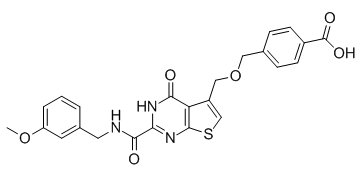
T-26c is a novel, highly potent and selective inhibitor of matrix metalloproteinase-13 (MMP-13) with an IC50 of 6.75 pM and shows more than 2600-fold selectivity over the other related metalloenzymes. It was discovered using X-ray co-crystal structures of matrix metalloproteinase-13 (MMP-13) in combination with its inhibitors. The goal of the structure-based drug design (SBDD) approach was to achieve high affinity by maximizing the interaction between the protein and the ligand through the specificity pocket of the S1 hydrophobic residue.
Physicochemical Properties
| Molecular Formula | C24H21N3O6S |
| Molecular Weight | 479.505044698715 |
| Exact Mass | 479.12 |
| Elemental Analysis | C, 60.12; H, 4.41; N, 8.76; O, 20.02; S, 6.69 |
| CAS # | 869296-13-9 |
| Related CAS # | 69298-22-6 (sodium);869296-13-9 (free acid); |
| PubChem CID | 11525848 |
| Appearance | White to off-white solid powder |
| LogP | 2.6 |
| Hydrogen Bond Donor Count | 3 |
| Hydrogen Bond Acceptor Count | 8 |
| Rotatable Bond Count | 9 |
| Heavy Atom Count | 34 |
| Complexity | 785 |
| Defined Atom Stereocenter Count | 0 |
| InChi Key | CDQRIIUMNLMHRH-UHFFFAOYSA-N |
| InChi Code | InChI=1S/C24H21N3O6S/c1-32-18-4-2-3-15(9-18)10-25-22(29)20-26-21(28)19-17(13-34-23(19)27-20)12-33-11-14-5-7-16(8-6-14)24(30)31/h2-9,13H,10-12H2,1H3,(H,25,29)(H,30,31)(H,26,27,28) |
| Chemical Name | 4-[[2-[(3-methoxyphenyl)methylcarbamoyl]-4-oxo-3H-thieno[2,3-d]pyrimidin-5-yl]methoxymethyl]benzoic acid |
| Synonyms | T-26c; T 26c; T26c |
| HS Tariff Code | 2934.99.9001 |
| Storage |
Powder-20°C 3 years 4°C 2 years In solvent -80°C 6 months -20°C 1 month |
| Shipping Condition | Room temperature (This product is stable at ambient temperature for a few days during ordinary shipping and time spent in Customs) |
Biological Activity
| Targets |
MMP-13 (IC50 = 6.75 pM) T-26c dramatically reduces the amount of collagen broken down in IL-1β and oncostatin M stimulated cartilage (87.4% inhibition at 0.1 μM)[1]. |
| ln Vitro |
T-26c dramatically reduces the amount of collagen broken down in IL-1β and oncostatin M stimulated cartilage (87.4% inhibition at 0.1 μM)[1]. The compound 26c exhibited potent inhibitory activity against human MMP-13 catalytic domain enzyme with an IC50 of 6.9 pM. In a bovine nasal cartilage (BNC) explant assay, 26c significantly inhibited cytokine-induced (IL-1β and oncostatin M) degradation and release of type II collagen fragments. At 0.1 μM, it showed 87.4% inhibition of collagen breakdown, comparable to the broad-spectrum MMP inhibitor RS-130,830 (76.3% inhibition at 0.1 μM) [1] |
| ln Vivo | T-26c is well absorbed in all species at the oral dose of 10–20 mg/kg. In comparison to the free acid T-26c (AUC = 6478 ng h/mL and Cmax = 911 ng/mL), oral administration of the disodium salt formulations of T-26c to guinea pigs causes significant increases in AUC (8357 ng h/mL) and Cmax (1445 ng/mL)[1]. |
| Enzyme Assay |
The inhibitory activity against human recombinant MMPs and TACE was determined using a fluorescence-based assay. Pro-MMPs were activated by preincubation with aminophenylmercuric acetate (APMA) in assay buffer. The assay buffer for MMPs consisted of 50 mM Tris-HCl (pH 7.5), 10 mM CaCl2, 150 mM NaCl, and 0.05% Brij-35. The TACE assay buffer consisted of 25 mM Tris-HCl (pH 9.0), 2.5 mM ZnCl2, and 0.005% Brij-35. Enzyme inhibition assays were performed in assay buffer containing enzymes and a fluorescence-quenched peptide substrate. Following incubation at 37 °C for 40 min, the reaction was terminated by addition of EDTA. The increase in fluorescence was measured. Enzyme activity (%) was calculated, and IC50 values were obtained by curve fitting. [1] |
| Cell Assay |
The inhibitory activity against collagen degradation was assessed using a bovine nasal septum cartilage explant assay. Cartilage slices were cut into small cubes and cultured in medium. For the assay, the medium was supplemented with IL-1β (10 ng/mL) and oncostatin M (50 ng/mL) in the presence or absence of compounds. The cartilage was incubated for 2 weeks, with medium changes every 7 days. Supernatants were collected, and the remaining cartilage was digested with papain. Hydroxyproline release in the media was determined as a measure of collagen degradation using chloramine T and p-dimethylaminobenzaldehyde. The percentage of inhibitory activity was calculated. [1] |
| Animal Protocol |
Pharmacokinetic studies of 26c and its disodium salt (43) were conducted in guinea pigs, dogs, and monkeys. For oral administration, the disodium salt formulation (43) was used. In guinea pigs, 26c (free acid) was administered intravenously at 1 mg/kg and orally at 10 mg/kg. The disodium salt (43) was administered orally at 10 mg/kg to guinea pigs, at 10 mg/kg to dogs (both iv and po), and at 20 mg/kg to monkeys (po). Blood samples were collected to determine pharmacokinetic parameters. [1] A 2-week repeated dose oral toxicity study was performed in rats with the disodium salt 43. [1] |
| ADME/Pharmacokinetics |
In guinea pigs following a 1 mg/kg intravenous dose of 26c, the volume of distribution at steady state (Vd,ss) was 923 mL/kg, and total body clearance (CL) was 431 mL/h/kg. Oral administration of 26c (10 mg/kg) in guinea pigs resulted in a Cmax of 911 ng/mL, Tmax of 0.83 h, AUC of 4478 ng·h/mL, and an oral bioavailability (F) of 28%. Oral administration of the disodium salt 43 (10 mg/kg) in guinea pigs gave a Cmax of 1445 ng/mL, Tmax of 0.67 h, and AUC of 8357 ng·h/mL. In dogs, intravenous administration of 43 (10 mg/kg) gave a Vd,ss of 395 mL/kg and CL of 111 mL/h/kg. Oral administration of 43 (10 mg/kg) in dogs resulted in a Cmax of 2438 ng/mL, Tmax of 2.0 h, AUC of 27136 ng·h/mL, and F of 29%. In monkeys, oral administration of 43 (20 mg/kg) resulted in a Cmax of 6607 ng/mL, Tmax of 3.0 h, and AUC of 82360 ng·h/mL. [1] In rats, following a single 1 mg/kg oral cassette dose, 26c showed an AUC of 366 ng·h/mL, Vd,ss of 878 mL/kg (at 0.1 mg/kg iv), and CL of 693 mL/h/kg (at 0.1 mg/kg iv). [1] |
| Toxicity/Toxicokinetics |
A 2-week repeated dose oral toxicity study of the disodium salt 43 in rats established a no observed adverse effect level (NOAEL) of 60 mg/kg/day. [1] |
| References |
[1]. Thieno[2,3-d]pyrimidine-2-carboxamides bearing a carboxybenzene group at 5-position: highly potent, selective, and orally available MMP-13 inhibitors interacting with the S1″ binding site. Bioorg Med Chem. 2014 Oct 1;22(19):5487-505. |
| Additional Infomation |
26c (thieno[2,3-d]pyrimidine-2-carboxamide bearing a 4-carboxybenzyloxymethyl group at the 5-position) was designed as a highly potent, selective, and orally available MMP-13 inhibitor based on structure-based drug design targeting the S1' pocket and the adjacent S1" hydrophobic specificity pocket of MMP-13. It acts as a non-zinc-chelating inhibitor. The incorporation of the carboxylic acid group on the P1" substituent was intended to form a salt bridge interaction with Lys140 in the S1" pocket, contributing to its high potency and selectivity. The compound was developed for the potential treatment of osteoarthritis. [1] |
Solubility Data
| Solubility (In Vitro) | DMSO: 15.6~40 mg/mL (32.6~83.4 mM) |
| Solubility (In Vivo) |
Solubility in Formulation 1: ≥ 1.56 mg/mL (3.25 mM) (saturation unknown) in 10% DMSO + 40% PEG300 + 5% Tween80 + 45% Saline (add these co-solvents sequentially from left to right, and one by one), clear solution. For example, if 1 mL of working solution is to be prepared, you can add 100 μL of 15.6 mg/mL clear DMSO stock solution to 400 μL PEG300 and mix evenly; then add 50 μL Tween-80 to the above solution and mix evenly; then add 450 μL normal saline to adjust the volume to 1 mL. Preparation of saline: Dissolve 0.9 g of sodium chloride in 100 mL ddH₂ O to obtain a clear solution. Solubility in Formulation 2: ≥ 1.56 mg/mL (3.25 mM) (saturation unknown) in 10% DMSO + 90% Corn Oil (add these co-solvents sequentially from left to right, and one by one), clear solution. For example, if 1 mL of working solution is to be prepared, you can add 100 μL of 15.6 mg/mL clear DMSO stock solution to 900 μL of corn oil and mix evenly. (Please use freshly prepared in vivo formulations for optimal results.) |
| Preparing Stock Solutions | 1 mg | 5 mg | 10 mg | |
| 1 mM | 2.0855 mL | 10.4273 mL | 20.8546 mL | |
| 5 mM | 0.4171 mL | 2.0855 mL | 4.1709 mL | |
| 10 mM | 0.2085 mL | 1.0427 mL | 2.0855 mL |