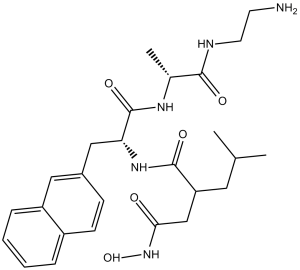
TAPI-1 is an inhibitor of ADAM17/TACE (TNF-α-converting enzyme) that may find application in treating kidney damage. It prevents cytokine receptors from shedding. In particular, it facilitates the splitting of the entire APP into the soluble N-terminal portion (sAPPα). It has been reported that muscarinic receptor stimulation increases the release of sAPPα through a receptor-coupled process. Treatment with TAPI-1 inhibited increased sAPPα in HEK293 cells, which was caused by M3 subtype expression. The M3-increased sAPPα and constitutive release of sAPPα were inhibited by TAPI-1 with IC50 values of 3.61 μM and 8.09 μM, respectively.
Physicochemical Properties
| Molecular Formula | C26H37N5O5 |
| Molecular Weight | 499.602486371994 |
| Exact Mass | 499.279 |
| CAS # | 171235-71-5 |
| Related CAS # | TAPI-1;163847-77-6 |
| PubChem CID | 9827273 |
| Appearance | White to off-white solid |
| Density | 1.2±0.1 g/cm3 |
| Index of Refraction | 1.581 |
| LogP | 1.29 |
| Hydrogen Bond Donor Count | 6 |
| Hydrogen Bond Acceptor Count | 6 |
| Rotatable Bond Count | 13 |
| Heavy Atom Count | 36 |
| Complexity | 746 |
| Defined Atom Stereocenter Count | 2 |
| SMILES | C[C@@H](C(=O)NCCN)NC(=O)[C@H](CC1=CC2=CC=CC=C2C=C1)NC(=O)C(CC(C)C)CC(=O)NO |
| InChi Key | AWNBSWDIOCXWJW-OWHMDLSXSA-N |
| InChi Code | InChI=1S/C26H37N5O5/c1-16(2)12-21(15-23(32)31-36)25(34)30-22(26(35)29-17(3)24(33)28-11-10-27)14-18-8-9-19-6-4-5-7-20(19)13-18/h4-9,13,16-17,21-22,36H,10-12,14-15,27H2,1-3H3,(H,28,33)(H,29,35)(H,30,34)(H,31,32)/t17-,21?,22-/m0/s1 |
| Chemical Name | N-[(2S)-1-[[(2S)-1-(2-aminoethylamino)-1-oxopropan-2-yl]amino]-3-naphthalen-2-yl-1-oxopropan-2-yl]-N'-hydroxy-2-(2-methylpropyl)butanediamide |
| Synonyms | TAPI-1; TAPI 1; TAPI;163847-77-6 |
| HS Tariff Code | 2934.99.9001 |
| Storage |
Powder-20°C 3 years 4°C 2 years In solvent -80°C 6 months -20°C 1 month |
| Shipping Condition | Room temperature (This product is stable at ambient temperature for a few days during ordinary shipping and time spent in Customs) |
Biological Activity
| Targets | TACE (ADAM17); MMP |
| ln Vitro |
TAPI-1 inhibits the release of soluble forms of TNF-alpha, p60 TNFR, and IL-6R from human peripheral blood monocytes and the monocytic cell line THP-1, both in response to stimulation and PMA. Additionally, TAPI prevents monocytes from shedding TNF-alpha and p60 TNFR in response to LPS.[1] TAPI-1 prevents co-transfected APP from constitutively releasing in a TACE-dependent manner (695).[2] TAPI-1 reduces the effects of Ang II-induced EGFR transactivation and cell division in human HSC line LI90.[3] TAPI-1 in combination with the EGFR inhibitor AG1478 shows a deactivated AREG/EGFR/ERK signaling pathway and decreases the release of pro-inflammatory cytokines in salivary gland-derived epithelial cells from pSS.[4] |
| ln Vivo | TAPI-1 is an ADAM17/TACE inhibitor that prevents cytokine receptors from being shed. |
| Cell Assay | Each well of 96-well plates contains 5,000 seeded cells, and the CellTiter-Glo Luminescent Cell Viability Assay is used to determine how viable the cells are. After 24 hours of serum deprivation, the cells undergo Ang II treatment for 60 hours, both with and without prior inhibitor and antagonist pretreatment. Next, each well on the plate is filled with the assay substrates, and a luminometer is used to assess the samples. |
| Animal Protocol |
Male Sprague-Dawley rats 1 μg i.c.v. |
| References |
[1]. J Immunol . 1995 Dec 1;155(11):5198-205. [2]. Biochem J . 2001 Aug 1;357(Pt 3):787-94. [3]. Life Sci . 2014 Mar 3;97(2):137-44. [4]. Clin Exp Med . 2015 May;15(2):215-25. [5]. Immunobiology . 2020 Mar;225(2):151887. [6]. Hypertension . 2019 Jul;74(1):63-72. |
Solubility Data
| Solubility (In Vitro) |
|
|||
| Solubility (In Vivo) |
Note: Listed below are some common formulations that may be used to formulate products with low water solubility (e.g. < 1 mg/mL), you may test these formulations using a minute amount of products to avoid loss of samples. Injection Formulations (e.g. IP/IV/IM/SC) Injection Formulation 1: DMSO : Tween 80: Saline = 10 : 5 : 85 (i.e. 100 μL DMSO stock solution → 50 μL Tween 80 → 850 μL Saline) *Preparation of saline: Dissolve 0.9 g of sodium chloride in 100 mL ddH ₂ O to obtain a clear solution. Injection Formulation 2: DMSO : PEG300 :Tween 80 : Saline = 10 : 40 : 5 : 45 (i.e. 100 μL DMSO → 400 μLPEG300 → 50 μL Tween 80 → 450 μL Saline) Injection Formulation 3: DMSO : Corn oil = 10 : 90 (i.e. 100 μL DMSO → 900 μL Corn oil) Example: Take the Injection Formulation 3 (DMSO : Corn oil = 10 : 90) as an example, if 1 mL of 2.5 mg/mL working solution is to be prepared, you can take 100 μL 25 mg/mL DMSO stock solution and add to 900 μL corn oil, mix well to obtain a clear or suspension solution (2.5 mg/mL, ready for use in animals). Injection Formulation 4: DMSO : 20% SBE-β-CD in saline = 10 : 90 [i.e. 100 μL DMSO → 900 μL (20% SBE-β-CD in saline)] *Preparation of 20% SBE-β-CD in Saline (4°C,1 week): Dissolve 2 g SBE-β-CD in 10 mL saline to obtain a clear solution. Injection Formulation 5: 2-Hydroxypropyl-β-cyclodextrin : Saline = 50 : 50 (i.e. 500 μL 2-Hydroxypropyl-β-cyclodextrin → 500 μL Saline) Injection Formulation 6: DMSO : PEG300 : castor oil : Saline = 5 : 10 : 20 : 65 (i.e. 50 μL DMSO → 100 μLPEG300 → 200 μL castor oil → 650 μL Saline) Injection Formulation 7: Ethanol : Cremophor : Saline = 10: 10 : 80 (i.e. 100 μL Ethanol → 100 μL Cremophor → 800 μL Saline) Injection Formulation 8: Dissolve in Cremophor/Ethanol (50 : 50), then diluted by Saline Injection Formulation 9: EtOH : Corn oil = 10 : 90 (i.e. 100 μL EtOH → 900 μL Corn oil) Injection Formulation 10: EtOH : PEG300:Tween 80 : Saline = 10 : 40 : 5 : 45 (i.e. 100 μL EtOH → 400 μLPEG300 → 50 μL Tween 80 → 450 μL Saline) Oral Formulations Oral Formulation 1: Suspend in 0.5% CMC Na (carboxymethylcellulose sodium) Oral Formulation 2: Suspend in 0.5% Carboxymethyl cellulose Example: Take the Oral Formulation 1 (Suspend in 0.5% CMC Na) as an example, if 100 mL of 2.5 mg/mL working solution is to be prepared, you can first prepare 0.5% CMC Na solution by measuring 0.5 g CMC Na and dissolve it in 100 mL ddH2O to obtain a clear solution; then add 250 mg of the product to 100 mL 0.5% CMC Na solution, to make the suspension solution (2.5 mg/mL, ready for use in animals). Oral Formulation 3: Dissolved in PEG400 Oral Formulation 4: Suspend in 0.2% Carboxymethyl cellulose Oral Formulation 5: Dissolve in 0.25% Tween 80 and 0.5% Carboxymethyl cellulose Oral Formulation 6: Mixing with food powders Note: Please be aware that the above formulations are for reference only. InvivoChem strongly recommends customers to read literature methods/protocols carefully before determining which formulation you should use for in vivo studies, as different compounds have different solubility properties and have to be formulated differently. (Please use freshly prepared in vivo formulations for optimal results.) |
| Preparing Stock Solutions | 1 mg | 5 mg | 10 mg | |
| 1 mM | 2.0016 mL | 10.0080 mL | 20.0160 mL | |
| 5 mM | 0.4003 mL | 2.0016 mL | 4.0032 mL | |
| 10 mM | 0.2002 mL | 1.0008 mL | 2.0016 mL |