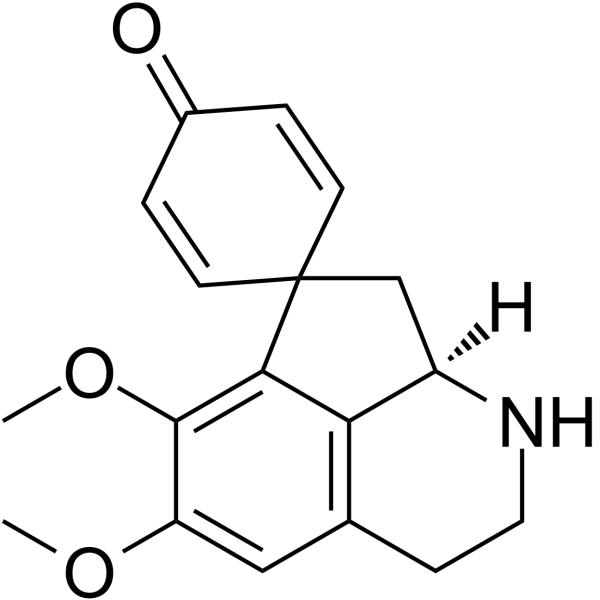
Physicochemical Properties
| Molecular Formula | C18H19NO3 |
| Molecular Weight | 297.35 |
| Exact Mass | 297.136 |
| CAS # | 2810-21-1 |
| PubChem CID | 98455 |
| Appearance | Pale purple to purple solid powder |
| Density | 1.27g/cm3 |
| Boiling Point | 487.1ºC at 760 mmHg |
| Flash Point | 248.4ºC |
| Vapour Pressure | 1.22E-09mmHg at 25°C |
| Index of Refraction | 1.632 |
| LogP | 2.556 |
| Hydrogen Bond Donor Count | 1 |
| Hydrogen Bond Acceptor Count | 4 |
| Rotatable Bond Count | 2 |
| Heavy Atom Count | 22 |
| Complexity | 510 |
| Defined Atom Stereocenter Count | 0 |
| InChi Key | OGJKMZVUJJYWKO-UHFFFAOYSA-N |
| InChi Code | InChI=1S/C18H19NO3/c1-21-14-9-11-5-8-19-13-10-18(6-3-12(20)4-7-18)16(15(11)13)17(14)22-2/h3-4,6-7,9,13,19H,5,8,10H2,1-2H3 |
| Chemical Name | 10,11-dimethoxyspiro[5-azatricyclo[6.3.1.04,12]dodeca-1(12),8,10-triene-2,4'-cyclohexa-2,5-diene]-1'-one |
| HS Tariff Code | 2934.99.9001 |
| Storage |
Powder-20°C 3 years 4°C 2 years In solvent -80°C 6 months -20°C 1 month Note: This product requires protection from light (avoid light exposure) during transportation and storage. |
| Shipping Condition | Room temperature (This product is stable at ambient temperature for a few days during ordinary shipping and time spent in Customs) |
Biological Activity
| ln Vitro | In LPS-activated BV-2 cells, streptomycin (10, 30 μM) significantly reduces the release of nitric oxide (NO) as well as the mRNA and protein expression of pro-inflammatory mediators [inducible nitric oxide synthase, interleukin (IL)-6, tumor necrosis factor (TNF)-α, IL-1β][1]. Stepharine (10, 30 μM) suppresses the upregulation of TLR4 expression, phosphorylation of IκBα, and nuclear translocation of NF-κB p65 produced by LPS[1]. Stepharine has neuroprotective effects on SH-SY5Y cells grown in conditioned media exposed with lipopolysaccharide (LPS). In vitro cholinesterase inhibition has also been demonstrated by stepharine[1]. |
| ln Vivo | In the MCAO ischemic cortex, stepharine (500 μg/kg) prevented the loss of NeuN+ cells and the growth of Iba-1+ cells[1]. |
| Animal Protocol |
Animal/Disease Models: Middle cerebral artery occlusion (MCAO) rat model[1]. Doses: 500 μg/kg ( 20 μL). Route of Administration: Intranasally injected into rats 1h after MCAO. Experimental Results: Attenuated the neuronal loss induced by MCAO (MCAO+ stepharine) group. |
| References |
[1]. Inflammatory mechanism of cerebral ischemia-reperfusion injury with treatment of stepharine in rats. Phytomedicine. 2020 Dec;79:153353. |
| Additional Infomation | Stepharine has been reported in Stephania yunnanensis, Stephania cephalantha, and other organisms with data available. |
Solubility Data
| Solubility (In Vitro) | DMSO: 25 mg/mL (84.08 mM) |
| Solubility (In Vivo) |
Note: Listed below are some common formulations that may be used to formulate products with low water solubility (e.g. < 1 mg/mL), you may test these formulations using a minute amount of products to avoid loss of samples. Injection Formulations (e.g. IP/IV/IM/SC) Injection Formulation 1: DMSO : Tween 80: Saline = 10 : 5 : 85 (i.e. 100 μL DMSO stock solution → 50 μL Tween 80 → 850 μL Saline) *Preparation of saline: Dissolve 0.9 g of sodium chloride in 100 mL ddH ₂ O to obtain a clear solution. Injection Formulation 2: DMSO : PEG300 :Tween 80 : Saline = 10 : 40 : 5 : 45 (i.e. 100 μL DMSO → 400 μLPEG300 → 50 μL Tween 80 → 450 μL Saline) Injection Formulation 3: DMSO : Corn oil = 10 : 90 (i.e. 100 μL DMSO → 900 μL Corn oil) Example: Take the Injection Formulation 3 (DMSO : Corn oil = 10 : 90) as an example, if 1 mL of 2.5 mg/mL working solution is to be prepared, you can take 100 μL 25 mg/mL DMSO stock solution and add to 900 μL corn oil, mix well to obtain a clear or suspension solution (2.5 mg/mL, ready for use in animals). Injection Formulation 4: DMSO : 20% SBE-β-CD in saline = 10 : 90 [i.e. 100 μL DMSO → 900 μL (20% SBE-β-CD in saline)] *Preparation of 20% SBE-β-CD in Saline (4°C,1 week): Dissolve 2 g SBE-β-CD in 10 mL saline to obtain a clear solution. Injection Formulation 5: 2-Hydroxypropyl-β-cyclodextrin : Saline = 50 : 50 (i.e. 500 μL 2-Hydroxypropyl-β-cyclodextrin → 500 μL Saline) Injection Formulation 6: DMSO : PEG300 : castor oil : Saline = 5 : 10 : 20 : 65 (i.e. 50 μL DMSO → 100 μLPEG300 → 200 μL castor oil → 650 μL Saline) Injection Formulation 7: Ethanol : Cremophor : Saline = 10: 10 : 80 (i.e. 100 μL Ethanol → 100 μL Cremophor → 800 μL Saline) Injection Formulation 8: Dissolve in Cremophor/Ethanol (50 : 50), then diluted by Saline Injection Formulation 9: EtOH : Corn oil = 10 : 90 (i.e. 100 μL EtOH → 900 μL Corn oil) Injection Formulation 10: EtOH : PEG300:Tween 80 : Saline = 10 : 40 : 5 : 45 (i.e. 100 μL EtOH → 400 μLPEG300 → 50 μL Tween 80 → 450 μL Saline) Oral Formulations Oral Formulation 1: Suspend in 0.5% CMC Na (carboxymethylcellulose sodium) Oral Formulation 2: Suspend in 0.5% Carboxymethyl cellulose Example: Take the Oral Formulation 1 (Suspend in 0.5% CMC Na) as an example, if 100 mL of 2.5 mg/mL working solution is to be prepared, you can first prepare 0.5% CMC Na solution by measuring 0.5 g CMC Na and dissolve it in 100 mL ddH2O to obtain a clear solution; then add 250 mg of the product to 100 mL 0.5% CMC Na solution, to make the suspension solution (2.5 mg/mL, ready for use in animals). Oral Formulation 3: Dissolved in PEG400 Oral Formulation 4: Suspend in 0.2% Carboxymethyl cellulose Oral Formulation 5: Dissolve in 0.25% Tween 80 and 0.5% Carboxymethyl cellulose Oral Formulation 6: Mixing with food powders Note: Please be aware that the above formulations are for reference only. InvivoChem strongly recommends customers to read literature methods/protocols carefully before determining which formulation you should use for in vivo studies, as different compounds have different solubility properties and have to be formulated differently. (Please use freshly prepared in vivo formulations for optimal results.) |
| Preparing Stock Solutions | 1 mg | 5 mg | 10 mg | |
| 1 mM | 3.3630 mL | 16.8152 mL | 33.6304 mL | |
| 5 mM | 0.6726 mL | 3.3630 mL | 6.7261 mL | |
| 10 mM | 0.3363 mL | 1.6815 mL | 3.3630 mL |