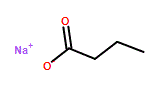
Sodium Butyrate, the sodium salt of butyrate, is a short-chain fatty acid acting as an histone deacetylase (HDAC) inhibitor with anticancer activity. Butyrate is an attractive therapeutic molecule because of its wide array of biological functions, such as its ability to serve as a histone deacetylase (HDAC) inhibitor, an energy metabolite to produce ATP and a G protein-coupled receptor (GPCR) activator. Pharmacologically, butyrate has had a profoundly beneficial effect on brain disorders ranging from neurodegenerative diseases to psychological disorders.
Physicochemical Properties
| Molecular Formula | C4H7NAO2 |
| Molecular Weight | 110.0870 |
| Exact Mass | 110.034 |
| CAS # | 156-54-7 |
| PubChem CID | 5222465 |
| Appearance | White to off-white solid powder |
| Density | 0.987g/cm3 |
| Boiling Point | 164.3ºC at 760 mmHg |
| Melting Point | 250-253 °C(lit.) |
| Flash Point | 69.7ºC |
| Vapour Pressure | 1.35mmHg at 25°C |
| Hydrogen Bond Donor Count | 0 |
| Hydrogen Bond Acceptor Count | 2 |
| Rotatable Bond Count | 2 |
| Heavy Atom Count | 7 |
| Complexity | 53.7 |
| Defined Atom Stereocenter Count | 0 |
| InChi Key | MFBOGIVSZKQAPD-UHFFFAOYSA-M |
| InChi Code | InChI=1S/C4H8O2.Na/c1-2-3-4(5)6;/h2-3H2,1H3,(H,5,6);/q;+1/p-1 |
| Chemical Name | sodium;butanoate |
| HS Tariff Code | 2934.99.9001 |
| Storage |
Powder-20°C 3 years 4°C 2 years In solvent -80°C 6 months -20°C 1 month |
| Shipping Condition | Room temperature (This product is stable at ambient temperature for a few days during ordinary shipping and time spent in Customs) |
Biological Activity
| ADME/Pharmacokinetics |
Absorption, Distribution and Excretion Since cancer may be regarded as a disease of differentiation and sodium butyrate induces differentiation of malignant cells in vitro, a study of the clinical pharmacology of sodium butyrate was undertaken. Nine patients with acute myeloid (n= 1), acute monocytic (n= 1), acute myelomonocytic (n= 6) and acute undifferentiated (n= 1) leukemia were treated. Their median age was 52 (range, 27-78) years. Six of the nine patients were pretreated with cytostatic agents. Sodium butyrate was administered iv at a dosage of 500 mg/kg/day as continuous infusion over 10 days. A sensitive and reproducible high-performance liquid chromatographic separation was developed after derivatization of sodium butyrate with 2,4'-dibromoacetophenone employing crown ether catalysts. Plasma concentrations and urinary excretion of sodium butyrate were monitored during the 10 days of continous infusion and for 2 days thereafter. During infusion, plasma concentrations increased 6-fold over the endogenous butyrate level and reached 39-59 uM. The area under the curve of the exogenous butyrate was 384 + or - 50 uM X day (mean + or - standard deviation). After the end of infusion, concentrations declined rapidly with a half-life of 6.1 + or - 1.4 min, and reached pretreatment values within 1 hr. The total clearance rate was 83 + or - 12 ml/kg/min and the volume of distribution 738 + or - 245 ml/kg. The excreted amounts of butyrate in the urine were minmal as compared to the infused dose. Although excretion by other organs was not ruled out, it is suggested that the infused sodium butyrate was rapidly metabolized. A significant increase in peripheral blast cells was observed, whereas bone marrow cytologies before and after treatment did not reveal a significant change in blasts. Differential counts of peripheral white blood cells did not show significantly changes. No toxicity was encountered. The apparent lack of clinical efficacy may be explained by the low plasma levels of sodium butyrate due to its short half-life in vivo. In comparison, concentrations reported for in vitro studies were at least 10 times higher. |
| Toxicity/Toxicokinetics |
Interactions THE INDUCTION OF HELA CELL ALKALINE PHOSPHATASE ACTIVITY BY SODIUM BUTYRATE COULD BE INHIBITED BY THE COADMINISTRATION OF CAFFEINE OR THEOPHYLLINE. SODIUM BUTYRATE AND DIMETHYL SULFOXIDE HAD MARKED EFFECTS ON THE GROWTH, MORPHOLOGY, AND BIOCHEMISTRY OF 2 HUMAN COLONIC ADENOCARCINOMA CELL LINES IN CULTURE. DOUBLING TIMES WERE INCR BETWEEN 18% & 660% WHEReAS CELL VIABILITY WAS UNAFFECTED. SODIUM BUTYRATE TOGETHER WITH INTERFERON ENHANCED THE ANTITUMOR EFFECT OF INTERFERON IN VIVO. WHEN SARCOMA 180 TG CELLS WERE INOCULATED IN MICE, THE MEAN SURVIVAL TIME AND FINAL SURVIVAL RATE WERE GREATLY INCR COMPARED TO THOSE TREATED WITH INTERFERON ALONE. THE COMBINATION OF THE SODIUM BUTYRATE WITH A THERAPEUTIC AGENT (X-RAYS, FLUOROURACIL, LOMUSTINE, VINCRISTINE, ADRIAMYCIN SULFATE, 5-(3,3-DIMETHYL-1-TRIAZENO)IMIDAZOLE-4-CARBOXAMIDE, OR METHOTREXATE) OR A CYCLIC AMP-STIMULATING AGENT (RO 20-1724, THEOPHYLLINE, PAPAVERINE, OR PROSTAGLANDIN E1) RESULTED IN A GREATER REDUCTION OF THE CELL NUMBER IN MOUSE NEUROBLASTOMA CULTURES THAN THAT OBSERVED WITH EACH AGENT ALONE. Epstein-Barr virus producer and nonproducer cell lines were treated with a combination of phorbol 12-myristate 13-acetate and n-butyrate (sodium salt). These inducers caused a massive hypomethylation of the Epstein-Barr virus producer line P3HR-1 DNA (approx 30%) at the time when DNA replication was inhibited. |
| References | :Neurosci Lett. 2016 Jun 20; 625: 56–63. |
| Additional Infomation |
Sodium butyrate is an organic sodium salt resulting from the replacement of the proton from the carboxy group of butyric acid by a sodium ion. It has a role as an EC 3.5.1.98 (histone deacetylase) inhibitor and a geroprotector. It contains a butyrate. Sodium Butyrate is the sodium salt of butyrate with potential antineoplastic activity. Butyrate, a short chain fatty acid, competitively binds to the zinc sites of class I and II histone deacetylases (HDACs). This binding affects hyperacetylation of histones, resulting in a modified DNA conformation, which subsequently leads to the uncoiling or relaxing of chromatin. Enhanced accessibility of chromatin to transcription-regulatory complexes leads to increased transcriptional activation of various epigenetically suppressed genes. Butyrate, a HDAC inhibitor, induces cell cycle arrest in G1 or G2/M and also increases the expression of other genes and proteins involved in cellular differentiation and apoptotic signaling. A four carbon acid, CH3CH2CH2COOH, with an unpleasant odor that occurs in butter and animal fat as the glycerol ester. Mechanism of Action SODIUM BUTYRATE INHIBITED INITIATION OF VIRAL AND CELLULAR DNA REPLICATION IN POLYOMA VIRUS-INFECTED MOUSE KIDNEY CELLS. 24 HR AFTER TREATMENT OF FRIEND ERYTHROLEUKEMIA CELLS WITH MILLIMOLAR CONCN OF SODIUM BUTYRATE, THE CHROMATIN HISTONES HAD BECOME HYPERACETYLATED. DURING THIS SAME TIME PERIOD, THE BUTYRATE-TREATED FRIEND CELLS ACCUMULATED A POPULATION OF APPROX 38% NEW RNA TRANSCRIPTS SYNTHESIZED FROM UNIQUE SEQUENCES OF MOUSE DNA. F9 mouse teratocarcinoma stem cells differentiate into parietal endoderm cells in the presence of retinoic acid, dibutyryl cyclic AMP, and theophylline. When F9 cells are exposed to 2-5 mM sodium butyrate plus retinoic acid, dibutyryl cyclic AMP, and theophylline, they fail to differentiate. Butyrate inhibits differentiation only when added within 8 hr after retinoic acid addition. Thus an early event in retinoid action on F9 cells is butyrate-sensitive. Butyrate inhibits histone deacetylation in F9 cells, and this could be the mechanism by which butyrate inhibits differentiation. Sodium butyrate treatment enhanced the development of colonic neoplasia and was associated with increased fecal butyric acid concentrations in rats given parenteral administration of 1,2-dimethylhydrazine. Inhibitors of DNA polymerase efficiently inhibit initiator induced amplification of SV40 DNA sequences in the SV40 transformed Chinese hamster cell line CO631. Sodium butyrate inhibits DNA synthesis by histone modification. |
Solubility Data
| Solubility (In Vitro) | May dissolve in DMSO (in most cases), if not, try other solvents such as H2O, Ethanol, or DMF with a minute amount of products to avoid loss of samples |
| Solubility (In Vivo) |
Note: Listed below are some common formulations that may be used to formulate products with low water solubility (e.g. < 1 mg/mL), you may test these formulations using a minute amount of products to avoid loss of samples. Injection Formulations (e.g. IP/IV/IM/SC) Injection Formulation 1: DMSO : Tween 80: Saline = 10 : 5 : 85 (i.e. 100 μL DMSO stock solution → 50 μL Tween 80 → 850 μL Saline) *Preparation of saline: Dissolve 0.9 g of sodium chloride in 100 mL ddH ₂ O to obtain a clear solution. Injection Formulation 2: DMSO : PEG300 :Tween 80 : Saline = 10 : 40 : 5 : 45 (i.e. 100 μL DMSO → 400 μLPEG300 → 50 μL Tween 80 → 450 μL Saline) Injection Formulation 3: DMSO : Corn oil = 10 : 90 (i.e. 100 μL DMSO → 900 μL Corn oil) Example: Take the Injection Formulation 3 (DMSO : Corn oil = 10 : 90) as an example, if 1 mL of 2.5 mg/mL working solution is to be prepared, you can take 100 μL 25 mg/mL DMSO stock solution and add to 900 μL corn oil, mix well to obtain a clear or suspension solution (2.5 mg/mL, ready for use in animals). Injection Formulation 4: DMSO : 20% SBE-β-CD in saline = 10 : 90 [i.e. 100 μL DMSO → 900 μL (20% SBE-β-CD in saline)] *Preparation of 20% SBE-β-CD in Saline (4°C,1 week): Dissolve 2 g SBE-β-CD in 10 mL saline to obtain a clear solution. Injection Formulation 5: 2-Hydroxypropyl-β-cyclodextrin : Saline = 50 : 50 (i.e. 500 μL 2-Hydroxypropyl-β-cyclodextrin → 500 μL Saline) Injection Formulation 6: DMSO : PEG300 : castor oil : Saline = 5 : 10 : 20 : 65 (i.e. 50 μL DMSO → 100 μLPEG300 → 200 μL castor oil → 650 μL Saline) Injection Formulation 7: Ethanol : Cremophor : Saline = 10: 10 : 80 (i.e. 100 μL Ethanol → 100 μL Cremophor → 800 μL Saline) Injection Formulation 8: Dissolve in Cremophor/Ethanol (50 : 50), then diluted by Saline Injection Formulation 9: EtOH : Corn oil = 10 : 90 (i.e. 100 μL EtOH → 900 μL Corn oil) Injection Formulation 10: EtOH : PEG300:Tween 80 : Saline = 10 : 40 : 5 : 45 (i.e. 100 μL EtOH → 400 μLPEG300 → 50 μL Tween 80 → 450 μL Saline) Oral Formulations Oral Formulation 1: Suspend in 0.5% CMC Na (carboxymethylcellulose sodium) Oral Formulation 2: Suspend in 0.5% Carboxymethyl cellulose Example: Take the Oral Formulation 1 (Suspend in 0.5% CMC Na) as an example, if 100 mL of 2.5 mg/mL working solution is to be prepared, you can first prepare 0.5% CMC Na solution by measuring 0.5 g CMC Na and dissolve it in 100 mL ddH2O to obtain a clear solution; then add 250 mg of the product to 100 mL 0.5% CMC Na solution, to make the suspension solution (2.5 mg/mL, ready for use in animals). Oral Formulation 3: Dissolved in PEG400 Oral Formulation 4: Suspend in 0.2% Carboxymethyl cellulose Oral Formulation 5: Dissolve in 0.25% Tween 80 and 0.5% Carboxymethyl cellulose Oral Formulation 6: Mixing with food powders Note: Please be aware that the above formulations are for reference only. InvivoChem strongly recommends customers to read literature methods/protocols carefully before determining which formulation you should use for in vivo studies, as different compounds have different solubility properties and have to be formulated differently. (Please use freshly prepared in vivo formulations for optimal results.) |
| Preparing Stock Solutions | 1 mg | 5 mg | 10 mg | |
| 1 mM | 9.0835 mL | 45.4174 mL | 90.8348 mL | |
| 5 mM | 1.8167 mL | 9.0835 mL | 18.1670 mL | |
| 10 mM | 0.9083 mL | 4.5417 mL | 9.0835 mL |