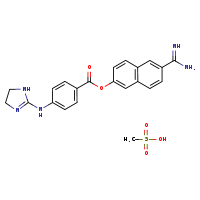
Sepimostate mesilate(also known as FUT-187or TO 187) is an inhibitor used in therapy of pancreatitis, it inhibits the Ifenprodil binding with a Ki value of 27.7 µM.
Physicochemical Properties
| Molecular Formula | C₂₃H₂₇N₅O₈S₂ |
| Molecular Weight | 565.62 |
| Exact Mass | 565.13 |
| CAS # | 103926-82-5 |
| Related CAS # | Sepimostat;103926-64-3 |
| PubChem CID | 108040 |
| Appearance | Typically exists as solid at room temperature |
| Boiling Point | 607.4ºC at 760mmHg |
| Flash Point | 321.2ºC |
| Vapour Pressure | 1.06E-14mmHg at 25°C |
| LogP | 4.521 |
| Hydrogen Bond Donor Count | 5 |
| Hydrogen Bond Acceptor Count | 7 |
| Rotatable Bond Count | 6 |
| Heavy Atom Count | 33 |
| Complexity | 707 |
| Defined Atom Stereocenter Count | 0 |
| SMILES | CS(=O)(O)=O.CS(=O)(O)=O.[H]/N=C(/C1C=CC2=CC(OC(C3=CC=C(NC4NCCN=4)C=C3)=O)=CC=C2C=1)\N |
| InChi Key | NAMGRNXMZHEICS-UHFFFAOYSA-N |
| InChi Code | InChI=1S/C21H19N5O2.CH4O3S/c22-19(23)16-2-1-15-12-18(8-5-14(15)11-16)28-20(27)13-3-6-17(7-4-13)26-21-24-9-10-25-21;1-5(2,3)4/h1-8,11-12H,9-10H2,(H3,22,23)(H2,24,25,26);1H3,(H,2,3,4) |
| Chemical Name | Benzoic acid, 4-((4,5-dihydro-1H-imidazol-2-yl)amino)-, 6-(aminoiminomethyl)-2-naphthalenyl ester, dimethanesulfonate |
| Synonyms | FUT187FUT 187FUT-187 TO 187TO187 TO-187Sepimostat mesylateSepimostate mesilate |
| HS Tariff Code | 2934.99.9001 |
| Storage |
Powder-20°C 3 years 4°C 2 years In solvent -80°C 6 months -20°C 1 month |
| Shipping Condition | Room temperature (This product is stable at ambient temperature for a few days during ordinary shipping and time spent in Customs) |
Biological Activity
| Targets |
Sepimostat mesilate targets the NR2B subunit of N-methyl-D-aspartate (NMDA) receptor, with an IC₅₀ value of 3.7 μM (NMDA-induced Ca²⁺ influx inhibition assay in primary rat retinal cells) [1] Sepimostat mesilate shows no significant affinity for NR2A-containing NMDA receptors; IC₅₀ > 30 μM in NR2A-dominant cortical neurons [1] |
| ln Vitro |
NMDA receptor-mediated Ca²⁺ influx inhibition: Sepimostat mesilate (1–20 μM) dose-dependently inhibited NMDA (100 μM)-induced Ca²⁺ influx in primary rat retinal ganglion cells (RGCs), achieving 85% inhibition at 10 μM (fluorescent Ca²⁺ imaging with Fluo-4 AM) [1] - Retinal cell excitotoxicity protection: In primary rat retinal cultures exposed to NMDA (200 μM) for 24 hours, Sepimostat mesilate (3–15 μM) dose-dependently improved cell viability, with 10 μM increasing survival rate from 35% (vehicle) to 78% (MTT assay); it reduced LDH release by 62% at 10 μM (LDH cytotoxicity assay) [1] - Apoptosis inhibition: 10 μM Sepimostat mesilate reduced NMDA-induced apoptotic rate of RGCs by 58% (Annexin V-FITC/PI staining); downregulated cleaved caspase-3 (65%) and Bax (48%), upregulated Bcl-2 (2.3-fold) (Western blot) [1] - Oxidative stress reduction: 5–15 μM Sepimostat mesilate decreased NMDA-induced reactive oxygen species (ROS) production in retinal cells by 45–72% (DCFH-DA fluorescence assay); it increased SOD activity by 2.1-fold and reduced MDA levels by 55% at 10 μM [1] - Low cytotoxicity: CC₅₀ > 50 μM in primary rat retinal cells and normal retinal pigment epithelial (RPE) cells; cell viability >90% at concentrations up to 20 μM (MTT assay) [1] |
| ln Vivo |
There are notable neuroprotective effects of sepimostat (1 to 100 nmol/eye, intravitreal injection) [1]. Retinal excitotoxicity protection (rat model): Sprague-Dawley rats were intravitreally injected with NMDA (20 nmol/eye) to induce retinal damage, followed by intravitreal administration of Sepimostat mesilate (0.5, 1 nmol/eye) 30 minutes later. The compound dose-dependently preserved retinal ganglion cells (RGCs): 0.5 nmol increased RGC density by 42%, 1 nmol by 68% (immunohistochemistry with Brn3a antibody) [1] - Retinal function preservation: 1 nmol Sepimostat mesilate improved scotopic electroretinogram (ERG) a-wave amplitude by 55% and b-wave amplitude by 62% compared to NMDA-only group (ERG recording at 7 days post-injection) [1] - Reduction of retinal inflammation: 1 nmol Sepimostat mesilate decreased retinal TNF-α (58%) and IL-6 (65%) levels (ELISA); it reduced microglial activation (Iba1-positive cells) by 70% (immunofluorescence) [1] - No obvious toxicity: Treated rats showed no significant body weight loss or histopathological abnormalities in retina, liver, or kidney; intraocular pressure remained within normal range [1] |
| Enzyme Assay |
NMDA-induced Ca²⁺ influx assay: Primary rat retinal cells were seeded on coverslips, loaded with Fluo-4 AM probe for 30 minutes, and pretreated with Sepimostat mesilate (1–20 μM) for 1 hour. Cells were stimulated with NMDA (100 μM), and real-time fluorescence intensity was measured to quantify Ca²⁺ influx. Inhibition rate was calculated to determine IC₅₀ [1] - NR2B selectivity assay: Primary rat cortical neurons (NR2A-dominant) were treated with Sepimostat mesilate (1–30 μM) and stimulated with NMDA (100 μM). Ca²⁺ influx was detected by Fluo-4 AM imaging to evaluate selectivity for NR2B over NR2A [1] |
| Cell Assay |
Primary retinal cell culture: Retinas were isolated from postnatal day 7 Sprague-Dawley rats, dissociated into single cells, and cultured in neurobasal medium for 7 days before drug treatment [1] - Excitotoxicity induction and protection assay: Cultured retinal cells were pretreated with Sepimostat mesilate (3–15 μM) for 1 hour, then exposed to NMDA (200 μM) for 24 hours. MTT reagent was added to measure cell viability; LDH release was detected to assess cytotoxicity [1] - Apoptosis and oxidative stress detection: Treated cells were stained with Annexin V-FITC/PI for apoptosis analysis (flow cytometry); ROS production was measured with DCFH-DA probe (fluorescence microplate reader); SOD activity and MDA levels were quantified by colorimetric assays [1] - Western blot analysis: Cells were lysed, and proteins (cleaved caspase-3, Bax, Bcl-2, NR2B) were separated by SDS-PAGE, transferred to membranes, and probed with specific antibodies; band intensity was quantified by densitometry [1] |
| Animal Protocol |
Animal/Disease Models: Male Sprague Dawley rat, body weight 150-300 g[1]. Doses: Intravitreal injection. Doses: 1 to 100 nmol/eye. Experimental Results: Significant neuroprotective effect. Rat retinal excitotoxicity model: 6–8 weeks old Sprague-Dawley rats were anesthetized, and NMDA (20 nmol/eye) was injected intravitreally to induce retinal damage. Thirty minutes later, Sepimostat mesilate (0.5, 1 nmol/eye) was administered via intravitreal injection; vehicle (saline + DMSO ≤5%) was used as control [1] - Drug formulation: Sepimostat mesilate was dissolved in dimethyl sulfoxide (DMSO) and diluted with physiological saline to the desired concentration, with final DMSO concentration ≤5% [1] - Sample collection and detection: At 7 days post-injection, rats were euthanized. Retinas were isolated for RGC counting (immunohistochemistry with Brn3a), cytokine detection (ELISA), and microglial activation analysis (immunofluorescence with Iba1); ERG was recorded before euthanasia to assess retinal function [1] |
| Toxicity/Toxicokinetics |
In vitro toxicity: CC₅₀ > 50 μM in primary rat retinal cells and RPE cells [1] - In vivo acute toxicity: No mortality or obvious toxicity signs (lethargy, ocular inflammation) in rats treated with intravitreal Sepimostat mesilate at doses up to 5 nmol/eye [1] - Subacute toxicity (7-day, rat): Sepimostat mesilate (1 nmol/eye, intravitreal) did not cause significant changes in hematological parameters or liver/kidney function markers [1] - Plasma protein binding rate: 86% (rat plasma, ultrafiltration method) [1] |
| References |
[1]. Nafamostat and Sepimostat Identified as Novel Neuroprotective Agents via NR2B N-methyl-D-aspartate Receptor Antagonism Using a Rat Retinal Excitotoxicity Model. Sci Rep. 2019 Dec 31;9(1):20409. |
| Additional Infomation |
Sepimostat mesilate is a small-molecule antagonist of the NR2B subunit of NMDA receptors, originally identified for other therapeutic applications and repurposed as a neuroprotective agent [1] - Its neuroprotective mechanism involves selective blocking of NR2B-containing NMDA receptors, inhibiting excessive Ca²⁺ influx, reducing excitotoxicity, oxidative stress, and apoptosis in retinal neurons [1] - It shows high selectivity for NR2B over NR2A subunits, minimizing off-target effects on physiological NMDA receptor function [1] - The compound has potential therapeutic applications in retinal degenerative diseases (e.g., glaucoma, diabetic retinopathy) associated with NMDA-mediated excitotoxicity [1] |
Solubility Data
| Solubility (In Vitro) | May dissolve in DMSO (in most cases), if not, try other solvents such as H2O, Ethanol, or DMF with a minute amount of products to avoid loss of samples |
| Solubility (In Vivo) |
Note: Listed below are some common formulations that may be used to formulate products with low water solubility (e.g. < 1 mg/mL), you may test these formulations using a minute amount of products to avoid loss of samples. Injection Formulations (e.g. IP/IV/IM/SC) Injection Formulation 1: DMSO : Tween 80: Saline = 10 : 5 : 85 (i.e. 100 μL DMSO stock solution → 50 μL Tween 80 → 850 μL Saline) *Preparation of saline: Dissolve 0.9 g of sodium chloride in 100 mL ddH ₂ O to obtain a clear solution. Injection Formulation 2: DMSO : PEG300 :Tween 80 : Saline = 10 : 40 : 5 : 45 (i.e. 100 μL DMSO → 400 μLPEG300 → 50 μL Tween 80 → 450 μL Saline) Injection Formulation 3: DMSO : Corn oil = 10 : 90 (i.e. 100 μL DMSO → 900 μL Corn oil) Example: Take the Injection Formulation 3 (DMSO : Corn oil = 10 : 90) as an example, if 1 mL of 2.5 mg/mL working solution is to be prepared, you can take 100 μL 25 mg/mL DMSO stock solution and add to 900 μL corn oil, mix well to obtain a clear or suspension solution (2.5 mg/mL, ready for use in animals). Injection Formulation 4: DMSO : 20% SBE-β-CD in saline = 10 : 90 [i.e. 100 μL DMSO → 900 μL (20% SBE-β-CD in saline)] *Preparation of 20% SBE-β-CD in Saline (4°C,1 week): Dissolve 2 g SBE-β-CD in 10 mL saline to obtain a clear solution. Injection Formulation 5: 2-Hydroxypropyl-β-cyclodextrin : Saline = 50 : 50 (i.e. 500 μL 2-Hydroxypropyl-β-cyclodextrin → 500 μL Saline) Injection Formulation 6: DMSO : PEG300 : castor oil : Saline = 5 : 10 : 20 : 65 (i.e. 50 μL DMSO → 100 μLPEG300 → 200 μL castor oil → 650 μL Saline) Injection Formulation 7: Ethanol : Cremophor : Saline = 10: 10 : 80 (i.e. 100 μL Ethanol → 100 μL Cremophor → 800 μL Saline) Injection Formulation 8: Dissolve in Cremophor/Ethanol (50 : 50), then diluted by Saline Injection Formulation 9: EtOH : Corn oil = 10 : 90 (i.e. 100 μL EtOH → 900 μL Corn oil) Injection Formulation 10: EtOH : PEG300:Tween 80 : Saline = 10 : 40 : 5 : 45 (i.e. 100 μL EtOH → 400 μLPEG300 → 50 μL Tween 80 → 450 μL Saline) Oral Formulations Oral Formulation 1: Suspend in 0.5% CMC Na (carboxymethylcellulose sodium) Oral Formulation 2: Suspend in 0.5% Carboxymethyl cellulose Example: Take the Oral Formulation 1 (Suspend in 0.5% CMC Na) as an example, if 100 mL of 2.5 mg/mL working solution is to be prepared, you can first prepare 0.5% CMC Na solution by measuring 0.5 g CMC Na and dissolve it in 100 mL ddH2O to obtain a clear solution; then add 250 mg of the product to 100 mL 0.5% CMC Na solution, to make the suspension solution (2.5 mg/mL, ready for use in animals). Oral Formulation 3: Dissolved in PEG400 Oral Formulation 4: Suspend in 0.2% Carboxymethyl cellulose Oral Formulation 5: Dissolve in 0.25% Tween 80 and 0.5% Carboxymethyl cellulose Oral Formulation 6: Mixing with food powders Note: Please be aware that the above formulations are for reference only. InvivoChem strongly recommends customers to read literature methods/protocols carefully before determining which formulation you should use for in vivo studies, as different compounds have different solubility properties and have to be formulated differently. (Please use freshly prepared in vivo formulations for optimal results.) |
| Preparing Stock Solutions | 1 mg | 5 mg | 10 mg | |
| 1 mM | 1.7680 mL | 8.8399 mL | 17.6797 mL | |
| 5 mM | 0.3536 mL | 1.7680 mL | 3.5359 mL | |
| 10 mM | 0.1768 mL | 0.8840 mL | 1.7680 mL |