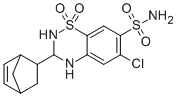
Cyclothiazide (CTZ; Fluidil; Doburil; Renazide) is a benzothiadiazide (thiazide) diuretic and antihypertensive approved in the United States in 1963. It acts as a positive allosteric modulator of ionotropic α-amino-3-hydroxy-5-methylisoxazole-4-propionic acid (AMPA)-type glutamate receptors with important roles in neurological development and function. It is used frequently to block the desensitization of both native and heterologously expressed AMPA receptors. Specifically, CTZ is known to produce a fast inhibition of AMPA receptor desensitization and a much slower potentiation of the AMPA current. Cyclothiazide is capable of inhibiting rapid desensitization of the ionotropic alpha-amino-3-hydroxy-5-methylisoxazole-4-propionic acid (AMPA)-type glutamate receptors, thereby potentiating glutamate responses which may induce seizures activity. Cyclothiazide was also found to inhibit gamma-aminobutyric acid (GABA)-A receptors.
Physicochemical Properties
| Molecular Formula | C14H16N3O4S2CL |
| Molecular Weight | 389.87754 |
| Exact Mass | 389.027 |
| CAS # | 2259-96-3 |
| Related CAS # | 191744-13-5 (CX614); 22503-72-6 (IDRA-21); 742-20-1 (Cyclopenthiazide) |
| PubChem CID | 2910 |
| Appearance | White to off-white solid powder |
| Density | 1.6±0.1 g/cm3 |
| Boiling Point | 627.3±65.0 °C at 760 mmHg |
| Melting Point | 234ºC |
| Flash Point | 333.2±34.3 °C |
| Vapour Pressure | 0.0±1.8 mmHg at 25°C |
| Index of Refraction | 1.654 |
| LogP | 1.15 |
| Hydrogen Bond Donor Count | 3 |
| Hydrogen Bond Acceptor Count | 7 |
| Rotatable Bond Count | 2 |
| Heavy Atom Count | 24 |
| Complexity | 758 |
| Defined Atom Stereocenter Count | 0 |
| InChi Key | BOCUKUHCLICSIY-UHFFFAOYSA-N |
| InChi Code | InChI=1S/C14H16ClN3O4S2/c15-10-5-11-13(6-12(10)23(16,19)20)24(21,22)18-14(17-11)9-4-7-1-2-8(9)3-7/h1-2,5-9,14,17-18H,3-4H2,(H2,16,19,20) |
| Chemical Name | 3-(bicyclo[2.2.1]hept-5-en-2-yl)-6-chloro-3,4-dihydro-2H-benzo[e][1,2,4]thiadiazine-7-sulfonamide 1,1-dioxide |
| Synonyms | CTZ, Cyclothiazide; Fluidil; Anhydron; Anhydron; Renazide; Valmiran; Doburil; Acquirel; Renazide; Tensodiural |
| HS Tariff Code | 2934.99.9001 |
| Storage |
Powder-20°C 3 years 4°C 2 years In solvent -80°C 6 months -20°C 1 month |
| Shipping Condition | Room temperature (This product is stable at ambient temperature for a few days during ordinary shipping and time spent in Customs) |
Biological Activity
| ADME/Pharmacokinetics |
Absorption, Distribution and Excretion THIAZIDES ARE RAPIDLY ABSORBED FROM GI TRACT...MOST...SHOW DEMONSTRABLE DIURETIC EFFECT WITHIN HR AFTER ORAL ADMIN. ...THIAZIDES WITH RELATIVELY LONG DURATIONS...SHOW...BOTH BINDING TO PLASMA PROTEINS & REABSORPTION BY RENAL TUBULES. /THIAZIDES/ ...THIAZIDES PROBABLY UNDERGO ACTIVE SECRETION IN PROXIMAL TUBULE. RENAL CLEARANCES OF DRUGS ARE HIGH & MAY BE EITHER ABOVE OR BELOW RATE OF FILTRATION. MOST COMPD ARE RAPIDLY EXCRETED WITHIN 3 TO 6 HR. /THIAZIDES/ |
| Toxicity/Toxicokinetics |
Interactions ...DIURETICS MAY INCR CONCN OF CLOTTING FACTORS BY LOSS OF PLASMA VOL & INCR CLOTTING FACTOR SYNTH BY REDUCING HEPATIC CONGESTION, THEREBY ANTAGONIZING EFFECT OF ORAL ANTICOAGULANTS. /DIURETICS, THIAZIDE/ CONCURRENT ADMIN OF THIAZIDE DIURETICS & MONOAMINE OXIDASE INHIBITORS MAY INCR HYPOTENSION. /THIAZIDE DIURETICS/ ...HYPOKALEMIA MAY INTENSIFY ACTION OF NEUROMUSCULAR BLOCKING AGENTS. ... POTASSIUM-DEPLETING DIURETICS ARE KNOWN TO CAUSE HYPOKALEMIA & MAY ENHANCE THIS EFFECT. /DIURETICS/ THIAZIDES ENHANCE ANTIHYPERTENSIVE ACTION OF GUANETHIDINE, ALLOWING DOSE OF GUANETHIDINE TO BE REDUCED & DECR INCIDENCE OF ADVERSE REACTIONS... /THIAZIDES/ For more Interactions (Complete) data for CYCLOTHIAZIDE (23 total), please visit the HSDB record page. |
| References | Proc Natl Acad Sci U S A. 2006 Feb 21; 103(8): 2943–2947. |
| Additional Infomation |
Therapeutic Uses Antihypertensive Agents; Diuretics, Thiazide LESS COMMON USAGES INCL TREATMENT OF DIABETES INSIPIDUS & MGMNT OF HYPERCALCIURIA IN PT WITH RECURRENT URINARY CALCULI COMPOSED OF CALCIUM. /THIAZIDES/ THIAZIDE DIURETICS ARE EFFECTIVE AS ADJUNCTIVE THERAPY IN EDEMA ASSOC WITH CONGESTIVE HEART FAILURE, HEPATIC CIRRHOSIS, & CORTICOSTEROID & ESTROGEN THERAPY, AS WELL AS EDEMA DUE TO VARIOUS FORMS OF RENAL DYSFUNCTION...& SEVERE EDEMA DUE TO PREGNANCY. /THIAZIDES/ CYCLOTHIAZIDE IS ORALLY EFFECTIVE DIURETIC & ANTIHYPERTENSIVE AGENT. DIURESIS OCCURS WITHIN 2 HR & LASTS 18 TO 24 HR. ...IT MAY BE USED AS ADJUNCT TO OTHER ANTIHYPERTENSIVE AGENTS, SUCH AS RESERPINE & GANGLIONIC BLOCKING AGENTS. For more Therapeutic Uses (Complete) data for CYCLOTHIAZIDE (10 total), please visit the HSDB record page. Drug Warnings PLASMA POTASSIUM CONCN SHOULD BE DETERMINED PERIODICALLY IN PATIENTS WHO RECEIVE THIAZIDE DIURECTICS FOR EXTENDED PERIODS. /BENZOTHIADIAZIDES/ THIAZIDE DIURETICS ARE CONTRAINDICATED IN ANURIA, PATIENTS HYPERSENSITIVE TO THESE & OTHER SULFONAMIDE DRUGS, & IN OTHERWISE HEALTHY PREGNANT WOMEN WITH OR WITHOUT MILD EDEMA. ...SHOULD BE USED WITH CAUTION IN PATIENTS WITH RENAL DISEASE, SINCE THEY MAY PPT AZOTEMIA. /THIAZIDES/ PERIODIC SERUM ELECTROLYTE DETERMINATION SHOULD BE DONE ON ALL PATIENTS IN ORDER TO DETECT ELECTROLYTE IMBALANCE SUCH AS HYPONATREMIA, HYPOCHLOREMIC ALKALOSIS, & HYPOKALEMIA. /THIAZIDES/ DOMINANT ACTION OF THIAZIDES IS TO INCR RENAL EXCRETION OF SODIUM & CHLORIDE & ACCOMPANYING VOL OF WATER. ... THIAZIDES INHIBIT REABSORPTION OF SODIUM & ITS ATTENDANT ANION, CHLORIDE, IN DISTAL SEGMENT. /THIAZIDES/ For more Drug Warnings (Complete) data for CYCLOTHIAZIDE (10 total), please visit the HSDB record page. Pharmacodynamics Like other thiazides, cyclothiazide promotes water loss from the body (diuretics). It inhibits Na+/Cl- reabsorption from the distal convoluted tubules in the kidneys. Thiazides also cause loss of potassium and an increase in serum uric acid. Thiazides are often used to treat hypertension, but their hypotensive effects are not necessarily due to their diuretic activity. Thiazides have been shown to prevent hypertension-related morbidity and mortality although the mechanism is not fully understood. Thiazides cause vasodilation by activating calcium-activated potassium channels (large conductance) in vascular smooth muscles and inhibiting various carbonic anhydrases in vascular tissue. Cyclothiazide affects the distal renal tubular mechanism of electrolyte reabsorption. At maximal therapeutic dosages, all thiazides are approximately equal in their diuretic efficacy. Cyclothiazide increases excretion of sodium and chloride in approximately equivalent amounts. Natriuresis may be accompanied by some loss of potassium and bicarbonate. |
Solubility Data
| Solubility (In Vitro) | DMSO : ~125 mg/mL (~320.61 mM) |
| Solubility (In Vivo) |
Note: Listed below are some common formulations that may be used to formulate products with low water solubility (e.g. < 1 mg/mL), you may test these formulations using a minute amount of products to avoid loss of samples. Injection Formulations (e.g. IP/IV/IM/SC) Injection Formulation 1: DMSO : Tween 80: Saline = 10 : 5 : 85 (i.e. 100 μL DMSO stock solution → 50 μL Tween 80 → 850 μL Saline) *Preparation of saline: Dissolve 0.9 g of sodium chloride in 100 mL ddH ₂ O to obtain a clear solution. Injection Formulation 2: DMSO : PEG300 :Tween 80 : Saline = 10 : 40 : 5 : 45 (i.e. 100 μL DMSO → 400 μLPEG300 → 50 μL Tween 80 → 450 μL Saline) Injection Formulation 3: DMSO : Corn oil = 10 : 90 (i.e. 100 μL DMSO → 900 μL Corn oil) Example: Take the Injection Formulation 3 (DMSO : Corn oil = 10 : 90) as an example, if 1 mL of 2.5 mg/mL working solution is to be prepared, you can take 100 μL 25 mg/mL DMSO stock solution and add to 900 μL corn oil, mix well to obtain a clear or suspension solution (2.5 mg/mL, ready for use in animals). Injection Formulation 4: DMSO : 20% SBE-β-CD in saline = 10 : 90 [i.e. 100 μL DMSO → 900 μL (20% SBE-β-CD in saline)] *Preparation of 20% SBE-β-CD in Saline (4°C,1 week): Dissolve 2 g SBE-β-CD in 10 mL saline to obtain a clear solution. Injection Formulation 5: 2-Hydroxypropyl-β-cyclodextrin : Saline = 50 : 50 (i.e. 500 μL 2-Hydroxypropyl-β-cyclodextrin → 500 μL Saline) Injection Formulation 6: DMSO : PEG300 : castor oil : Saline = 5 : 10 : 20 : 65 (i.e. 50 μL DMSO → 100 μLPEG300 → 200 μL castor oil → 650 μL Saline) Injection Formulation 7: Ethanol : Cremophor : Saline = 10: 10 : 80 (i.e. 100 μL Ethanol → 100 μL Cremophor → 800 μL Saline) Injection Formulation 8: Dissolve in Cremophor/Ethanol (50 : 50), then diluted by Saline Injection Formulation 9: EtOH : Corn oil = 10 : 90 (i.e. 100 μL EtOH → 900 μL Corn oil) Injection Formulation 10: EtOH : PEG300:Tween 80 : Saline = 10 : 40 : 5 : 45 (i.e. 100 μL EtOH → 400 μLPEG300 → 50 μL Tween 80 → 450 μL Saline) Oral Formulations Oral Formulation 1: Suspend in 0.5% CMC Na (carboxymethylcellulose sodium) Oral Formulation 2: Suspend in 0.5% Carboxymethyl cellulose Example: Take the Oral Formulation 1 (Suspend in 0.5% CMC Na) as an example, if 100 mL of 2.5 mg/mL working solution is to be prepared, you can first prepare 0.5% CMC Na solution by measuring 0.5 g CMC Na and dissolve it in 100 mL ddH2O to obtain a clear solution; then add 250 mg of the product to 100 mL 0.5% CMC Na solution, to make the suspension solution (2.5 mg/mL, ready for use in animals). Oral Formulation 3: Dissolved in PEG400 Oral Formulation 4: Suspend in 0.2% Carboxymethyl cellulose Oral Formulation 5: Dissolve in 0.25% Tween 80 and 0.5% Carboxymethyl cellulose Oral Formulation 6: Mixing with food powders Note: Please be aware that the above formulations are for reference only. InvivoChem strongly recommends customers to read literature methods/protocols carefully before determining which formulation you should use for in vivo studies, as different compounds have different solubility properties and have to be formulated differently. (Please use freshly prepared in vivo formulations for optimal results.) |
| Preparing Stock Solutions | 1 mg | 5 mg | 10 mg | |
| 1 mM | 2.5649 mL | 12.8245 mL | 25.6489 mL | |
| 5 mM | 0.5130 mL | 2.5649 mL | 5.1298 mL | |
| 10 mM | 0.2565 mL | 1.2824 mL | 2.5649 mL |