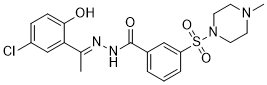
Seclidemstat (formerly also known as SP-2577; SP2577) is a novel, potent small molecule inhibitor of epigenetic enzyme LSD1 (lysine-specific demethylase 1) with anticancer activity. It inhibits LSD1 with a mean IC50 of 127 nM. Seclidemstat has the potential for the treatment of cancer. It is currently undergoing Phase 1 clinical trial in Ewing's sarcoma. Seclidemstat represents a paradigm shift in the treatment of cancer and Ewing sarcoma is a devastating pediatric, adolescent and young adult bone cancer where no targeted therapies are currently available.
Physicochemical Properties
| Molecular Formula | C20H23CLN4O4S | |
| Molecular Weight | 450.93 | |
| Exact Mass | 450.112 | |
| CAS # | 1423715-37-0 | |
| Related CAS # | Seclidemstat mesylate;2044953-70-8 | |
| PubChem CID | 135565033 | |
| Appearance | Off-white to yellow solid powder | |
| Density | 1.4±0.1 g/cm3 | |
| Index of Refraction | 1.645 | |
| LogP | 4.07 | |
| Hydrogen Bond Donor Count | 2 | |
| Hydrogen Bond Acceptor Count | 7 | |
| Rotatable Bond Count | 5 | |
| Heavy Atom Count | 30 | |
| Complexity | 734 | |
| Defined Atom Stereocenter Count | 0 | |
| SMILES | C/C(=N\NC(=O)C1=CC(=CC=C1)S(=O)(=O)N2CCN(CC2)C)/C3=C(C=CC(=C3)Cl)O |
|
| InChi Key | MVSQDUZRRVBYLA-HYARGMPZSA-N | |
| InChi Code | InChI=1S/C20H23ClN4O4S/c1-14(18-13-16(21)6-7-19(18)26)22-23-20(27)15-4-3-5-17(12-15)30(28,29)25-10-8-24(2)9-11-25/h3-7,12-13,26H,8-11H2,1-2H3,(H,23,27)/b22-14+ | |
| Chemical Name |
|
|
| Synonyms |
|
|
| HS Tariff Code | 2934.99.9001 | |
| Storage |
Powder-20°C 3 years 4°C 2 years In solvent -80°C 6 months -20°C 1 month |
|
| Shipping Condition | Room temperature (This product is stable at ambient temperature for a few days during ordinary shipping and time spent in Customs) |
Biological Activity
| Targets |
|
|
| ln Vitro | In cells with an IC50 ranging from 0.013 to 2.819 μM (COV434, BIN67, SCCOHT-1, TOV21G, SKOV3, A427, H522, A549, H1299, G401, G402, HCC15 cells), seclidemstat (72 hours) inhibits the growth of tumors caused by SWI/SNF mutations. seclidemstat (72 hours) increases IFNβ immunity and endogenous retrovirus (ERV) expression in SCCOHT cell lines (SCCOHT-1), BIN67, and COV434 cells [2]. seclidemstat (72 hours) increases PD-L1 expression in SCCOHT COV 434 pIND 20 BRG1-2.7 cell line [2]. | |
| ln Vivo |
|
|
| References |
[1]. Reversible Lysine Specific Demethylase 1 (LSD1) Inhibitors: A Promising Wrench to Impair LSD1 [published correction appears in J Med Chem. 2021 May 13;64(9):6410-6411]. J Med Chem. 2021;64(5):2466-2488. [2]. The novel reversible LSD1 inhibitor SP-2577 promotes anti-tumor immunity in SWItch/Sucrose-NonFermentable (SWI/SNF) complex mutated ovarian cancer. PLoS One. 2020;15(7):e0235705. Published 2020 Jul 10. |
|
| Additional Infomation | Seclidemstat is an orally available, reversible, noncompetitive inhibitor of lysine-specific demethylase 1 (LSD1, or KDM1A), with potential antineoplastic activity. Upon oral administration, seclidemstat reversibly inhibits LSD1, a demethylase that suppresses the expression of target genes by converting the di- and mono-methylated forms of lysine at position 4 of histone 3 (H3K4) to mono- and unmethylated H3K4, respectively. LSD1 inhibition enhances H3K4 methylation and increases the expression of tumor suppressor genes. This may lead to an inhibition of cell growth in LSD1-overexpressing tumor cells. In addition, LSD1 demethylates mono- or di-methylated H3K9 which increases gene expression of tumor promoting genes; inhibition of LSD1 promotes H3K9 methylation and decreases transcription of these genes. |
Solubility Data
| Solubility (In Vitro) |
|
|||
| Solubility (In Vivo) |
Solubility in Formulation 1: ≥ 2.08 mg/mL (4.61 mM) (saturation unknown) in 10% DMSO + 40% PEG300 + 5% Tween80 + 45% Saline (add these co-solvents sequentially from left to right, and one by one), clear solution. For example, if 1 mL of working solution is to be prepared, you can add 100 μL of 20.8 mg/mL clear DMSO stock solution to 400 μL PEG300 and mix evenly; then add 50 μL Tween-80 to the above solution and mix evenly; then add 450 μL normal saline to adjust the volume to 1 mL. Preparation of saline: Dissolve 0.9 g of sodium chloride in 100 mL ddH₂ O to obtain a clear solution. Solubility in Formulation 2: 2 mg/mL (4.44 mM) in 1.6% DMA 5% Ethanol 45% PEG400 48.4% PBS (add these co-solvents sequentially from left to right, and one by one), clear solution; with ultrasonication (<60°C). Solubility in Formulation 3: 10 mg/mL (22.18 mM) in 0.5% CMC-Na/saline water (add these co-solvents sequentially from left to right, and one by one), suspension solution; with ultrasonication. Preparation of saline: Dissolve 0.9 g of sodium chloride in 100 mL ddH₂ O to obtain a clear solution. (Please use freshly prepared in vivo formulations for optimal results.) |
| Preparing Stock Solutions | 1 mg | 5 mg | 10 mg | |
| 1 mM | 2.2176 mL | 11.0882 mL | 22.1764 mL | |
| 5 mM | 0.4435 mL | 2.2176 mL | 4.4353 mL | |
| 10 mM | 0.2218 mL | 1.1088 mL | 2.2176 mL |