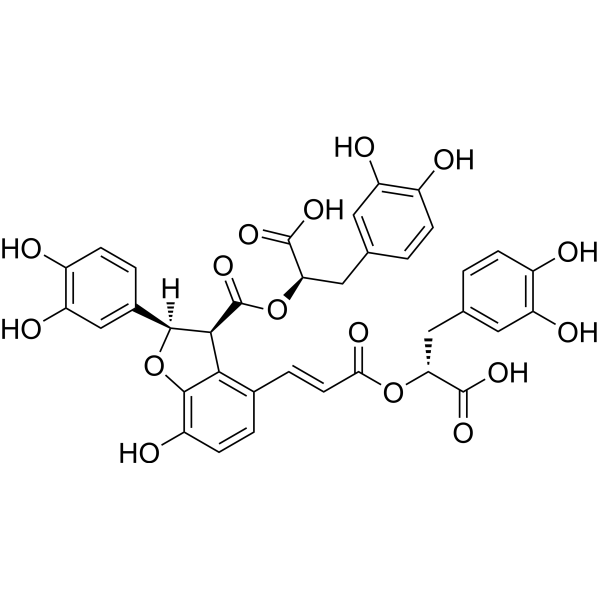
Physicochemical Properties
| Molecular Formula | C36H30O16 |
| Molecular Weight | 718.613811969757 |
| Exact Mass | 718.153 |
| CAS # | 1638738-76-7 |
| PubChem CID | 5316299 |
| Appearance | White to light yellow solid powder |
| LogP | 4 |
| Hydrogen Bond Donor Count | 9 |
| Hydrogen Bond Acceptor Count | 16 |
| Rotatable Bond Count | 14 |
| Heavy Atom Count | 52 |
| Complexity | 1290 |
| Defined Atom Stereocenter Count | 0 |
| SMILES | O1C2C(=CC=C(/C=C/C(=O)O[C@H](C(=O)O)CC3C=CC(=C(C=3)O)O)C=2[C@H](C(=O)O[C@H](C(=O)O)CC2C=CC(=C(C=2)O)O)[C@@H]1C1C=CC(=C(C=1)O)O)O |
| InChi Key | SNKFFCBZYFGCQN-BJMVGYQFSA-N |
| InChi Code | InChI=1S/C36H30O16/c37-20-6-1-16(11-24(20)41)13-27(34(45)46)50-29(44)10-5-18-3-9-23(40)33-30(18)31(32(52-33)19-4-8-22(39)26(43)15-19)36(49)51-28(35(47)48)14-17-2-7-21(38)25(42)12-17/h1-12,15,27-28,31-32,37-43H,13-14H2,(H,45,46)(H,47,48)/b10-5+ |
| Chemical Name | 2-[(E)-3-[3-[1-carboxy-2-(3,4-dihydroxyphenyl)ethoxy]carbonyl-2-(3,4-dihydroxyphenyl)-7-hydroxy-2,3-dihydro-1-benzofuran-4-yl]prop-2-enoyl]oxy-3-(3,4-dihydroxyphenyl)propanoic acid |
| Synonyms | Salvianolic acid Y; 1638738-76-7; (2S)-2-[(E)-3-[(2R,3S)-3-[(1S)-1-carboxy-2-(3,4-dihydroxyphenyl)ethoxy]carbonyl-2-(3,4-dihydroxyphenyl)-7-hydroxy-2,3-dihydro-1-benzofuran-4-yl]prop-2-enoyl]oxy-3-(3,4-dihydroxyphenyl)propanoic acid; |
| HS Tariff Code | 2934.99.9001 |
| Storage |
Powder-20°C 3 years 4°C 2 years In solvent -80°C 6 months -20°C 1 month Note: This product requires protection from light (avoid light exposure) during transportation and storage. |
| Shipping Condition | Room temperature (This product is stable at ambient temperature for a few days during ordinary shipping and time spent in Customs) |
Biological Activity
| Targets | Natural antioxidant |
| ln Vitro |
Salvianolic acid Y exhibits protective properties against cell lesions induced by hydrogen peroxide (H2O2). In the rat pheochromocytoma line PC12, salvianolic acid Y has a 54.2% protection rate[1]. Salvianolic acid Y (TSL 1), a new phenolic acid with the same planar structure as salvianolic acid B, was isolated from Salvia officinalis. The structural elucidation and stereochemistry determination were achieved by spectroscopic and chemical methods, including 1D, 2D-NMR (1H-1H COSY, HMQC and HMBC) and circular dichroism (CD) experiments. The biosynthesis pathway of salvianolic acid B and salvianolic acid Y (TSL 1) was proposed based on structural analysis. The protection of PC12 cells from injury induced by H2O2 was assessed in vitro using a cell viability assay. Salvianolic acid Y (TSL 1) protected cells from injury by 54.2%, which was significantly higher than salvianolic acid B (35.2%). [1] |
| Enzyme Assay |
Activity in Vitro [1] Rat pheochromocytoma PC12 cells were grown in tissue culture flasks in DMEM supplemented with 10% fetal bovine serum, and 100 U/mL penicillin and 100 U/mL streptomycin. The cultures were maintained at 37 °C in a humidified atmosphere containing 5% CO2. The culture media were changed every 2 days. The cells were inoculated to 96-well plates when grown to anastomose and treated with 10 µM salvianolic acid B and 10 µM Isosalvianolic acid Y for 6 h, respectively, followed by co-culture with 400 μM H2O2 for another 1 h. Cell survival was evaluated by the method of MTT (3-(4,5-dimethylthiazol-2-yl)-2,5-diphenyltetra-zolium bromide). The OD value was measured at λ = 570 nm by a spectrophotometer. The protection rate of tested compounds was calculated using the following equation: protection rate (%) = (cell viability of drug group − cell viability of model group)/(cell viability of control group − cell viability of model group) × 100% |
| References |
[1]. Salvianolic acid Y: a new protector of PC12 cells against hydrogen peroxide-induced injury from Salvia officinalis. Molecules. 2015 Jan 6;20(1):683-92. |
| Additional Infomation | A new phenolic acid with the same planar structure as salvianolic acid B, 4-[(1E)-3-[(1R)-1-carboxy-2-(3,4-dihydroxphenyl)ethoxy]-3-oxo-1-propene-1-yl]-2-(3,4-dihydroxphenyl)-2S,3S-dihydro-7-hydroxy-, 3-[(1R)-1-carboxy-2-(3,4-dihydroxphenyl)ethyl] ester, was isolated from the extract of Salvia officinalis. The structural elucidation and stereochemistry determination were achieved by spectroscopic and chemical methods. The new compound was named salvianolic acid Y. For the In vitro biological activity test, our results suggest showed that salvianolic acid Y could rescue cell injury by H2O2, which was significantly better than salvianolic acid B. A plausible biogenetic pathway for salvianolic acid Y was proposed by our study.[1] |
Solubility Data
| Solubility (In Vitro) | May dissolve in DMSO (in most cases), if not, try other solvents such as H2O, Ethanol, or DMF with a minute amount of products to avoid loss of samples |
| Solubility (In Vivo) |
Note: Listed below are some common formulations that may be used to formulate products with low water solubility (e.g. < 1 mg/mL), you may test these formulations using a minute amount of products to avoid loss of samples. Injection Formulations (e.g. IP/IV/IM/SC) Injection Formulation 1: DMSO : Tween 80: Saline = 10 : 5 : 85 (i.e. 100 μL DMSO stock solution → 50 μL Tween 80 → 850 μL Saline) *Preparation of saline: Dissolve 0.9 g of sodium chloride in 100 mL ddH ₂ O to obtain a clear solution. Injection Formulation 2: DMSO : PEG300 :Tween 80 : Saline = 10 : 40 : 5 : 45 (i.e. 100 μL DMSO → 400 μLPEG300 → 50 μL Tween 80 → 450 μL Saline) Injection Formulation 3: DMSO : Corn oil = 10 : 90 (i.e. 100 μL DMSO → 900 μL Corn oil) Example: Take the Injection Formulation 3 (DMSO : Corn oil = 10 : 90) as an example, if 1 mL of 2.5 mg/mL working solution is to be prepared, you can take 100 μL 25 mg/mL DMSO stock solution and add to 900 μL corn oil, mix well to obtain a clear or suspension solution (2.5 mg/mL, ready for use in animals). Injection Formulation 4: DMSO : 20% SBE-β-CD in saline = 10 : 90 [i.e. 100 μL DMSO → 900 μL (20% SBE-β-CD in saline)] *Preparation of 20% SBE-β-CD in Saline (4°C,1 week): Dissolve 2 g SBE-β-CD in 10 mL saline to obtain a clear solution. Injection Formulation 5: 2-Hydroxypropyl-β-cyclodextrin : Saline = 50 : 50 (i.e. 500 μL 2-Hydroxypropyl-β-cyclodextrin → 500 μL Saline) Injection Formulation 6: DMSO : PEG300 : castor oil : Saline = 5 : 10 : 20 : 65 (i.e. 50 μL DMSO → 100 μLPEG300 → 200 μL castor oil → 650 μL Saline) Injection Formulation 7: Ethanol : Cremophor : Saline = 10: 10 : 80 (i.e. 100 μL Ethanol → 100 μL Cremophor → 800 μL Saline) Injection Formulation 8: Dissolve in Cremophor/Ethanol (50 : 50), then diluted by Saline Injection Formulation 9: EtOH : Corn oil = 10 : 90 (i.e. 100 μL EtOH → 900 μL Corn oil) Injection Formulation 10: EtOH : PEG300:Tween 80 : Saline = 10 : 40 : 5 : 45 (i.e. 100 μL EtOH → 400 μLPEG300 → 50 μL Tween 80 → 450 μL Saline) Oral Formulations Oral Formulation 1: Suspend in 0.5% CMC Na (carboxymethylcellulose sodium) Oral Formulation 2: Suspend in 0.5% Carboxymethyl cellulose Example: Take the Oral Formulation 1 (Suspend in 0.5% CMC Na) as an example, if 100 mL of 2.5 mg/mL working solution is to be prepared, you can first prepare 0.5% CMC Na solution by measuring 0.5 g CMC Na and dissolve it in 100 mL ddH2O to obtain a clear solution; then add 250 mg of the product to 100 mL 0.5% CMC Na solution, to make the suspension solution (2.5 mg/mL, ready for use in animals). Oral Formulation 3: Dissolved in PEG400 Oral Formulation 4: Suspend in 0.2% Carboxymethyl cellulose Oral Formulation 5: Dissolve in 0.25% Tween 80 and 0.5% Carboxymethyl cellulose Oral Formulation 6: Mixing with food powders Note: Please be aware that the above formulations are for reference only. InvivoChem strongly recommends customers to read literature methods/protocols carefully before determining which formulation you should use for in vivo studies, as different compounds have different solubility properties and have to be formulated differently. (Please use freshly prepared in vivo formulations for optimal results.) |
| Preparing Stock Solutions | 1 mg | 5 mg | 10 mg | |
| 1 mM | 1.3916 mL | 6.9579 mL | 13.9158 mL | |
| 5 mM | 0.2783 mL | 1.3916 mL | 2.7832 mL | |
| 10 mM | 0.1392 mL | 0.6958 mL | 1.3916 mL |