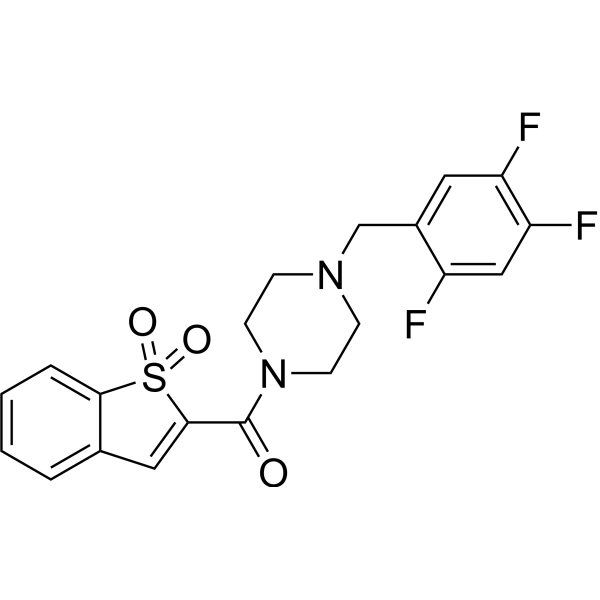
Physicochemical Properties
| Molecular Formula | C20H17F3N2O3S |
| Molecular Weight | 422.42 |
| Appearance | Off-white to light yellow solid powder |
| HS Tariff Code | 2934.99.9001 |
| Storage |
Powder-20°C 3 years 4°C 2 years In solvent -80°C 6 months -20°C 1 month |
| Shipping Condition | Room temperature (This product is stable at ambient temperature for a few days during ordinary shipping and time spent in Customs) |
Biological Activity
| Targets | STAT3 |
| ln Vitro | Compound 10k, STAT3-IN-15, has an IC50 of 0.47 μM, which reduces the growth of NIH-3T3 cells [1]. STAT3-IN-15 resides in the pY subpocket of STAT3 and makes hydrogen bonds with Ser636 and Lys591. [1]. Inhibiting fibroblast activation and proliferation, STAT3-IN-15 (0-100 nM, 72 h) [1]. NIH-3T3 cells' activation mediated by TGF-β1 (5 ng/mL) is inhibited by STAT3-IN-15 (50 nM, 24 h) [1]. In A549 cells, TGF-β1-induced EMT (morphological alterations) is blocked by STAT3-IN-15 (200 nM, 24 hours) [1]. |
| ln Vivo | When given by gavage, STAT3-IN-15 (Compound 10k) (30 and 60 mg/kg) reduces the lung fibrosis that Bleomycin (HY-108345) causes in mice [1]. |
| Cell Assay |
Cell Viability Assay[1] Cell Types: NIH-3T3 cells Tested Concentrations: 0, 6.25, 12.5, 25, 50, 100 nM Incubation Duration: 72 h Experimental Results: Inhibited NIH-3T3 cell viability dose-dependently. Western Blot Analysis[1] Cell Types: NIH-3T3 cells Tested Concentrations: Inhibited NIH-3T3 cell viability dose-dependently. Incubation Duration: 24 h Experimental Results: Inhibited the expression of α-SMA and collagen I and the phosphorylation of STAT3. |
| Animal Protocol |
Animal/Disease Models: BLM-induced pulmonary fibrosis mouse model[1] Doses: 30 and 60 mg/kg Route of Administration: intragastric (po) administration Experimental Results: Recovered the lung structure and decreased the hydroxyproline content. decreased the expression of the p-Stat3Ty705 protein in the lung tissue . Improved BLM-induced imbalance of immune microenvironment. |
| References |
[1]. Discovery of the novel Benzo[b]thiophene 1,1-dioxide derivatives as a potent STAT3 inhibitor against idiopathic pulmonary fibrosis. Eur J Med Chem. 2022 Nov 28;246:114953. |
Solubility Data
| Solubility (In Vitro) | DMSO :~100 mg/mL (~236.73 mM) |
| Solubility (In Vivo) |
Solubility in Formulation 1: ≥ 2.5 mg/mL (5.92 mM) (saturation unknown) in 10% DMSO + 90% Corn Oil (add these co-solvents sequentially from left to right, and one by one), clear solution. For example, if 1 mL of working solution is to be prepared, you can add 100 μL of 25.0 mg/mL clear DMSO stock solution to 900 μL of corn oil and mix evenly. (Please use freshly prepared in vivo formulations for optimal results.) |
| Preparing Stock Solutions | 1 mg | 5 mg | 10 mg | |
| 1 mM | 2.3673 mL | 11.8366 mL | 23.6731 mL | |
| 5 mM | 0.4735 mL | 2.3673 mL | 4.7346 mL | |
| 10 mM | 0.2367 mL | 1.1837 mL | 2.3673 mL |