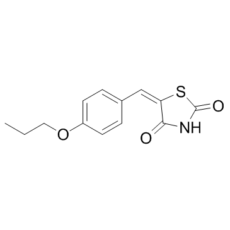
SMI-16a (Pim1/2 Inhibitor IV) is a novel, potent, selective, cell-permeable, ATP-competitive Pim kinase inhibitor with IC50 values of 0.15, 0.02 and 48 μM for Pim1, Pim2 and PC3 cells, respectively. The Pim protein kinases are frequently overexpressed in prostate cancer and certain forms of leukemia and lymphoma. SMI-16a was identified by screening to be a Pim-1 inhibitor and was found to attenuate the autophosphorylation of tagged Pim-1 in intact cells. Although SMI-16a is a competitive inhibitor with respect to ATP, a screen of approximately 50 diverse protein kinases demonstrated that it has high selectivity for Pim kinases. SMI-16a demonstrated selectivities of more than 2500-fold and 400-fold for Pim-1 or Pim-2, respectively. Overall, SMI-16a has the potential to be developed into a novel anticancer agent.
Physicochemical Properties
| Molecular Formula | C13H13NO3S | |
| Molecular Weight | 263.31222 | |
| Exact Mass | 263.061 | |
| CAS # | 587852-28-6 | |
| Related CAS # |
|
|
| PubChem CID | 6076476 | |
| Appearance | Light yellow to yellow solid powder | |
| LogP | 3.1 | |
| Hydrogen Bond Donor Count | 1 | |
| Hydrogen Bond Acceptor Count | 4 | |
| Rotatable Bond Count | 4 | |
| Heavy Atom Count | 18 | |
| Complexity | 359 | |
| Defined Atom Stereocenter Count | 0 | |
| SMILES | O=C(NC/1=O)SC1=C\C2=CC=C(OCCC)C=C2 |
|
| InChi Key | GBWOSXZUTXXXQF-FLIBITNWSA-N | |
| InChi Code | InChI=1S/C13H13NO3S/c1-2-7-17-10-5-3-9(4-6-10)8-11-12(15)14-13(16)18-11/h3-6,8H,2,7H2,1H3,(H,14,15,16)/b11-8- | |
| Chemical Name |
|
|
| Synonyms |
|
|
| HS Tariff Code | 2934.99.9001 | |
| Storage |
Powder-20°C 3 years 4°C 2 years In solvent -80°C 6 months -20°C 1 month |
|
| Shipping Condition | Room temperature (This product is stable at ambient temperature for a few days during ordinary shipping and time spent in Customs) |
Biological Activity
| ln Vitro | SMI-16a exhibits superior inhibitory properties against Pim-1 and Pim-2 [1]. In MM cells, treatment with Pim-2 short interfering RNA and the Pim inhibitor SMI-16a effectively restored osteoblastogenesis, which had been suppressed by all of the aforementioned inhibitors. Treatment with SMI-16a increases anabolic signaling mediated by BMP-2 and inhibits TGF-β signaling [2]. | ||
| ln Vivo | SMI-16a was administered intraperitoneally to mice at a dose of 50 mg/kg every day for five days; a dose of 100 mg/kg was markedly hazardous. Five days a week of SMI-16a treatment decreased tumor growth in the mice by around 50% without resulting in weight loss. Red blood cell and white blood cell counts (including lymphocytes, monocytes, and granulocytes) were unaffected by subchronic treatment of SMI-16a, suggesting that the substance has no myelosuppressive effects. Because albumin, alkaline phosphatase, and alanine aminotransferase levels remain unchanged, SMI-16a is not hepatotoxic [1]. SMI-16a can successfully stop bone deterioration while preventing MM tumor growth in animal models of MM [2]. | ||
| Animal Protocol |
|
||
| References |
[1]. Synthesis and evaluation of novel inhibitors of Pim-1 and Pim-2 protein kinases. J Med Chem. 2009 Jan 8;52(1):74-86. [2]. Pim-2 kinase is an important target of treatment for tumor progression and bone loss in myeloma. Leukemia. 2015 Jan;29(1):207-17. |
Solubility Data
| Solubility (In Vitro) |
|
|||
| Solubility (In Vivo) |
Solubility in Formulation 1: ≥ 2.5 mg/mL (9.49 mM) (saturation unknown) in 10% DMSO + 40% PEG300 + 5% Tween80 + 45% Saline (add these co-solvents sequentially from left to right, and one by one), clear solution. For example, if 1 mL of working solution is to be prepared, you can add 100 μL of 25.0 mg/mL clear DMSO stock solution to 400 μL PEG300 and mix evenly; then add 50 μL Tween-80 to the above solution and mix evenly; then add 450 μL normal saline to adjust the volume to 1 mL. Preparation of saline: Dissolve 0.9 g of sodium chloride in 100 mL ddH₂ O to obtain a clear solution. Solubility in Formulation 2: ≥ 2.5 mg/mL (9.49 mM) (saturation unknown) in 10% DMSO + 90% (20% SBE-β-CD in Saline) (add these co-solvents sequentially from left to right, and one by one), clear solution. For example, if 1 mL of working solution is to be prepared, you can add 100 μL of 25.0 mg/mL clear DMSO stock solution to 900 μL of 20% SBE-β-CD physiological saline solution and mix evenly. Preparation of 20% SBE-β-CD in Saline (4°C,1 week): Dissolve 2 g SBE-β-CD in 10 mL saline to obtain a clear solution. Solubility in Formulation 3: ≥ 2.5 mg/mL (9.49 mM) (saturation unknown) in 10% DMSO + 90% Corn Oil (add these co-solvents sequentially from left to right, and one by one), clear solution. For example, if 1 mL of working solution is to be prepared, you can add 100 μL of 25.0 mg/mL clear DMSO stock solution to 900 μL of corn oil and mix evenly. (Please use freshly prepared in vivo formulations for optimal results.) |
| Preparing Stock Solutions | 1 mg | 5 mg | 10 mg | |
| 1 mM | 3.7978 mL | 18.9890 mL | 37.9780 mL | |
| 5 mM | 0.7596 mL | 3.7978 mL | 7.5956 mL | |
| 10 mM | 0.3798 mL | 1.8989 mL | 3.7978 mL |