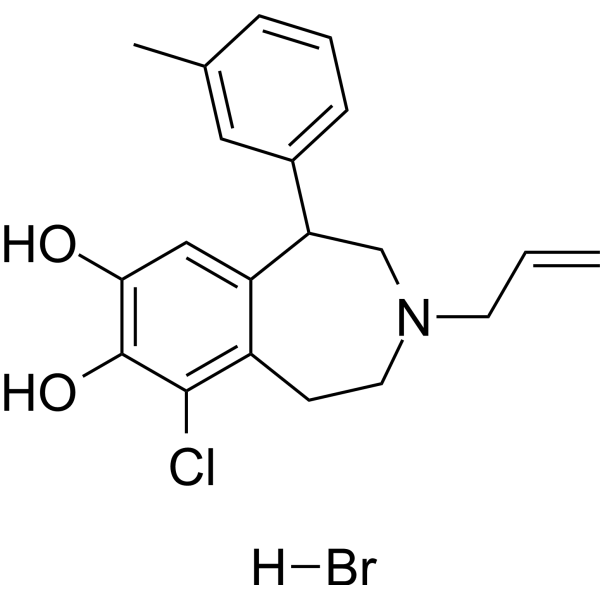
Physicochemical Properties
| Molecular Formula | C20H23BRCLNO2 |
| Molecular Weight | 424.759124040604 |
| Exact Mass | 423.06 |
| CAS # | 74115-10-9 |
| Related CAS # | SKF 83822;74115-08-5 |
| PubChem CID | 12909789 |
| Appearance | Typically exists as solid at room temperature |
| LogP | 5.131 |
| Hydrogen Bond Donor Count | 3 |
| Hydrogen Bond Acceptor Count | 3 |
| Rotatable Bond Count | 3 |
| Heavy Atom Count | 25 |
| Complexity | 432 |
| Defined Atom Stereocenter Count | 0 |
| SMILES | Br.C=CCN1CCC2=C(C(=C(C=C2[C@@H](C2=CC=CC(C)=C2)C1)O)O)Cl |
| InChi Key | CFWPKYBBXBANLU-UHFFFAOYSA-N |
| InChi Code | InChI=1S/C20H22ClNO2.BrH/c1-3-8-22-9-7-15-16(11-18(23)20(24)19(15)21)17(12-22)14-6-4-5-13(2)10-14;/h3-6,10-11,17,23-24H,1,7-9,12H2,2H3;1H |
| Chemical Name | 9-chloro-5-(3-methylphenyl)-3-prop-2-enyl-1,2,4,5-tetrahydro-3-benzazepine-7,8-diol;hydrobromide |
| HS Tariff Code | 2934.99.9001 |
| Storage |
Powder-20°C 3 years 4°C 2 years In solvent -80°C 6 months -20°C 1 month |
| Shipping Condition | Room temperature (This product is stable at ambient temperature for a few days during ordinary shipping and time spent in Customs) |
Biological Activity
| Targets | D1 Receptor |
| ln Vitro | In neostriatal slices, SKF83822 (1 μM) raises DARPP-32 phosphorylation. After 5 minutes of SKF83822 treatment, DARPP-32 Thr34 phosphorylation is stimulated to its maximum at 100 μM, with a half maximal effect at around 1 μM. The phosphorylation of DARPP-32 at Thr75, Ser97, or Ser130 is unaffected by SKF83822 (1 μM)[1]. |
| ln Vivo | SKF83822 stimulates downstream cyclase activity and dopamine D1 receptors connected to Gαs/olf. In models including rodents and non-human primates, SKF83822 elicits a locomotor response without influencing dyskinesia, excessive grooming, or stereotypy. For every genotype, a single acute dose of SKF83822 (0.4 mg/kg; ip) increased locomotor activity by more than three times compared to the baseline period[1]. |
| Cell Assay |
Western Blot Analysis[1] Cell Types: Neostriatal slices Tested Concentrations: 1 μM Incubation Duration: 0, 0.5, 2, 5, and 10 minutes Experimental Results: Treatment with 1 μM increased the level of phospho-Thr34 DARPP-32, maximally by ∼6-fold within 2 min of incubation. |
| Animal Protocol |
Animal/Disease Models: Gαq knockout mice[1] Doses: 0.4 mg/kg Route of Administration: Experimental Results: There was a significant increase in locomotor activity in each genotype. |
| References |
[1]. Mahomi Kuroiwa, et al. Regulation of DARPP-32 phosphorylation by three distinct dopamine D1-like receptor signaling pathways in the neostriatum. J Neurochem. 2008 Nov;107(4):1014-26. [2]. Aliya L Frederick, et al. Neurobehavioral phenotyping of G(αq) knockout mice reveals impairments in motor functions and spatial working memory without changes in anxiety or behavioral despair. Front Behav Neurosci. 2012 Jun 19;6:29. |
| Additional Infomation | N-allyl-6-chloro-1-(3-methylphenyl)-2,3,4,5-tetrahydro-3-benzazepine-7,8-diol hydrobromide is a hydrobromide salt prepared from N-allyl-6-chloro-1-(3-methylphenyl)-2,3,4,5-tetrahydro-3-benzazepine-7,8-diol and one equivalent of hydrogen bromide. High affinity, selective dopamine D1-like receptor agonist. Ki values are 3.2, 3.1, 186, 66, 335, 1167, 1251 and 1385 nM at recombinant D1, D5, D2, D3, D4, 5-HT2A, alpha1A and alpha1B receptors respectively. Stimulates adenylyl cyclase (EC50 = 65 nM) but not phosphoinositide hydrolysis. Induces extreme arousal and hyperlocomotion following subcutaneous administration in monkeys. It has a role as a dopamine agonist and a prodrug. It contains a N-allyl-6-chloro-1-(3-methylphenyl)-2,3,4,5-tetrahydro-3-benzazepinium-7,8-diol(1+). |
Solubility Data
| Solubility (In Vitro) | May dissolve in DMSO (in most cases), if not, try other solvents such as H2O, Ethanol, or DMF with a minute amount of products to avoid loss of samples |
| Solubility (In Vivo) |
Note: Listed below are some common formulations that may be used to formulate products with low water solubility (e.g. < 1 mg/mL), you may test these formulations using a minute amount of products to avoid loss of samples. Injection Formulations (e.g. IP/IV/IM/SC) Injection Formulation 1: DMSO : Tween 80: Saline = 10 : 5 : 85 (i.e. 100 μL DMSO stock solution → 50 μL Tween 80 → 850 μL Saline) *Preparation of saline: Dissolve 0.9 g of sodium chloride in 100 mL ddH ₂ O to obtain a clear solution. Injection Formulation 2: DMSO : PEG300 :Tween 80 : Saline = 10 : 40 : 5 : 45 (i.e. 100 μL DMSO → 400 μLPEG300 → 50 μL Tween 80 → 450 μL Saline) Injection Formulation 3: DMSO : Corn oil = 10 : 90 (i.e. 100 μL DMSO → 900 μL Corn oil) Example: Take the Injection Formulation 3 (DMSO : Corn oil = 10 : 90) as an example, if 1 mL of 2.5 mg/mL working solution is to be prepared, you can take 100 μL 25 mg/mL DMSO stock solution and add to 900 μL corn oil, mix well to obtain a clear or suspension solution (2.5 mg/mL, ready for use in animals). Injection Formulation 4: DMSO : 20% SBE-β-CD in saline = 10 : 90 [i.e. 100 μL DMSO → 900 μL (20% SBE-β-CD in saline)] *Preparation of 20% SBE-β-CD in Saline (4°C,1 week): Dissolve 2 g SBE-β-CD in 10 mL saline to obtain a clear solution. Injection Formulation 5: 2-Hydroxypropyl-β-cyclodextrin : Saline = 50 : 50 (i.e. 500 μL 2-Hydroxypropyl-β-cyclodextrin → 500 μL Saline) Injection Formulation 6: DMSO : PEG300 : castor oil : Saline = 5 : 10 : 20 : 65 (i.e. 50 μL DMSO → 100 μLPEG300 → 200 μL castor oil → 650 μL Saline) Injection Formulation 7: Ethanol : Cremophor : Saline = 10: 10 : 80 (i.e. 100 μL Ethanol → 100 μL Cremophor → 800 μL Saline) Injection Formulation 8: Dissolve in Cremophor/Ethanol (50 : 50), then diluted by Saline Injection Formulation 9: EtOH : Corn oil = 10 : 90 (i.e. 100 μL EtOH → 900 μL Corn oil) Injection Formulation 10: EtOH : PEG300:Tween 80 : Saline = 10 : 40 : 5 : 45 (i.e. 100 μL EtOH → 400 μLPEG300 → 50 μL Tween 80 → 450 μL Saline) Oral Formulations Oral Formulation 1: Suspend in 0.5% CMC Na (carboxymethylcellulose sodium) Oral Formulation 2: Suspend in 0.5% Carboxymethyl cellulose Example: Take the Oral Formulation 1 (Suspend in 0.5% CMC Na) as an example, if 100 mL of 2.5 mg/mL working solution is to be prepared, you can first prepare 0.5% CMC Na solution by measuring 0.5 g CMC Na and dissolve it in 100 mL ddH2O to obtain a clear solution; then add 250 mg of the product to 100 mL 0.5% CMC Na solution, to make the suspension solution (2.5 mg/mL, ready for use in animals). Oral Formulation 3: Dissolved in PEG400 Oral Formulation 4: Suspend in 0.2% Carboxymethyl cellulose Oral Formulation 5: Dissolve in 0.25% Tween 80 and 0.5% Carboxymethyl cellulose Oral Formulation 6: Mixing with food powders Note: Please be aware that the above formulations are for reference only. InvivoChem strongly recommends customers to read literature methods/protocols carefully before determining which formulation you should use for in vivo studies, as different compounds have different solubility properties and have to be formulated differently. (Please use freshly prepared in vivo formulations for optimal results.) |
| Preparing Stock Solutions | 1 mg | 5 mg | 10 mg | |
| 1 mM | 2.3543 mL | 11.7714 mL | 23.5427 mL | |
| 5 mM | 0.4709 mL | 2.3543 mL | 4.7085 mL | |
| 10 mM | 0.2354 mL | 1.1771 mL | 2.3543 mL |