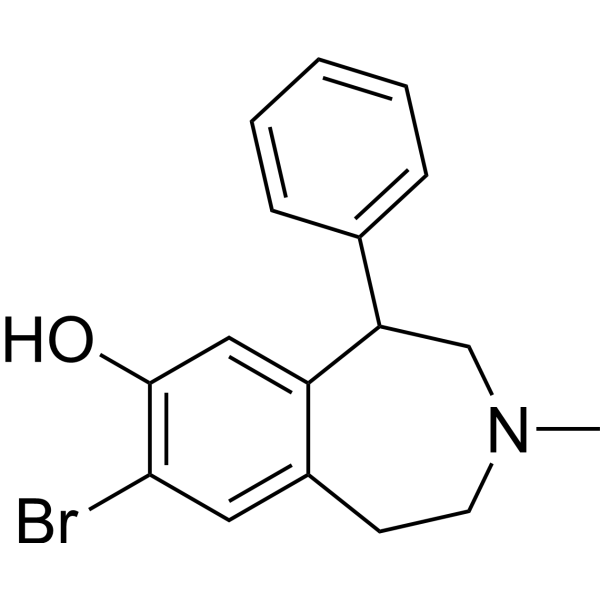
Physicochemical Properties
| Molecular Formula | C17H18BRNO |
| Molecular Weight | 332.23 |
| Exact Mass | 367.034 |
| CAS # | 99295-33-7 |
| Related CAS # | SKF-83566 hydrobromide;108179-91-5 |
| PubChem CID | 1243 |
| Appearance | Off-white to light yellow solid powder |
| Boiling Point | 447.5ºC at 760mmHg |
| Flash Point | 224.4ºC |
| LogP | 4.514 |
| Hydrogen Bond Donor Count | 1 |
| Hydrogen Bond Acceptor Count | 2 |
| Rotatable Bond Count | 1 |
| Heavy Atom Count | 20 |
| Complexity | 318 |
| Defined Atom Stereocenter Count | 0 |
| InChi Key | XFTVOHWWEQGXLS-UHFFFAOYSA-N |
| InChi Code | InChI=1S/C17H18BrNO/c1-19-8-7-13-9-16(18)17(20)10-14(13)15(11-19)12-5-3-2-4-6-12/h2-6,9-10,15,20H,7-8,11H2,1H3 |
| Chemical Name | 8-bromo-3-methyl-5-phenyl-1,2,4,5-tetrahydro-3-benzazepin-7-ol |
| HS Tariff Code | 2934.99.9001 |
| Storage |
Powder-20°C 3 years 4°C 2 years In solvent -80°C 6 months -20°C 1 month |
| Shipping Condition | Room temperature (This product is stable at ambient temperature for a few days during ordinary shipping and time spent in Customs) |
Biological Activity
| Targets | D1 Receptor D5 Receptor 5-HT2 Receptor 11 nM (Ki) |
| ln Vitro | When single-pulse stimulation is applied, SKF-83566 (0.1 μM–10 μM) increases peak evoked extracellular DA concentration ([DA]o) in a concentration-dependent manner. Peak increases of up to 65% are observed when 5 μM is applied. For this effect, SKF-83566 has an EC50 value of 1.3 μM[2]. The [3H]DA uptake is inhibited by SKF-83566, with an IC50 of 5.73 μM. Moreover, tests on [3H]DA uptake and [3H]CFT binding show that SKF-83566 inhibits [3H]CFT binding more successfully, with an IC50 of 0.51 μM [2]. Likewise, with an IC50 of 0.77 μM, SKF-83566 also prevented [3H]CFT binding in LLc-PK-rDAT cell membrane preparations [2]. |
| ln Vivo | SKF 83566 (oral; 20 μg/mL; 7 days) did not change LTP (115%) in any way. SKF 83566 + nicotine + cocaine, 120%; nicotine + cocaine, 143%), however, significantly inhibited the increase of long-term synaptic potentiation (LTP) caused by nicotine pretreatment[1]. |
| Animal Protocol |
Animal/Disease Models: Male C57BL6/J mice (6- to 9-wk-old)[1] Doses: 20 µg/mL (Together with nicotine for 7 d, followed by the injection of cocaine) Route of Administration: Oral administration; 7 days Experimental Results: Blocked nicotine and cocaine-induced facilitation of LTP. |
| References |
[1]. D1/D5 Receptors and Histone Deacetylation Mediate the Gateway Effect of LTP in Hippocampal Dentate Gyrus. [2]. SKF-83566, a D1-dopamine Receptor Antagonist, Inhibits the Dopamine Transporter. J Neurochem. 2011 Sep;118(5):714-20. [3]. SCH 23390 and SK&F 83566 are antagonists at vascular dopamine and serotonin receptors. Eur J Pharmacol. 1985 Jan 22;108(2):205-8. [4]. Development of a high-throughput screening paradigm for the discovery of small-molecule modulators of adenylyl cyclase: identification of an adenylyl cyclase 2 inhibitor. J Pharmacol Exp Ther. 2013 Nov;347(2):276-87. [5]. D1/D5 receptors and histone deacetylation mediate the Gateway Effect of LTP in hippocampal dentate gyrus. Learn Mem. 2014 Feb 18;21(3):153-60. doi: 10.1101/lm.032292.113. |
| Additional Infomation | 8-bromo-3-methyl-5-phenyl-1,2,4,5-tetrahydro-3-benzazepin-7-ol is a benzazepine. |
Solubility Data
| Solubility (In Vitro) | DMSO: 33.33 mg/mL (100.32 mM) |
| Solubility (In Vivo) |
Solubility in Formulation 1: ≥ 2.5 mg/mL (7.52 mM) (saturation unknown) in 10% DMSO + 40% PEG300 + 5% Tween80 + 45% Saline (add these co-solvents sequentially from left to right, and one by one), clear solution. For example, if 1 mL of working solution is to be prepared, you can add 100 μL of 25.0 mg/mL clear DMSO stock solution to 400 μL PEG300 and mix evenly; then add 50 μL Tween-80 to the above solution and mix evenly; then add 450 μL normal saline to adjust the volume to 1 mL. Preparation of saline: Dissolve 0.9 g of sodium chloride in 100 mL ddH₂ O to obtain a clear solution. Solubility in Formulation 2: ≥ 2.5 mg/mL (7.52 mM) (saturation unknown) in 10% DMSO + 90% (20% SBE-β-CD in Saline) (add these co-solvents sequentially from left to right, and one by one), clear solution. For example, if 1 mL of working solution is to be prepared, you can add 100 μL of 25.0 mg/mL clear DMSO stock solution to 900 μL of 20% SBE-β-CD physiological saline solution and mix evenly. Preparation of 20% SBE-β-CD in Saline (4°C,1 week): Dissolve 2 g SBE-β-CD in 10 mL saline to obtain a clear solution. Solubility in Formulation 3: ≥ 2.5 mg/mL (7.52 mM) (saturation unknown) in 10% DMSO + 90% Corn Oil (add these co-solvents sequentially from left to right, and one by one), clear solution. For example, if 1 mL of working solution is to be prepared, you can add 100 μL of 25.0 mg/mL clear DMSO stock solution to 900 μL of corn oil and mix evenly. (Please use freshly prepared in vivo formulations for optimal results.) |
| Preparing Stock Solutions | 1 mg | 5 mg | 10 mg | |
| 1 mM | 3.0100 mL | 15.0498 mL | 30.0996 mL | |
| 5 mM | 0.6020 mL | 3.0100 mL | 6.0199 mL | |
| 10 mM | 0.3010 mL | 1.5050 mL | 3.0100 mL |