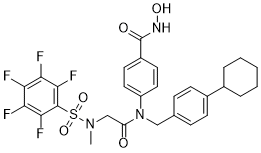
SH5-07 (SH5 07; SH-507; SH5-07), a structural analog of BP-1-102, is a novel, potent and hydroxamic acid-based STAT3 inhibitor with potential antitumor activity. It shows potent anti-proliferative activity in vitro and high in vivo antitumor efficacy against human glioma and breast cancer models. SH5-07 dose-dependently inhibits Stat3 activity with an IC50 of 3.9±0.6 μM in in vitro assay. It preferentially inhibits Stat3: Stat3 DNA-binding activity, ahead of inhibiting Stat1:Stat3 activity, with minimal effects on Stat1:Stat1 activity. SH5-07 binds Stat3, disrupts Stat3 association with growth factor receptor, and thereby inhibits Stat3 phosphorylation.
Physicochemical Properties
| Molecular Formula | C29H28F5N3O5S | |
| Molecular Weight | 625.61 | |
| Exact Mass | 625.167 | |
| CAS # | 1456632-41-9 | |
| Related CAS # |
|
|
| PubChem CID | 72550504 | |
| Appearance | White to off-white solid powder | |
| LogP | 5.5 | |
| Hydrogen Bond Donor Count | 2 | |
| Hydrogen Bond Acceptor Count | 11 | |
| Rotatable Bond Count | 9 | |
| Heavy Atom Count | 43 | |
| Complexity | 1030 | |
| Defined Atom Stereocenter Count | 0 | |
| InChi Key | QPSUYVALAOXFGL-UHFFFAOYSA-N | |
| InChi Code | InChI=1S/C29H28F5N3O5S/c1-36(43(41,42)28-26(33)24(31)23(30)25(32)27(28)34)16-22(38)37(21-13-11-20(12-14-21)29(39)35-40)15-17-7-9-19(10-8-17)18-5-3-2-4-6-18/h7-14,18,40H,2-6,15-16H2,1H3,(H,35,39) | |
| Chemical Name | 4-[(4-cyclohexylphenyl)methyl-[2-[methyl-(2,3,4,5,6-pentafluorophenyl)sulfonylamino]acetyl]amino]-N-hydroxybenzamide | |
| Synonyms |
|
|
| HS Tariff Code | 2934.99.9001 | |
| Storage |
Powder-20°C 3 years 4°C 2 years In solvent -80°C 6 months -20°C 1 month |
|
| Shipping Condition | Room temperature (This product is stable at ambient temperature for a few days during ordinary shipping and time spent in Customs) |
Biological Activity
| Targets |
STAT3 (IC50 = 1.2 μM for STAT3 DNA-binding activity; IC50 values for cancer cell proliferation: U87 = 2.5 μM, U251 = 3.1 μM, MDA-MB-231 = 2.8 μM, MCF-7 = 3.5 μM) [1] |
| ln Vitro |
An analog of BP-1-102 is hydroxamic acid, or SH5-07. In an in vitro assay, Stat3 activity is dose-dependently inhibited by SH5-07, with an IC50 of 3.9±0.6 μM. With negligible effects on Stat1:Stat1 activity, it preferentially inhibits the DNA-binding activity of Stat3:Stat3, prior to inhibiting Stat1:Stat3. By binding to Stat3, SH5-07 prevents Stat3 from attaching to the growth factor receptor, which prevents Stat3 from being phosphorylated. It causes malignant cells with constitutively active Stat3 to exhibit antitumor cell effects. The expression of recognized Stat3-regulated genes is inhibited by SH5 -07. The expression of Bcl-2, Bcl-xL, c-Myc, Survivin, Cyclin D1, and Mcl-1 decreases in response to a 24-hour treatment with 5 μM SH5-07[1]. SH5-07 potently inhibited STAT3 DNA-binding activity in U87 glioma nuclear extracts, with an IC50 of 1.2 μM, as measured by electrophoretic mobility shift assay (EMSA) [1] - It exhibited dose-dependent antiproliferative activity against human glioma (U87, U251) and breast cancer (MDA-MB-231, MCF-7) cells. At concentrations of 2, 5, and 10 μM, it reduced U87 cell viability by 35%, 62%, and 80% respectively after 72 hours of incubation (MTT assay) [1] - The compound induced apoptosis in MDA-MB-231 cells: 10 μM treatment for 48 hours increased the apoptotic rate by 4.2-fold compared to the control group, as detected by Annexin V/PI flow cytometry. It also activated caspase-3 and caspase-9, with a 3.8-fold and 2.9-fold increase in activity respectively [1] - SH5-07 suppressed cancer cell clonogenicity: 2 μM treatment reduced U251 colony formation by 55% and MDA-MB-231 colony formation by 60% after 14 days of culture [1] - It downregulated STAT3 downstream target genes (Bcl-2, cyclin D1, survivin) in U87 and MCF-7 cells, as demonstrated by Western blot and RT-PCR: Bcl-2 protein levels decreased by 65% (U87) and 58% (MCF-7) at 10 μM [1] |
| ln Vivo |
The growth of established subcutaneous mouse xenografts of human glioma (U251MG) and breast tumor (MDA-MB-231), which have aberrantly-active Stat3, is inhibited by tail vein injection or oral gavage delivery of SH5-07 or SH4-54. This is related with lower expression of c-Myc, Mcl-1, and Cyclin D1. The tumors measure 90-150 mm3. There are no appreciable alterations in body weights, blood cell counts, gross organ architecture, or overt toxicity[1]. In nude mouse xenograft models of U87 glioma and MDA-MB-231 breast cancer, intraperitoneal administration of SH5-07 (10, 20 mg/kg, 3 times/week for 4 weeks) dose-dependently inhibited tumor growth. For U87 xenografts, the 20 mg/kg dose reduced tumor volume by 68% and tumor weight by 72% compared to the vehicle control group [1] - In MDA-MB-231 xenografts, 20 mg/kg SH5-07 suppressed tumor growth by 62% and decreased intratumoral STAT3 phosphorylation (Tyr705) by 75%, as detected by immunohistochemistry [1] - The drug did not cause significant reduction in mouse body weight (≤5% change) and did not induce obvious organ damage in the tumor-bearing mice [1] |
| Enzyme Assay |
Nuclear extracts were prepared from U87 glioma cells. Serial dilutions of SH5-07 (0.1–10 μM) were mixed with nuclear extracts and a biotin-labeled STAT3-specific DNA probe in binding buffer. The mixture was incubated at room temperature for 30 minutes, then separated by non-denaturing polyacrylamide gel electrophoresis. The gel was transferred to a membrane, and the biotin-labeled DNA-protein complex was detected using a chemiluminescent substrate. The inhibition rate of STAT3 DNA-binding activity was calculated by densitometric analysis, and the IC50 value was determined [1] |
| Cell Assay |
Antiproliferation Assay: Glioma (U87, U251) and breast cancer (MDA-MB-231, MCF-7) cells were seeded in 96-well plates at a density of 5×10³ cells per well. After 24 hours of stabilization, SH5-07 (0.5–20 μM) was added, and cells were incubated for 72 hours. MTT reagent was added, and absorbance was measured at 570 nm to calculate cell viability and IC50 values [1] - Apoptosis Assay: MDA-MB-231 cells were seeded in 6-well plates and treated with SH5-07 (2–10 μM) for 48 hours. Cells were harvested, stained with Annexin V-FITC and PI, and analyzed by flow cytometry to determine the apoptotic rate. Caspase-3 and caspase-9 activities were quantified using colorimetric assay kits [1] - Clonogenic Assay: U251 and MDA-MB-231 cells were seeded in 6-well plates at 200 cells per well, treated with SH5-07 (1–5 μM) for 24 hours, then cultured in drug-free medium for 14 days. Colonies were fixed and stained, and the number of colonies with >50 cells was counted to calculate the clonogenic inhibition rate [1] - Western Blot/RT-PCR Assay: U87 and MCF-7 cells were treated with SH5-07 (2–10 μM) for 24 hours. Total protein and RNA were extracted, and Western blot was performed to detect Bcl-2, cyclin D1, survivin, and phosphorylated STAT3 (Tyr705) protein levels. RT-PCR was used to quantify the mRNA expression of these target genes [1] |
| Animal Protocol |
3, 5 or 6 mg/kg; Oral or tail vein injection Mouse xenografts with human glioma (U251MG) and breast (MDA-MB-231) tumors U87 Glioma Xenograft Model: Female nude mice (6–8 weeks old) were subcutaneously injected with 5×10⁶ U87 cells into the right flank. When tumors reached a volume of 100–150 mm³, mice were randomly divided into vehicle control and SH5-07 groups (10, 20 mg/kg, i.p., n=6 per group). The drug was administered 3 times per week for 4 weeks. Tumor volume was measured every 3 days using calipers, and tumor weight was recorded after sacrifice. Tumor tissues were collected for immunohistochemical detection of p-STAT3 (Tyr705) [1] - MDA-MB-231 Breast Cancer Xenograft Model: Female nude mice were subcutaneously implanted with 2×10⁶ MDA-MB-231 cells. Tumor-bearing mice were treated with SH5-07 (10, 20 mg/kg, i.p., 3 times/week for 4 weeks) as described above. Tumor growth parameters and p-STAT3 expression were evaluated similarly [1] |
| Toxicity/Toxicokinetics |
In nude mice treated with SH5-07 (up to 20 mg/kg, i.p., 4 weeks), no significant changes in serum ALT, AST, creatinine, or urea nitrogen levels were observed, indicating no obvious hepatotoxicity or nephrotoxicity [1] - The drug did not cause severe weight loss (mouse body weight remained ≥95% of the initial weight) or obvious pathological changes in liver, kidney, heart, or lung tissues, as shown by histopathological examination [1] |
| References |
[1]. Hydroxamic Acid and Benzoic Acid-Based STAT3 Inhibitors Suppress Human Glioma and Breast Cancer Phenotypes In Vitro and In Vivo. Cancer Res. 2016 Feb 1;76(3):652-63. |
| Additional Infomation |
SH5-07 is a hydroxamic acid-based small-molecule STAT3 inhibitor [1] - Its mechanism of action involves inhibiting STAT3 dimerization and DNA-binding activity, thereby blocking the transcription of STAT3-dependent oncogenes (Bcl-2, cyclin D1, survivin) that regulate cell proliferation, survival, and angiogenesis [1] - It exhibits specific anti-tumor activity against STAT3-overactivated cancers (glioma and breast cancer) without significant cytotoxicity to normal human astrocytes and mammary epithelial cells (IC50 > 20 μM) [1] - The compound has potential therapeutic value for the treatment of glioma and breast cancer, particularly in tumors with dysregulated STAT3 signaling [1] |
Solubility Data
| Solubility (In Vitro) |
|
|||
| Solubility (In Vivo) |
Solubility in Formulation 1: ≥ 2.5 mg/mL (4.00 mM) (saturation unknown) in 10% DMSO + 40% PEG300 + 5% Tween80 + 45% Saline (add these co-solvents sequentially from left to right, and one by one), clear solution. For example, if 1 mL of working solution is to be prepared, you can add 100 μL of 25.0 mg/mL clear DMSO stock solution to 400 μL PEG300 and mix evenly; then add 50 μL Tween-80 to the above solution and mix evenly; then add 450 μL normal saline to adjust the volume to 1 mL. Preparation of saline: Dissolve 0.9 g of sodium chloride in 100 mL ddH₂ O to obtain a clear solution. Solubility in Formulation 2: ≥ 2.5 mg/mL (4.00 mM) (saturation unknown) in 10% DMSO + 90% Corn Oil (add these co-solvents sequentially from left to right, and one by one), clear solution. For example, if 1 mL of working solution is to be prepared, you can add 100 μL of 25.0 mg/mL clear DMSO stock solution to 900 μL of corn oil and mix evenly. (Please use freshly prepared in vivo formulations for optimal results.) |
| Preparing Stock Solutions | 1 mg | 5 mg | 10 mg | |
| 1 mM | 1.5984 mL | 7.9922 mL | 15.9844 mL | |
| 5 mM | 0.3197 mL | 1.5984 mL | 3.1969 mL | |
| 10 mM | 0.1598 mL | 0.7992 mL | 1.5984 mL |