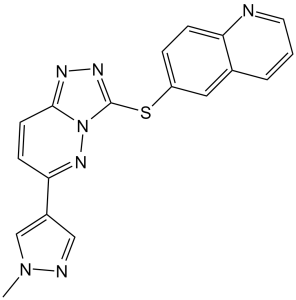
SGX-523 is a novel potent and ATP-competitive Met inhibitor with anticancer activity. It inhibits the tyrosine kinase Met with an IC50 of 4 nM, and exhibits no activity against BRAFV599E, c-Raf, Abl and p38α. MET is implicated in the development and progression of various cancer types.
Physicochemical Properties
| Molecular Formula | C18H13N7S |
| Molecular Weight | 359.4077 |
| Exact Mass | 359.095 |
| Elemental Analysis | C, 60.15; H, 3.65; N, 27.28; S, 8.92 |
| CAS # | 1072116-01-8 |
| Related CAS # | :1022150-57-7 |
| PubChem CID | 24779724 |
| Appearance | Light yellow to yellow solid powder |
| Density | 1.5±0.1 g/cm3 |
| Index of Refraction | 1.817 |
| LogP | 2.73 |
| Hydrogen Bond Acceptor Count | 6 |
| Rotatable Bond Count | 3 |
| Heavy Atom Count | 26 |
| Complexity | 494 |
| Defined Atom Stereocenter Count | 0 |
| InChi Key | BCZUAADEACICHN-UHFFFAOYSA-N |
| InChi Code | InChI=1S/C18H13N7S/c1-24-11-13(10-20-24)16-6-7-17-21-22-18(25(17)23-16)26-14-4-5-15-12(9-14)3-2-8-19-15/h2-11H,1H3 |
| Chemical Name | 6-(6-(1-Methyl-1H-pyrazol-4-yl)-[1,2,4]triazolo[4,3-b]pyridazin-3-ylthio)quinoline |
| Synonyms | SGX-523; SGX 523; 6-(6-(1-methyl-1H-pyrazol-4-yl)-[1,2,4]triazolo[4,3-b]pyridazin-3-ylthio)quinoline; 6-((6-(1-methyl-1H-pyrazol-4-yl)-[1,2,4]triazolo[4,3-b]pyridazin-3-yl)thio)quinoline; WH8SQN09KJ; CHEMBL1236107; SGX523 |
| HS Tariff Code | 2934.99.9001 |
| Storage |
Powder-20°C 3 years 4°C 2 years In solvent -80°C 6 months -20°C 1 month |
| Shipping Condition | Room temperature (This product is stable at ambient temperature for a few days during ordinary shipping and time spent in Customs) |
Biological Activity
| Targets | MET |
| ln Vitro | In comparison to the more active phospho-enzyme [MET-KD(3P), Ki=23 nM], SGX523 exhibits ATP-competitive inhibition with a higher apparent affinity for the less active, unphosphorylated version of MET [MET-KD(0P), Ki=2.7 nM][1]. Even at high micromolar concentrations, SGX523 has no effect on cell lines with a normal copy number of the MET gene, but it inhibits the proliferation of gastric and lung cancer cell lines exhibiting MET gene amplification. The gastric cancer Hs746T cells, NSCLC H1993, and gastric cancer MKN45 had IC50s of 0.02, 0.113, and 0.035 µM, respectively[1]. In GTL16 cells, the IC50 value for inhibiting MET autophosphorylation is 0.040 μM[1]. SGX523 (0.5, 1.5, 4.6, 13.7, 41, 123, 370, 1100, 3300, 10000 nM; 1 hour) suppresses the autophosphorylation of MET in HGF-stimulated A549 cells without influencing the amounts of extracellular signal-regulated kinase protein or total MET. |
| ln Vivo |
SGX523 significantly retards the growth of preestablished GTL16 tumors when administered orally at doses of ≥10 mg/kg twice daily. Strongly suppressing the growth of U87MG tumors, SGX523 causes a noticeable regression of U87MG tumors when dosed twice daily at 30 mg/kg. When SGX523 is administered twice a day at a dose of 30 mg/kg, it also lowers tumor MET autophosphorylation levels while slowing the growth of H441 tumors. Tumor xenografts derived from human glioblastoma, lung, and gastric cancers grow less rapidly in response to SGX523's dose-dependent inhibition of MET in vivo, indicating that these tumors are dependent on Catalytic Activity of MET. [1] |
| Enzyme Assay | In the presence of 100 mM HEPES (pH 7.5), 0.3 mg/mL poly(Glu-Tyr) peptide substrate, 10 mM MgCl2, 1 mg/mL bovine serum albumin, 5% DMSO, 20 nM MET-KD, and varying concentrations of ATP and SGX523, initial rate constants are measured at 21 °C. Kinase-Glo detection buffer (20 μL) is used to quench the entire reaction volumes (20 μL). A plate-reading luminometer is used to detect luminosity, and nonlinear regression is used to analyze the data. |
| Cell Assay |
Cell Viability Assay[1] Cell Types: Gastric cancer cell line GTL16 Tested Concentrations: 4.6, 14, 40, 120, 370, 1100, 3300, 10000 nM Incubation Duration: 1 hrs (hours) Experimental Results: Abolished constitutive signaling induced by MET gene amplification. |
| Animal Protocol |
Animal/Disease Models: Female Harlan nude mice (athymic nu/nu) were sc implanted with U87 cells[2] Doses: 10 or 30 mg/kg Route of Administration: po (oral gavage); twice (two times) daily starting at day 5 for 22 days Experimental Results: Potently inhibited U87MG tumor growth at a dose of 10 mg/kg administered twice (two times) daily. Led to clear regression of U87MG tumors at 30 mg/kg dosed twice (two times) daily. |
| References |
[1]. SGX523 is an exquisitely selective, ATP-competitive inhibitor of the MET receptor tyrosine kinase with antitumor activity in vivo. Mol Cancer Ther, 2009, 8(12), 3181-3190. |
| Additional Infomation | The MET receptor tyrosine kinase has emerged as an important target for the development of novel cancer therapeutics. Activation of MET by mutation or gene amplification has been linked to kidney, gastric, and lung cancers. In other cancers, such as glioblastoma, autocrine activation of MET has been demonstrated. Several classes of ATP-competitive inhibitor have been described, which inhibit MET but also other kinases. Here, we describe SGX523, a novel, ATP-competitive kinase inhibitor remarkable for its exquisite selectivity for MET. SGX523 potently inhibited MET with an IC50 of 4 nmol/L and is >1,000-fold selective versus the >200-fold selectivity of other protein kinases tested in biochemical assays. Crystallographic study revealed that SGX523 stabilizes MET in a unique inactive conformation that is inaccessible to other protein kinases, suggesting an explanation for the selectivity. SGX523 inhibited MET-mediated signaling, cell proliferation, and cell migration at nanomolar concentrations but had no effect on signaling dependent on other protein kinases, including the closely related RON, even at micromolar concentrations. SGX523 inhibition of MET in vivo was associated with the dose-dependent inhibition of growth of tumor xenografts derived from human glioblastoma and lung and gastric cancers, confirming the dependence of these tumors on MET catalytic activity. Our results show that SGX523 is the most selective inhibitor of MET catalytic activity described to date and is thus a useful tool to investigate the role of MET kinase in cancer without the confounding effects of promiscuous protein kinase inhibition.[1] |
Solubility Data
| Solubility (In Vitro) | May dissolve in DMSO (in most cases), if not, try other solvents such as H2O, Ethanol, or DMF with a minute amount of products to avoid loss of samples |
| Solubility (In Vivo) |
Note: Listed below are some common formulations that may be used to formulate products with low water solubility (e.g. < 1 mg/mL), you may test these formulations using a minute amount of products to avoid loss of samples. Injection Formulations (e.g. IP/IV/IM/SC) Injection Formulation 1: DMSO : Tween 80: Saline = 10 : 5 : 85 (i.e. 100 μL DMSO stock solution → 50 μL Tween 80 → 850 μL Saline) *Preparation of saline: Dissolve 0.9 g of sodium chloride in 100 mL ddH ₂ O to obtain a clear solution. Injection Formulation 2: DMSO : PEG300 :Tween 80 : Saline = 10 : 40 : 5 : 45 (i.e. 100 μL DMSO → 400 μLPEG300 → 50 μL Tween 80 → 450 μL Saline) Injection Formulation 3: DMSO : Corn oil = 10 : 90 (i.e. 100 μL DMSO → 900 μL Corn oil) Example: Take the Injection Formulation 3 (DMSO : Corn oil = 10 : 90) as an example, if 1 mL of 2.5 mg/mL working solution is to be prepared, you can take 100 μL 25 mg/mL DMSO stock solution and add to 900 μL corn oil, mix well to obtain a clear or suspension solution (2.5 mg/mL, ready for use in animals). Injection Formulation 4: DMSO : 20% SBE-β-CD in saline = 10 : 90 [i.e. 100 μL DMSO → 900 μL (20% SBE-β-CD in saline)] *Preparation of 20% SBE-β-CD in Saline (4°C,1 week): Dissolve 2 g SBE-β-CD in 10 mL saline to obtain a clear solution. Injection Formulation 5: 2-Hydroxypropyl-β-cyclodextrin : Saline = 50 : 50 (i.e. 500 μL 2-Hydroxypropyl-β-cyclodextrin → 500 μL Saline) Injection Formulation 6: DMSO : PEG300 : castor oil : Saline = 5 : 10 : 20 : 65 (i.e. 50 μL DMSO → 100 μLPEG300 → 200 μL castor oil → 650 μL Saline) Injection Formulation 7: Ethanol : Cremophor : Saline = 10: 10 : 80 (i.e. 100 μL Ethanol → 100 μL Cremophor → 800 μL Saline) Injection Formulation 8: Dissolve in Cremophor/Ethanol (50 : 50), then diluted by Saline Injection Formulation 9: EtOH : Corn oil = 10 : 90 (i.e. 100 μL EtOH → 900 μL Corn oil) Injection Formulation 10: EtOH : PEG300:Tween 80 : Saline = 10 : 40 : 5 : 45 (i.e. 100 μL EtOH → 400 μLPEG300 → 50 μL Tween 80 → 450 μL Saline) Oral Formulations Oral Formulation 1: Suspend in 0.5% CMC Na (carboxymethylcellulose sodium) Oral Formulation 2: Suspend in 0.5% Carboxymethyl cellulose Example: Take the Oral Formulation 1 (Suspend in 0.5% CMC Na) as an example, if 100 mL of 2.5 mg/mL working solution is to be prepared, you can first prepare 0.5% CMC Na solution by measuring 0.5 g CMC Na and dissolve it in 100 mL ddH2O to obtain a clear solution; then add 250 mg of the product to 100 mL 0.5% CMC Na solution, to make the suspension solution (2.5 mg/mL, ready for use in animals). Oral Formulation 3: Dissolved in PEG400 Oral Formulation 4: Suspend in 0.2% Carboxymethyl cellulose Oral Formulation 5: Dissolve in 0.25% Tween 80 and 0.5% Carboxymethyl cellulose Oral Formulation 6: Mixing with food powders Note: Please be aware that the above formulations are for reference only. InvivoChem strongly recommends customers to read literature methods/protocols carefully before determining which formulation you should use for in vivo studies, as different compounds have different solubility properties and have to be formulated differently. (Please use freshly prepared in vivo formulations for optimal results.) |
| Preparing Stock Solutions | 1 mg | 5 mg | 10 mg | |
| 1 mM | 2.7823 mL | 13.9117 mL | 27.8234 mL | |
| 5 mM | 0.5565 mL | 2.7823 mL | 5.5647 mL | |
| 10 mM | 0.2782 mL | 1.3912 mL | 2.7823 mL |