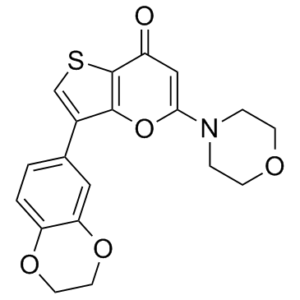
SF2523 (SF-2523; SF 2523) is a novel, selective and potent dual inhibitor of PI3K-BRD4 with potential anticancer activities. Its respective IC50 values for PI3K, PI3K, DNA-PK, BRD4, and mTOR are 34 nM, 158 nM, 9 nM, 241 nM, and 280 nM. BRD4 cannot bind to the MYCN promoter PS1/PS2 because of SF2523. It inhibits the M1-M2 transition and lowers p-AKT and N-MYC levels in a number of neuroblastoma cell lines. MYCN and Cyclin D1, the MYCN target, have lower protein levels after being treated with SF2523. It also prevents AKT activation by preventing Ser473-phosphorylation of AKT. In vitro and in vivo PI3K/BRD4 signaling is compromised by the dual-action inhibitor SF2523, which also provides the greatest MYC down-regulation. The simultaneous inhibition of PI3K and BRD4 prevents MYC expression and activation, encourages MYC degradation, and significantly reduces the growth and metastasis of cancer cells. The combination of these results points to the dual-activity inhibitor as a very promising lead compound for the creation of brand-new anticancer therapeutics.
Physicochemical Properties
| Molecular Formula | C19H17NO5S | |
| Molecular Weight | 371.4070 | |
| Exact Mass | 371.082 | |
| Elemental Analysis | C, 61.44; H, 4.61; N, 3.77; O, 21.54; S, 8.63 | |
| CAS # | 1174428-47-7 | |
| Related CAS # |
|
|
| PubChem CID | 44180156 | |
| Appearance | Red solid powder | |
| LogP | 2.9 | |
| Hydrogen Bond Donor Count | 0 | |
| Hydrogen Bond Acceptor Count | 7 | |
| Rotatable Bond Count | 2 | |
| Heavy Atom Count | 26 | |
| Complexity | 578 | |
| Defined Atom Stereocenter Count | 0 | |
| InChi Key | BYTKNUOMWLJVNQ-UHFFFAOYSA-N | |
| InChi Code | InChI=1S/C19H17NO5S/c21-14-10-17(20-3-5-22-6-4-20)25-18-13(11-26-19(14)18)12-1-2-15-16(9-12)24-8-7-23-15/h1-2,9-11H,3-8H2 | |
| Chemical Name | 3-(2,3-dihydro-1,4-benzodioxin-6-yl)-5-morpholin-4-ylthieno[3,2-b]pyran-7-one | |
| Synonyms |
|
|
| HS Tariff Code | 2934.99.9001 | |
| Storage |
Powder-20°C 3 years 4°C 2 years In solvent -80°C 6 months -20°C 1 month |
|
| Shipping Condition | Room temperature (This product is stable at ambient temperature for a few days during ordinary shipping and time spent in Customs) |
Biological Activity
| Targets |
PI3Kα (IC50 = 34 nM); PI3Kγ (IC50 = 158 nM); BRD4 (BD1) (IC50 = 241 nM); DNA-PK (IC50 = 9 nM); mTOR (IC50 = 280 nM)
SF2523 targets bromodomain-containing protein 4 (BRD4) (IC50 = 37 nM for BRD4 BD1; IC50 = 126 nM for BRD4 BD2) and cyclin-dependent kinase 9 (CDK9) (IC50 = 42 nM) [1] SF2523 targets BRD4 and CDK9 [2] SF2523 targets BRD4 (IC50 = 37 nM for BRD4 BD1) and CDK9 (IC50 = 42 nM) [3] |
| ln Vitro |
SF2523 blocks BRD4 binding to MYCN promoter PS1/PS2. It inhibits the M1-M2 transition and lowers p-AKT and N-MYC levels in a number of neuroblastoma cell lines. Treatment with SF2523 lowers the protein levels of MYCN and Cyclin D1, the MYCN target, and prevents AKT activation by preventing AKT's Ser473 phosphorylation. SF2523 interacts strongly with BRD4 in its entirety (Kd = 140 nM) and similarly with its first BD (BD1) (Kd = 150 nM), but it binds to BRD4's second BD (BD2) less strongly (Kd = 710 nM). According to a comparison of SF2523's binding affinities for other proteins' BDs, it binds to BDs of BRD4, BRD2, and BRD3 equally well, moderately to BDs of CECR2 and BRDT, but much weaker to other BDs[3]. 1. SF2523 potently inhibited BRD4 BD1/BD2 binding to acetylated histone H4 (H4K16ac) with IC50 values of 37 nM and 126 nM, respectively; it inhibited CDK9/cyclin T1 kinase activity with an IC50 of 42 nM, showing dual inhibitory activity against BRD4 and CDK9 [1] 2. SF2523 exhibited anti-proliferative activity in a panel of cancer cell lines (AML, MM, DLBCL, solid tumors) with IC50 values ranging from 0.1 μM to 1.2 μM; maximum growth inhibition (>90%) was observed in MV4-11 (AML) and RPMI-8226 (MM) cells at 1 μM [1] 3. Western blot analysis showed that SF2523 (0.1-1 μM) downregulated c-Myc, MCL-1, and XIAP protein expression in MV4-11 cells in a concentration-dependent manner; it also reduced phosphorylation of RNA polymerase II C-terminal domain (RNAPII CTD) at Ser2 (pSer2), a downstream target of CDK9 [1] 4. SF2523 induced apoptosis in MV4-11 cells (Annexin V/PI staining) with an EC50 of 0.3 μM; caspase-3/7 activity was increased by 3.5-fold at 1 μM compared with vehicle control [1] 5. In primary AML patient blasts, SF2523 (0.5 μM) inhibited cell viability by 65% and reduced c-Myc/MCL-1 expression; it showed minimal toxicity to normal bone marrow mononuclear cells (viability reduction <15% at 1 μM) [1] 6. SF2523 (0.1-1 μM) suppressed global transcription in MV4-11 cells, as measured by 5-ethynyluridine (EU) incorporation assay; transcription inhibition was correlated with BRD4/CDK9 dual inhibition [3] 7. SF2523 showed synergistic anti-proliferative activity when combined with venetoclax (BCL-2 inhibitor) in AML cell lines (CI < 0.8 at 0.1 μM SF2523 + 0.1 μM venetoclax) [2] |
| ln Vivo |
SF2523 blocks spontaneous metastasis and tumor growth. SF2523 has demonstrated animal efficacy results without toxicity in the following 4 animal models: orthotopic pancreatic model, multiple myeloma model, renal cell carcinoma model, neuroblastoma xenograft model[2]. In vivo, SF2523 targets PI3K- and BRD4-driven oncogenic pathways. In contrast to a combination of an equipotent PI3K inhibitor and a BRD4 inhibitor, SF2523 is less toxic to the host organism in vivo[3]. 1. In a MV4-11 AML xenograft mouse model (NOD/SCID mice), intraperitoneal administration of SF2523 (50 mg/kg once daily for 14 days) reduced tumor volume by 85% compared with vehicle control (p<0.001); tumor growth inhibition was accompanied by reduced c-Myc/MCL-1 expression and increased cleaved caspase-3 in tumor tissues [1] 2. SF2523 (50 mg/kg, i.p.) improved overall survival of MV4-11 xenograft mice (median survival: 42 days vs 28 days for vehicle, p<0.01) [1] 3. In a patient-derived xenograft (PDX) model of relapsed/refractory AML, SF2523 (50 mg/kg, i.p., qd × 14) reduced bone marrow blast count by 70% and downregulated c-Myc/MCL-1 expression in bone marrow samples [3] 4. SF2523 (50 mg/kg, i.p.) showed minimal weight loss (<5%) in xenograft mice, indicating low in vivo toxicity [1] 5. In a DLBCL xenograft model (OCI-LY10 cells), SF2523 (50 mg/kg, i.p., qd × 14) reduced tumor volume by 75% and prolonged median survival by 35% [2] |
| Enzyme Assay |
SF2523 is a novel, selective and potent dual inhibitor of PI3K-BRD4 with IC50s of 34 nM, 158 nM, 9 nM, 241 nM and 280 nM for PI3Kα, PI3Kγ, DNA-PK, BRD4 and mTOR, respectively. 1. AlphaLISA assays were performed to evaluate SF2523 inhibition of BRD4 BD1/BD2 binding to H4K16ac; recombinant BRD4 BD1/BD2 proteins were incubated with biotinylated H4K16ac peptide and SF2523 (0.01-10 μM) for 1 h at room temperature; AlphaLISA signal was measured to generate concentration-response curves and calculate IC50 values [1] 2. Kinase activity assays were conducted to measure SF2523 inhibition of CDK9/cyclin T1; recombinant CDK9/cyclin T1 was incubated with ATP (10 μM) and a fluorescent peptide substrate, and SF2523 (0.01-10 μM) was added to the reaction mixture; kinase activity was quantified by measuring fluorescence intensity of phosphorylated substrate, and IC50 values were calculated [1] 3. No detailed enzyme assay procedures for SF2523 were described in this literature [2] 4. Surface plasmon resonance (SPR) assays were used to confirm direct binding of SF2523 to BRD4 BD1; BRD4 BD1 protein was immobilized on a sensor chip, and SF2523 (0.1-10 μM) was injected over the chip; binding affinity (KD = 32 nM) was calculated from sensorgrams [3] |
| Cell Assay |
SKNBE2 cells are serum-starved for 4 h, stimulated with 50 ng/mL IGF, and treated with 1 μM JQ1, 5 μM SF2523, 10 μM SF1126, 1 μM BKM120, 1 μM BEZ235, or 200 nM CAL101 for 24 h. RT-PCR is then carried out after total RNA has been extracted from the harvested cells. 1. Cancer cell lines (MV4-11, RPMI-8226, OCI-LY10, HCT116) were cultured in standard medium and treated with SF2523 (0.01-10 μM) for 72 h; cell viability was measured by MTT assay to generate concentration-response curves and calculate anti-proliferative IC50 values [1] 2. MV4-11 cells were treated with SF2523 (0.1-1 μM) for 24 h; western blot analysis was performed to detect protein expression of c-Myc, MCL-1, XIAP, and pSer2-RNAPII CTD (β-actin as loading control); experiments were repeated 3 times, and band intensity was quantified by densitometry [1] 3. MV4-11 cells were treated with SF2523 (0.01-1 μM) for 48 h; apoptosis was assessed by Annexin V/PI staining and flow cytometry, and caspase-3/7 activity was measured using a fluorometric assay kit [1] 4. Primary AML patient blasts and normal bone marrow mononuclear cells were isolated and treated with SF2523 (0.1-1 μM) for 72 h; cell viability was measured by trypan blue exclusion assay, and c-Myc/MCL-1 expression was detected by western blot [1] 5. MV4-11 cells were treated with SF2523 (0.1-1 μM) for 6 h; global transcription was assessed by EU incorporation assay, and EU-positive cells were quantified by flow cytometry [3] 6. AML cell lines (MV4-11, MOLM-13) were treated with SF2523 (0.01-1 μM) alone or in combination with venetoclax (0.01-1 μM) for 72 h; combination index (CI) was calculated using the Chou-Talalay method to evaluate synergism [2] |
| Animal Protocol |
Nude mice (8-wk old, female, NSG) with xenografted tumor 50 mg/kg i.p. 1. MV4-11 AML xenograft model: NOD/SCID mice (6-8 weeks old) were subcutaneously inoculated with MV4-11 cells (1 × 10⁷ cells/mouse); when tumors reached 100 mm³, mice were randomized to receive SF2523 (50 mg/kg, i.p., once daily) or vehicle (10% DMSO/90% corn oil) for 14 days; tumor volume was measured every 2 days (volume = length × width²/2), and mice were euthanized at day 14 for tumor tissue collection [1] 2. PDX model of relapsed/refractory AML: NOD/SCID mice were intravenously injected with bone marrow blasts from AML patients (1 × 10⁶ cells/mouse); SF2523 (50 mg/kg, i.p., once daily for 14 days) was administered 7 days post-inoculation; bone marrow samples were collected at day 14 to quantify blast count by flow cytometry and detect c-Myc/MCL-1 expression by western blot [3] 3. DLBCL xenograft model: NOD/SCID mice were subcutaneously inoculated with OCI-LY10 cells (2 × 10⁷ cells/mouse); SF2523 (50 mg/kg, i.p., once daily for 14 days) was administered when tumors reached 100 mm³; tumor volume was measured every 2 days, and overall survival was recorded for 60 days [2] 4. For all xenograft experiments, body weight was measured every 2 days to assess in vivo toxicity; no significant weight loss (>10%) was observed in SF2523-treated mice [1] |
| ADME/Pharmacokinetics |
1. In CD-1 mice, intraperitoneal administration of SF2523 (50 mg/kg) resulted in a peak plasma concentration (Cmax) of 2.8 μM at 1 h post-administration, with a half-life (t1/2) of 4.2 h; oral bioavailability was 18% (Cmax = 0.5 μM, t1/2 = 3.8 h after oral dosing of 50 mg/kg) [1] 2. SF2523 showed moderate plasma protein binding (82% bound to mouse plasma proteins) [1] 3. In NOD/SCID mice, SF2523 (50 mg/kg, i.p.) achieved a peak tumor concentration of 3.1 μM at 2 h post-administration, with sustained concentrations (>0.5 μM) for 8 h [3] |
| Toxicity/Toxicokinetics |
1. In vitro, SF2523 showed minimal toxicity to normal bone marrow mononuclear cells (viability >85% at 1 μM) [1] 2. In xenograft mice, SF2523 (50 mg/kg, i.p., qd × 14) caused minimal weight loss (<5%) and no overt toxic symptoms (lethargy, diarrhea, organ damage); histopathological analysis of liver/kidney showed no significant lesions [1] 3. In PDX mice, SF2523 (50 mg/kg, i.p., qd × 14) did not affect peripheral blood cell counts (WBC, RBC, platelets) or liver/kidney function (ALT, AST, creatinine levels) [3] |
| References |
[1]. J. Med. Chem. 2016, 59, 20, 9305–9320 [2]. Cancer Res (2016) 76 (14_Supplement): LB-211. [3]. Proc Natl Acad Sci U S A . 2017 Feb 14;114(7):E1072-E1080. |
| Additional Infomation |
1. SF2523 is a novel dual inhibitor of BRD4 and CDK9, designed to target transcriptional addiction in cancer cells; BRD4 regulates epigenetic activation of oncogenes (e.g., c-Myc), while CDK9 controls transcriptional elongation via RNAPII phosphorylation [1] 2. Dual inhibition of BRD4 and CDK9 by SF2523 has a synergistic effect on suppressing oncogenic transcription, leading to downregulation of short-lived anti-apoptotic proteins (MCL-1, XIAP) and induction of apoptosis in cancer cells [1] 3. SF2523 shows selective activity against AML, MM, and DLBCL cells, with minimal toxicity to normal hematopoietic cells, making it a promising candidate for hematological malignancy treatment [2] 4. Combination of SF2523 with venetoclax enhances anti-leukemic activity in AML models, potentially overcoming venetoclax resistance mediated by MCL-1 upregulation [2] 5. SF2523 binds to the acetyl-lysine binding pocket of BRD4 BD1 and the ATP-binding pocket of CDK9, with no significant off-target inhibition of other bromodomains (BRD2, BRD3) or CDKs (CDK1, CDK2, CDK4) at concentrations up to 10 μM [3] |
Solubility Data
| Solubility (In Vitro) |
|
|||
| Solubility (In Vivo) |
Solubility in Formulation 1: ≥ 2.5 mg/mL (6.73 mM) (saturation unknown) in 10% DMSO + 40% PEG300 + 5% Tween80 + 45% Saline (add these co-solvents sequentially from left to right, and one by one), clear solution. For example, if 1 mL of working solution is to be prepared, you can add 100 μL of 25.0 mg/mL clear DMSO stock solution to 400 μL PEG300 and mix evenly; then add 50 μL Tween-80 to the above solution and mix evenly; then add 450 μL normal saline to adjust the volume to 1 mL. Preparation of saline: Dissolve 0.9 g of sodium chloride in 100 mL ddH₂ O to obtain a clear solution. Solubility in Formulation 2: ≥ 2.5 mg/mL (6.73 mM) (saturation unknown) in 10% DMSO + 90% (20% SBE-β-CD in Saline) (add these co-solvents sequentially from left to right, and one by one), clear solution. For example, if 1 mL of working solution is to be prepared, you can add 100 μL of 25.0 mg/mL clear DMSO stock solution to 900 μL of 20% SBE-β-CD physiological saline solution and mix evenly. Preparation of 20% SBE-β-CD in Saline (4°C,1 week): Dissolve 2 g SBE-β-CD in 10 mL saline to obtain a clear solution. (Please use freshly prepared in vivo formulations for optimal results.) |
| Preparing Stock Solutions | 1 mg | 5 mg | 10 mg | |
| 1 mM | 2.6924 mL | 13.4622 mL | 26.9244 mL | |
| 5 mM | 0.5385 mL | 2.6924 mL | 5.3849 mL | |
| 10 mM | 0.2692 mL | 1.3462 mL | 2.6924 mL |