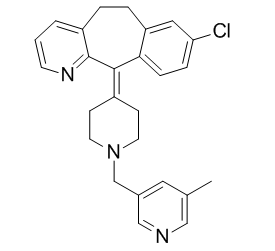
Rupatadine (also known as UR-12592) is a potent inhibitor of PAFR and histamine (H1) receptor with Ki of 550 nM and 102 nM, respectively. Rupatadine inhibits the effects of platelet-activating factor (PAF) and histamine (H1) by interacting with specific receptors. Rupatadine competitively suppresses histamine-induced guinea pig ileum contraction (pA2 = 9.29 ± 0.06) without affecting contraction induced by ACh, serotonin, or leukotriene D4 (LTD4). Additionally, it selectively prevents platelet aggregation caused by PAF in washed rabbit platelets (WRP) (pA2 = 6.68 ± 0.08) and in human platelet-rich plasma (HPRP) (IC50 = 0.68 μM), but not in platelet aggregation caused by arachidonic acid or ADP.
Physicochemical Properties
| Molecular Formula | C26H26CLN3 | |
| Molecular Weight | 415.96 | |
| Exact Mass | 415.181 | |
| Elemental Analysis | C, 75.08; H, 6.30; Cl, 8.52; N, 10.10 | |
| CAS # | 158876-82-5 | |
| Related CAS # | Rupatadine Fumarate; 182349-12-8; Rupatadine-d4 fumarate; 1795153-63-7 | |
| PubChem CID | 133017 | |
| Appearance | Solid powder | |
| Density | 1.2±0.1 g/cm3 | |
| Boiling Point | 586.4±50.0 °C at 760 mmHg | |
| Melting Point | 58-61ºC | |
| Flash Point | 308.4±30.1 °C | |
| Vapour Pressure | 0.0±1.6 mmHg at 25°C | |
| Index of Refraction | 1.646 | |
| LogP | 6.11 | |
| Hydrogen Bond Donor Count | 0 | |
| Hydrogen Bond Acceptor Count | 3 | |
| Rotatable Bond Count | 2 | |
| Heavy Atom Count | 30 | |
| Complexity | 609 | |
| Defined Atom Stereocenter Count | 0 | |
| SMILES | CC1=CN=CC(CN2CC/C(CC2)=C3C4=CC=C(Cl)C=C4CCC5=CC=CN=C5\3)=C1 |
|
| InChi Key | WUZYKBABMWJHDL-UHFFFAOYSA-N | |
| InChi Code | InChI=1S/C26H26ClN3/c1-18-13-19(16-28-15-18)17-30-11-8-20(9-12-30)25-24-7-6-23(27)14-22(24)5-4-21-3-2-10-29-26(21)25/h2-3,6-7,10,13-16H,4-5,8-9,11-12,17H2,1H3 | |
| Chemical Name | 13-chloro-2-[1-[(5-methylpyridin-3-yl)methyl]piperidin-4-ylidene]-4-azatricyclo[9.4.0.03,8]pentadeca-1(11),3(8),4,6,12,14-hexaene | |
| Synonyms |
|
|
| HS Tariff Code | 2934.99.9001 | |
| Storage |
Powder-20°C 3 years 4°C 2 years In solvent -80°C 6 months -20°C 1 month |
|
| Shipping Condition | Room temperature (This product is stable at ambient temperature for a few days during ordinary shipping and time spent in Customs) |
Biological Activity
| Targets | H1 Receptor ( Ki = 0.1 μM ); PAF ( Ki = 0.55 μM ) | ||
| ln Vitro |
|
||
| ln Vivo |
|
||
| Enzyme Assay | In 0.5 ml of 50 mM PBS, pH 7.5, antagonists are incubated for 30 minutes at 25 °C with guinea pig cerebellum membranes (0.6 mg/ml) and [3H]-pyrilamine (1.2 nM). The incubation is ended by the addition of 5 ml of ice-cold PBS containing 2 μM pyrilamine and the collection of membranes on Whatman GF/B filters. After being cleaned with 3 × 5 ml of ice-cold PBS and 2 μM pyrilamine, the filters are placed in counting vials. Using 3 ml of HiSafe 3, liquid scintillation counting is used to determine the amount of radioactivity retained by each filter. The determination of specific binding is based on the variation in the amount of [3H]-pyrilamine bound when unlabeled promethazine (10 μM) is present compared to when it is not. | ||
| Cell Assay | C18-PAF is used to induce platelet aggregation, which is then measured with a dual-channel aggregometer Chrono-log 560. Platelet aggregation is measured both with and without the test compounds (5-min incubation). The inhibitors' activity is represented by their IC50 values. Rupatadine is tested in WRP against other aggregating agents, such as arachidonic acid (1 mM) and ADP (5 μM), in order to determine its selectivity. Rupatadine is present at different concentrations (3 × 10⁻⁷–3 × 10⁻⁵ M) and in the absence to obtain dose-response curves for PAF-induced aggregation in WRP. | ||
| Animal Protocol |
|
||
| ADME/Pharmacokinetics |
Absorption, Distribution and Excretion Rupatidine is rapidly absorbed with a Tmax of 1 h. Administration with a high fat meal increases exposure by 23% and increases Tmax to 2 h. The apparent volume of distribution is 9799 L. Systemic clearance is 1556.2 L/h in young adults and 798.2 L/h in geriatric patients. Metabolism / Metabolites Rupatadine is metabolized by oxidation mediated primarily by CYP3A4. CYP2C9, CYP2C19, and CYP2D6 are also involved to a lesser extent. The metabolites desloratidine and hydroxylated forms of desloratidine retain some activity as H1 receptor antagonists. Rupatadine has known human metabolites that include Desloratadine. Biological Half-Life The half life of elimination is 15.9 h in children 2-5 years old, 12.3 h in children 6-11 years old, 5.9 h in adults, and 8.7 h in geriatric patients. |
||
| Toxicity/Toxicokinetics |
Protein Binding Rupatidine is 98.5-99.0% bound to human plasma proteins. |
||
| References |
[1]. Rupatadine, a new potent, orally active dual antagonist of histamine and platelet-activating factor (PAF). J Pharmacol Exp Ther. 1997 Jan;280(1):114-21. [2]. In vitro inhibitory effect of rupatadine on histamine and TNF-alpha release from dispersed canine skin mast cells and the human mast cell line HMC-1. Inflamm Res. 2000 Jul;49(7):355-60. [3]. Rupatadine protects against pulmonary fibrosis by attenuating PAF-mediated senescence in rodents. PLoS One. 2013 Jul 15;8(7):e68631. |
||
| Additional Infomation |
Rupatadine is a benzocycloheptapyridine. Rupatadine is a dual histamine H1 receptor and platelet activating factor receptor antagonist that is used for symptomatic relief in seasonal and perennial rhinitis as well as chronic spontaneous urticaria. It was approved for marketing in Canada under the tradename Rupall and comes in tablet formulation for adult use and liquid formulation for pediatric use. Drug Indication For the symptomatic relief of nasal and non-nasal symptoms of seasonal allergic rhinitis and perennial allergic rhinitis in patients 2 years of age and older. Also used for the symptomatic relief of chronic spontaneous urticaria in patients 2 years of age and older. FDA Label Mechanism of Action Rupatadine is a dual histamine H1 receptor and platelet activating (PAF) receptor antagonist. During allergic response mast cells undergo degranulation, releasing histamine and other substances. Histamine acts on H1 receptors to produce symptoms of nasal blockage, rhinorhea, itching, and swelling. PAF is produced from phospholipids cleaved by phospholipase A2. It acts to produce vascular leakage which contributes to rhinorhea and nasal blockage. By blocking both the H1 receptor and PAF receptor, rupatidine prevents these mediators from exerting their effects and so reduces the severity of allergic symptoms. |
Solubility Data
| Solubility (In Vitro) |
|
|||
| Solubility (In Vivo) |
|
| Preparing Stock Solutions | 1 mg | 5 mg | 10 mg | |
| 1 mM | 2.4041 mL | 12.0204 mL | 24.0408 mL | |
| 5 mM | 0.4808 mL | 2.4041 mL | 4.8082 mL | |
| 10 mM | 0.2404 mL | 1.2020 mL | 2.4041 mL |