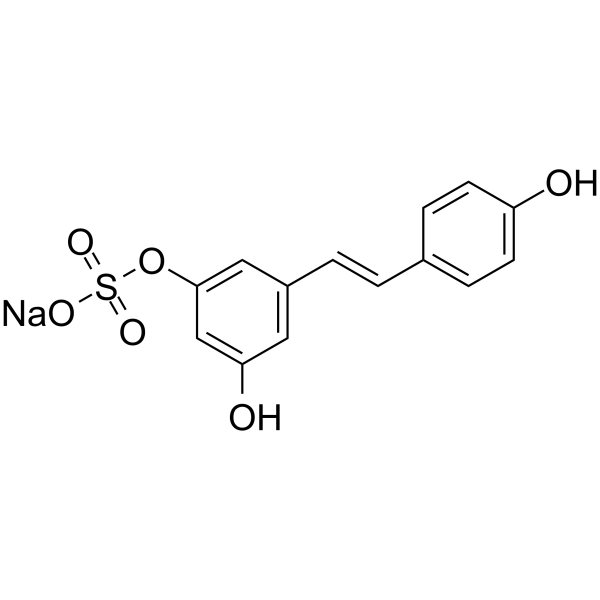
Physicochemical Properties
| Molecular Formula | C14H11NAO6S |
| Molecular Weight | 330.29 |
| Exact Mass | 330.017 |
| CAS # | 858127-11-4 |
| PubChem CID | 56665631 |
| Appearance | Typically exists as solid at room temperature |
| LogP | 3.968 |
| Hydrogen Bond Donor Count | 2 |
| Hydrogen Bond Acceptor Count | 6 |
| Rotatable Bond Count | 4 |
| Heavy Atom Count | 22 |
| Complexity | 452 |
| Defined Atom Stereocenter Count | 0 |
| SMILES | O(C1C=C(O)C=C(/C=C/C2C=CC(O)=CC=2)C=1)S(O)(=O)=O.[Na] |
| InChi Key | OWGXRCOCVOPKAM-TYYBGVCCSA-M |
| InChi Code | InChI=1S/C14H12O6S.Na/c15-12-5-3-10(4-6-12)1-2-11-7-13(16)9-14(8-11)20-21(17,18)19;/h1-9,15-16H,(H,17,18,19);/q;+1/p-1/b2-1+; |
| Chemical Name | sodium;[3-hydroxy-5-[(E)-2-(4-hydroxyphenyl)ethenyl]phenyl] sulfate |
| Synonyms | trans Resveratrol 3-Sulfate Sodium Salt; 858127-11-4; CHEMBL1823816; Resveratrol-3-O-sulfate (sodium); sodium;[3-hydroxy-5-[(E)-2-(4-hydroxyphenyl)ethenyl]phenyl] sulfate; Resveratrol-3-O-Sulfate (sodium salt); |
| HS Tariff Code | 2934.99.9001 |
| Storage |
Powder-20°C 3 years 4°C 2 years In solvent -80°C 6 months -20°C 1 month |
| Shipping Condition | Room temperature (This product is stable at ambient temperature for a few days during ordinary shipping and time spent in Customs) |
Biological Activity
| Targets | Resveratrol metabolite |
| ln Vivo | Resveratrol is a phytochemical with chemopreventive activity in preclinical rodent models of colorectal carcinogenesis. Antiproliferation is one of the many chemopreventive modes of action it has been shown to engage in. Concentrations of resveratrol, which can be achieved in human tissues after p.o. administration, have not yet been defined. The purpose of this study was to measure concentrations of resveratrol and its metabolites in the colorectal tissue of humans who ingested resveratrol. Twenty patients with histologically confirmed colorectal cancer consumed eight daily doses of resveratrol at 0.5 or 1.0 g before surgical resection. Resveratrol was found to be well tolerated. Normal and malignant biopsy tissue samples were obtained before dosing. Parent compound plus its metabolites resveratrol-3-O-glucuronide, resveratrol-4'-O-glucuronide, resveratrol-3-O-sulfate, resveratrol-4'-O-sulfate, resveratrol sulfate glucuronide, and resveratrol disulfate were identified by high-performance liquid chromatography (HPLC) with UV or mass spectrometric detection in colorectal resection tissue. Quantitation was achieved by HPLC/UV. Cell proliferation, as reflected by Ki-67 staining, was compared in preintervention and postintervention tissue samples. Resveratrol and resveratrol-3-O-glucuronide were recovered from tissues at maximal mean concentrations of 674 and 86.0 nmol/g, respectively. Levels of resveratrol and its metabolites were consistently higher in tissues originating in the right side of the colon compared with the left. Consumption of resveratrol reduced tumor cell proliferation by 5% (P = 0.05). The results suggest that daily p.o. doses of resveratrol at 0.5 or 1.0 g produce levels in the human gastrointestinal tract of an order of magnitude sufficient to elicit anticarcinogenic effects. Resveratrol merits further clinical evaluation as a potential colorectal cancer chemopreventive agent.[1] |
| References | [1]. Patel KR, et al. Clinical pharmacology of resveratrol and its metabolites in colorectal cancer patients. Cancer Res. 2010;70(19):7392-7399. |
Solubility Data
| Solubility (In Vitro) | May dissolve in DMSO (in most cases), if not, try other solvents such as H2O, Ethanol, or DMF with a minute amount of products to avoid loss of samples |
| Solubility (In Vivo) |
Note: Listed below are some common formulations that may be used to formulate products with low water solubility (e.g. < 1 mg/mL), you may test these formulations using a minute amount of products to avoid loss of samples. Injection Formulations (e.g. IP/IV/IM/SC) Injection Formulation 1: DMSO : Tween 80: Saline = 10 : 5 : 85 (i.e. 100 μL DMSO stock solution → 50 μL Tween 80 → 850 μL Saline) *Preparation of saline: Dissolve 0.9 g of sodium chloride in 100 mL ddH ₂ O to obtain a clear solution. Injection Formulation 2: DMSO : PEG300 :Tween 80 : Saline = 10 : 40 : 5 : 45 (i.e. 100 μL DMSO → 400 μLPEG300 → 50 μL Tween 80 → 450 μL Saline) Injection Formulation 3: DMSO : Corn oil = 10 : 90 (i.e. 100 μL DMSO → 900 μL Corn oil) Example: Take the Injection Formulation 3 (DMSO : Corn oil = 10 : 90) as an example, if 1 mL of 2.5 mg/mL working solution is to be prepared, you can take 100 μL 25 mg/mL DMSO stock solution and add to 900 μL corn oil, mix well to obtain a clear or suspension solution (2.5 mg/mL, ready for use in animals). Injection Formulation 4: DMSO : 20% SBE-β-CD in saline = 10 : 90 [i.e. 100 μL DMSO → 900 μL (20% SBE-β-CD in saline)] *Preparation of 20% SBE-β-CD in Saline (4°C,1 week): Dissolve 2 g SBE-β-CD in 10 mL saline to obtain a clear solution. Injection Formulation 5: 2-Hydroxypropyl-β-cyclodextrin : Saline = 50 : 50 (i.e. 500 μL 2-Hydroxypropyl-β-cyclodextrin → 500 μL Saline) Injection Formulation 6: DMSO : PEG300 : castor oil : Saline = 5 : 10 : 20 : 65 (i.e. 50 μL DMSO → 100 μLPEG300 → 200 μL castor oil → 650 μL Saline) Injection Formulation 7: Ethanol : Cremophor : Saline = 10: 10 : 80 (i.e. 100 μL Ethanol → 100 μL Cremophor → 800 μL Saline) Injection Formulation 8: Dissolve in Cremophor/Ethanol (50 : 50), then diluted by Saline Injection Formulation 9: EtOH : Corn oil = 10 : 90 (i.e. 100 μL EtOH → 900 μL Corn oil) Injection Formulation 10: EtOH : PEG300:Tween 80 : Saline = 10 : 40 : 5 : 45 (i.e. 100 μL EtOH → 400 μLPEG300 → 50 μL Tween 80 → 450 μL Saline) Oral Formulations Oral Formulation 1: Suspend in 0.5% CMC Na (carboxymethylcellulose sodium) Oral Formulation 2: Suspend in 0.5% Carboxymethyl cellulose Example: Take the Oral Formulation 1 (Suspend in 0.5% CMC Na) as an example, if 100 mL of 2.5 mg/mL working solution is to be prepared, you can first prepare 0.5% CMC Na solution by measuring 0.5 g CMC Na and dissolve it in 100 mL ddH2O to obtain a clear solution; then add 250 mg of the product to 100 mL 0.5% CMC Na solution, to make the suspension solution (2.5 mg/mL, ready for use in animals). Oral Formulation 3: Dissolved in PEG400 Oral Formulation 4: Suspend in 0.2% Carboxymethyl cellulose Oral Formulation 5: Dissolve in 0.25% Tween 80 and 0.5% Carboxymethyl cellulose Oral Formulation 6: Mixing with food powders Note: Please be aware that the above formulations are for reference only. InvivoChem strongly recommends customers to read literature methods/protocols carefully before determining which formulation you should use for in vivo studies, as different compounds have different solubility properties and have to be formulated differently. (Please use freshly prepared in vivo formulations for optimal results.) |
| Preparing Stock Solutions | 1 mg | 5 mg | 10 mg | |
| 1 mM | 3.0276 mL | 15.1382 mL | 30.2764 mL | |
| 5 mM | 0.6055 mL | 3.0276 mL | 6.0553 mL | |
| 10 mM | 0.3028 mL | 1.5138 mL | 3.0276 mL |