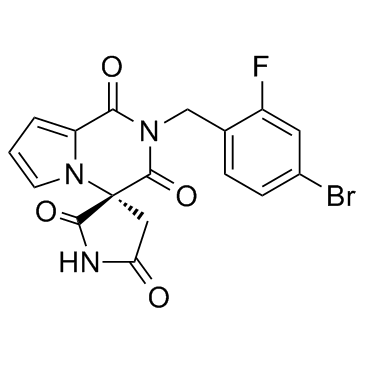
Ranirestat (AS-3201; SX-3201) is a novel, oral and potent aldose reductase inhibitor with the potential for the treatment of diabetic neuropathy. It inhibits aldose reductase (AR) with IC50s of 11 nM and 15 nM for rat lens AR and recombinant human AR, respectively, and a Ki of 0.38 nM for recombinant human AR. Ranirestat also has a neuroprotective effect on diabetic retinas. Aldose reductase is an enzyme that catalyzes one of the steps in sorbitol (polyol) pathway which is responsible for formation of fructose from glucose. Aldose reductase activity is increased, parallel to glucose blood levels, in tissues that are not insulin sensitive, including lenses, peripheral nerves and renal glomeruli. Sorbitol does not diffuse through cell membranes easily and therefore accumulates in these tissues, causing osmotic damage, leading to retinopathy and neuropathy.
Physicochemical Properties
| Molecular Formula | C17H11BRFN3O4 |
| Molecular Weight | 420.1944 |
| Exact Mass | 418.992 |
| CAS # | 147254-64-6 |
| PubChem CID | 153948 |
| Appearance | Off-white to pink solid powder |
| Density | 1.83g/cm3 |
| Boiling Point | 702.7ºC at 760mmHg |
| Flash Point | 378.8ºC |
| Vapour Pressure | 1.36E-19mmHg at 25°C |
| Index of Refraction | 1.749 |
| LogP | 1.527 |
| Hydrogen Bond Donor Count | 1 |
| Hydrogen Bond Acceptor Count | 5 |
| Rotatable Bond Count | 2 |
| Heavy Atom Count | 26 |
| Complexity | 689 |
| Defined Atom Stereocenter Count | 1 |
| SMILES | C1C(=O)NC(=O)[C@@]12C(=O)N(C(=O)C3=CC=CN23)CC4=C(C=C(C=C4)Br)F |
| InChi Key | QCVNMNYRNIMDKV-QGZVFWFLSA-N |
| InChi Code | InChI=1S/C17H11BrFN3O4/c18-10-4-3-9(11(19)6-10)8-21-14(24)12-2-1-5-22(12)17(16(21)26)7-13(23)20-15(17)25/h1-6H,7-8H2,(H,20,23,25)/t17-/m1/s1 |
| Chemical Name | (R)-2'-(4-bromo-2-fluorobenzyl)-1'H-spiro[pyrrolidine-3,4'-pyrrolo[1,2-a]pyrazine]-1',2,3',5(2'H)-tetraone |
| Synonyms | AS-3201 SX-3201AS3201 SX3201AS 3201 SX 3201 Ranirestat. |
| HS Tariff Code | 2934.99.9001 |
| Storage |
Powder-20°C 3 years 4°C 2 years In solvent -80°C 6 months -20°C 1 month |
| Shipping Condition | Room temperature (This product is stable at ambient temperature for a few days during ordinary shipping and time spent in Customs) |
Biological Activity
| ln Vitro | When large doses (500 mg/dl) of glucose are added to rat erythrocytes and sciatic nerves, ranirestat concentration-dependently prevents sorbitol formation. With IC50 values of 0.010 μM and 0.041 μM, respectively, ranirestat has a similar inhibitory impact on sorbitol buildup in rat erythrocytes and sciatic nerve [1]. |
| ln Vivo | In male STD-Wistar rats, ranirestat (0.03-1.0 mg/kg; oral; once daily; for three weeks) lowers high levels of fructose and sorbitol in the sciatic nerves of rats in a dose-dependent manner without changing blood glucose levels. Additionally, ranirestat dose-dependently reduces the reductions in motor nerve conduction velocity (MNCV) brought on by STZ [1]. |
| Animal Protocol |
Animal/Disease Models: Male STD-Wistar rats (12 weeks old; 260-290 g) were injected with streptozotocin (STZ) [1] Doses: 0.03 mg/kg, 0.1 mg/kg, 0.3 mg/kg, 1 mg /kg Route of Administration: Oral; one time/day; for 3 weeks Experimental Results: Dose-dependently diminished elevated sorbitol and fructose levels in rat sciatic nerve without affecting blood glucose levels. |
| References |
[1]. Improvement of motor nerve conduction velocity in diabetic rats requires normalization of the polyol pathway metabolites flux. J Pharmacol Sci. 2009 Feb;109(2):203-10. [2]. Effect of ranirestat, a new aldose reductase inhibitor, on diabetic retinopathy in SDT rats. J Diabetes Res. 2014;2014:672590. |
| Additional Infomation |
Ranirestat is a structurally novel and stereospecifically potent aldose reductase (AKR1B; EC 1.1.1.21) inhibitor, which contains a succinimide ring that undergoes ring-opening at physiological pH levels. It has been used in trials studying the treatment of Mild to Moderate Diabetic Sensorimotor Polyneuropathy. Drug Indication Investigated for use/treatment in neuropathy (diabetic). Mechanism of Action Ranirestat alleviates diabetic neuropathy, a complication of diabetes, by inhibiting aldose reductase and thereby inhibiting the accumulation of intracellular sorbitol that causes diabetic neuropathy. This drug has a stronger inhibitory effect and is longer acting compared to other drugs in this therapeutic area. Ranirestat showed good penetration into the nerve tissue, resulting in dose-dependent inhibition of intraneural accumulation of sorbitol and fructose in a clinical study. |
Solubility Data
| Solubility (In Vitro) | DMSO : ≥ 50 mg/mL (~118.99 mM) |
| Solubility (In Vivo) |
Solubility in Formulation 1: ≥ 2.5 mg/mL (5.95 mM) (saturation unknown) in 10% DMSO + 40% PEG300 + 5% Tween80 + 45% Saline (add these co-solvents sequentially from left to right, and one by one), clear solution. For example, if 1 mL of working solution is to be prepared, you can add 100 μL of 25.0 mg/mL clear DMSO stock solution to 400 μL PEG300 and mix evenly; then add 50 μL Tween-80 to the above solution and mix evenly; then add 450 μL normal saline to adjust the volume to 1 mL. Preparation of saline: Dissolve 0.9 g of sodium chloride in 100 mL ddH₂ O to obtain a clear solution. Solubility in Formulation 2: ≥ 2.5 mg/mL (5.95 mM) (saturation unknown) in 10% DMSO + 90% (20% SBE-β-CD in Saline) (add these co-solvents sequentially from left to right, and one by one), clear solution. For example, if 1 mL of working solution is to be prepared, you can add 100 μL of 25.0 mg/mL clear DMSO stock solution to 900 μL of 20% SBE-β-CD physiological saline solution and mix evenly. Preparation of 20% SBE-β-CD in Saline (4°C,1 week): Dissolve 2 g SBE-β-CD in 10 mL saline to obtain a clear solution. Solubility in Formulation 3: ≥ 2.5 mg/mL (5.95 mM) (saturation unknown) in 10% DMSO + 90% Corn Oil (add these co-solvents sequentially from left to right, and one by one), clear solution. For example, if 1 mL of working solution is to be prepared, you can add 100 μL of 25.0 mg/mL clear DMSO stock solution to 900 μL of corn oil and mix evenly. (Please use freshly prepared in vivo formulations for optimal results.) |
| Preparing Stock Solutions | 1 mg | 5 mg | 10 mg | |
| 1 mM | 2.3799 mL | 11.8994 mL | 23.7988 mL | |
| 5 mM | 0.4760 mL | 2.3799 mL | 4.7598 mL | |
| 10 mM | 0.2380 mL | 1.1899 mL | 2.3799 mL |