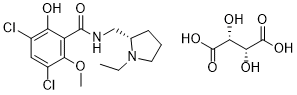
Raclopride (formerly also known as FLA 870) is a novel, potent and selective dopamine D2/D3 receptor antagonist, which binds to D2 and D3 receptors with dissociation constants (Kis) of 1.8 nM and 3.5 nM, respectively, but has a very low affinity for D1 and D4 receptors with Kis of 18000 nM and 2400 nM, respectively. Raclopride's corresponding Ki-values for D2, D3, D4, and D1 receptors are 1.8, 3.5, 2400, and 18000 nM, respectively, indicating its selectivity to the cerebral D2 receptors. It can be radiolabelled using radioisotopes such as 3H or 11C and used as a tracer for positron emission tomography (PET) and in vitro imaging (autoradiography). The non-invasive evaluation of the cerebral D2 dopamine receptor's binding capacity is made possible by images acquired through cerebral PET scanning (e.g., PET/CT or PET/MRI), which can be helpful in the diagnosis of movement disorders.
Physicochemical Properties
| Molecular Formula | C19H26CL2N2O9 |
| Molecular Weight | 497.32374 |
| Exact Mass | 496.102 |
| Elemental Analysis | C, 45.89; H, 5.27; Cl, 14.26; N, 5.63; O, 28.95 |
| CAS # | 98185-20-7 |
| Related CAS # | Raclopride; 84225-95-6 |
| PubChem CID | 16219926 |
| Appearance | Solid powder |
| LogP | 1.127 |
| Hydrogen Bond Donor Count | 6 |
| Hydrogen Bond Acceptor Count | 10 |
| Rotatable Bond Count | 8 |
| Heavy Atom Count | 32 |
| Complexity | 520 |
| Defined Atom Stereocenter Count | 3 |
| SMILES | CC[NH+]1CCC[C@H]1CNC(=O)c2c(c(cc(c2OC)Cl)Cl)O.[C@@H]([C@H](C(=O)[O-])O)(C(=O)O)O |
| InChi Key | QULBVRZTKPQGCR-NDAAPVSOSA-N |
| InChi Code | InChI=1S/C15H20Cl2N2O3.C4H6O6/c1-3-19-6-4-5-9(19)8-18-15(21)12-13(20)10(16)7-11(17)14(12)22-2;5-1(3(7)8)2(6)4(9)10/h7,9,20H,3-6,8H2,1-2H3,(H,18,21);1-2,5-6H,(H,7,8)(H,9,10)/t9-;1-,2-/m01/s1 |
| Chemical Name | 3,5-dichloro-N-[[(2S)-1-ethylpyrrolidin-2-yl]methyl]-2-hydroxy-6-methoxybenzamide;(2R,3R)-2,3-dihydroxybutanedioic acid |
| Synonyms | Raclopride; FLA-870; FLA870; Raclopride tartrate; 98185-20-7; EXZ5FGZ55J; Raclopride (tartrate); UNII-EXZ5FGZ55J; 98185-20-7 (tartrate); (S)-3,5-dichloro-N-((1-ethylpyrrolidin-2-yl)methyl)-2-hydroxy-6-methoxybenzamide (2R,3R)-2,3-dihydroxysuccinate; (S)-(-)-3,5-Dichloro-N-((1-ethyl-2-pyrrolidinyl)methyl)-6-methoxysalicylamide L-(+)-tartrate; FLA 870; Raclopride tartrate |
| HS Tariff Code | 2934.99.9001 |
| Storage |
Powder-20°C 3 years 4°C 2 years In solvent -80°C 6 months -20°C 1 month |
| Shipping Condition | Room temperature (This product is stable at ambient temperature for a few days during ordinary shipping and time spent in Customs) |
Biological Activity
| Targets | D2 Receptor ( Ki = 1.8 nM ); D3 Receptor ( Ki = 3.5 nM ); D4 Receptor ( Ki = 2400 nM )); D1 Receptor ( Ki = 18000 nM ) |
| ln Vivo |
Raclopride tartrate (0.1, 0.3, or 0.6 mg/kg; IP; 30 min; albino male mice; OF1 strain) dramatically shortens the amount of time that the mice spend engaging in aggressive behavior[2]. Raclopride is a substituted benzamide with high selectivity as an antagonist of central dopaminergic D2 receptors and potential antipsychotic effects. In comparison with a classic DA receptor blocking agent like haloperidol, raclopride displays an atypical profile in preclinical tests for extrapyramidal side effects. Antiaggressive properties of raclopride on agonistic behavior have not yet been fully explored. In this work the effects of raclopride (0.1, 0.3, or 0.6 mg/kg) on aggressive and motor behaviors in male mice were studied. Aggression tests were performed 30 min after injections. Encounters were videotaped and behavior was evaluated, measuring the time spent in 11 broad categories of behavior. The results show a clear antiaggressive effect of raclopride, with very little motor impairment and some increase in exploratory behavior. This behavioral profile is very similar to the one observed with other atypical neuroleptics and differs somewhat from that found in the classic compounds.[2] |
| References |
[1]. Dopamine receptor pharmacology. Trends Pharmacol Sci. 1994;15(7):264-270. [2]. Behavioral profile of raclopride in agonistic encounters between male mice. Pharmacol Biochem Behav. 1994;47(3):753-756. |
| Additional Infomation |
3,5-dichloro-N-[[(2S)-1-ethyl-2-pyrrolidinyl]methyl]-2-hydroxy-6-methoxybenzamide is a member of salicylamides. Raclopride has been used in trials studying Parkinson Disease. A substituted benzamide that has antipsychotic properties. It is a dopamine D2 receptor (see RECEPTORS, DOPAMINE D2) antagonist. Dopamine receptors are the primary targets in the treatment of schizophrenia, Parkinson's disease, and Huntington's chorea, and are discussed in this review by Philip Seeman and Hubert Van Tol. Improved therapy may be obtained by drugs that selectively target a particular subtype of dopamine receptor. Most antipsychotic drugs block D2 receptors in direct correlation to clinical potency, except clozapine, which prefers D4 receptors. D1 and D2 receptors can enhance each other's actions, possibly through subunits of the G proteins. In schizophrenia, the D2 and D3 receptor density is elevated by 10%, while the D4 receptor density is elevated by 600%. Therefore, D4 receptors may be a target for future antipsychotic drugs. While antipsychotics originally helped to discover dopamine receptors, the five cloned dopamine receptors are now facilitating the discovery of selective antipsychotic and antiparkinson drugs. Antipsychotic Agents Agents that control agitated psychotic behavior, alleviate acute psychotic states, reduce psychotic symptoms, and exert a quieting effect. They are used in SCHIZOPHRENIA; senile dementia; transient psychosis following surgery; or MYOCARDIAL INFARCTION; etc. These drugs are often referred to as neuroleptics alluding to the tendency to produce neurological side effects, but not all antipsychotics are likely to produce such effects. Many of these drugs may also be effective against nausea, emesis, and pruritus. (See all compounds classified as Antipsychotic Agents.) Dopamine Antagonists Drugs that bind to but do not activate DOPAMINE RECEPTORS, thereby blocking the actions of dopamine or exogenous agonists. Many drugs used in the treatment of psychotic disorders (ANTIPSYCHOTIC AGENTS) are dopamine antagonists, although their therapeutic effects may be due to long-term adjustments of the brain rather than to the acute effects of blocking dopamine receptors. Dopamine antagonists have been used for several other clinical purposes including as ANTIEMETICS, in the treatment of Tourette syndrome, and for hiccup. Dopamine receptor blockade is associated with NEUROLEPTIC MALIGNANT SYNDROME. |
Solubility Data
| Solubility (In Vitro) |
DMSO: ~100 mg/mL (~288 mM) H2O: ~0.1 mg/mL (~0.3 mM) |
| Solubility (In Vivo) |
Note: Listed below are some common formulations that may be used to formulate products with low water solubility (e.g. < 1 mg/mL), you may test these formulations using a minute amount of products to avoid loss of samples. Injection Formulations (e.g. IP/IV/IM/SC) Injection Formulation 1: DMSO : Tween 80: Saline = 10 : 5 : 85 (i.e. 100 μL DMSO stock solution → 50 μL Tween 80 → 850 μL Saline) *Preparation of saline: Dissolve 0.9 g of sodium chloride in 100 mL ddH ₂ O to obtain a clear solution. Injection Formulation 2: DMSO : PEG300 :Tween 80 : Saline = 10 : 40 : 5 : 45 (i.e. 100 μL DMSO → 400 μLPEG300 → 50 μL Tween 80 → 450 μL Saline) Injection Formulation 3: DMSO : Corn oil = 10 : 90 (i.e. 100 μL DMSO → 900 μL Corn oil) Example: Take the Injection Formulation 3 (DMSO : Corn oil = 10 : 90) as an example, if 1 mL of 2.5 mg/mL working solution is to be prepared, you can take 100 μL 25 mg/mL DMSO stock solution and add to 900 μL corn oil, mix well to obtain a clear or suspension solution (2.5 mg/mL, ready for use in animals). Injection Formulation 4: DMSO : 20% SBE-β-CD in saline = 10 : 90 [i.e. 100 μL DMSO → 900 μL (20% SBE-β-CD in saline)] *Preparation of 20% SBE-β-CD in Saline (4°C,1 week): Dissolve 2 g SBE-β-CD in 10 mL saline to obtain a clear solution. Injection Formulation 5: 2-Hydroxypropyl-β-cyclodextrin : Saline = 50 : 50 (i.e. 500 μL 2-Hydroxypropyl-β-cyclodextrin → 500 μL Saline) Injection Formulation 6: DMSO : PEG300 : castor oil : Saline = 5 : 10 : 20 : 65 (i.e. 50 μL DMSO → 100 μLPEG300 → 200 μL castor oil → 650 μL Saline) Injection Formulation 7: Ethanol : Cremophor : Saline = 10: 10 : 80 (i.e. 100 μL Ethanol → 100 μL Cremophor → 800 μL Saline) Injection Formulation 8: Dissolve in Cremophor/Ethanol (50 : 50), then diluted by Saline Injection Formulation 9: EtOH : Corn oil = 10 : 90 (i.e. 100 μL EtOH → 900 μL Corn oil) Injection Formulation 10: EtOH : PEG300:Tween 80 : Saline = 10 : 40 : 5 : 45 (i.e. 100 μL EtOH → 400 μLPEG300 → 50 μL Tween 80 → 450 μL Saline) Oral Formulations Oral Formulation 1: Suspend in 0.5% CMC Na (carboxymethylcellulose sodium) Oral Formulation 2: Suspend in 0.5% Carboxymethyl cellulose Example: Take the Oral Formulation 1 (Suspend in 0.5% CMC Na) as an example, if 100 mL of 2.5 mg/mL working solution is to be prepared, you can first prepare 0.5% CMC Na solution by measuring 0.5 g CMC Na and dissolve it in 100 mL ddH2O to obtain a clear solution; then add 250 mg of the product to 100 mL 0.5% CMC Na solution, to make the suspension solution (2.5 mg/mL, ready for use in animals). Oral Formulation 3: Dissolved in PEG400 Oral Formulation 4: Suspend in 0.2% Carboxymethyl cellulose Oral Formulation 5: Dissolve in 0.25% Tween 80 and 0.5% Carboxymethyl cellulose Oral Formulation 6: Mixing with food powders Note: Please be aware that the above formulations are for reference only. InvivoChem strongly recommends customers to read literature methods/protocols carefully before determining which formulation you should use for in vivo studies, as different compounds have different solubility properties and have to be formulated differently. (Please use freshly prepared in vivo formulations for optimal results.) |
| Preparing Stock Solutions | 1 mg | 5 mg | 10 mg | |
| 1 mM | 2.0108 mL | 10.0539 mL | 20.1078 mL | |
| 5 mM | 0.4022 mL | 2.0108 mL | 4.0216 mL | |
| 10 mM | 0.2011 mL | 1.0054 mL | 2.0108 mL |