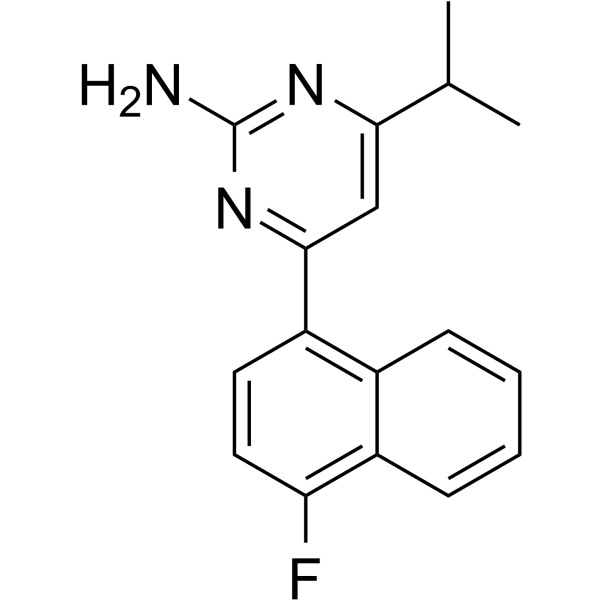
Physicochemical Properties
| Molecular Formula | C17H16N3F.HCL |
| Molecular Weight | 317.78838 |
| Exact Mass | 317.11 |
| CAS # | 199864-86-3 |
| Related CAS # | RS-127445;199864-87-4 |
| PubChem CID | 9905058 |
| Appearance | Off-white to light yellow solid powder |
| LogP | 5.524 |
| Hydrogen Bond Donor Count | 2 |
| Hydrogen Bond Acceptor Count | 4 |
| Rotatable Bond Count | 2 |
| Heavy Atom Count | 22 |
| Complexity | 349 |
| Defined Atom Stereocenter Count | 0 |
| InChi Key | MKJPYBJBPRFMHL-UHFFFAOYSA-N |
| InChi Code | InChI=1S/C17H16FN3.ClH/c1-10(2)15-9-16(21-17(19)20-15)13-7-8-14(18)12-6-4-3-5-11(12)13;/h3-10H,1-2H3,(H2,19,20,21);1H |
| Chemical Name | 4-(4-fluoronaphthalen-1-yl)-6-propan-2-ylpyrimidin-2-amine;hydrochloride |
| HS Tariff Code | 2934.99.9001 |
| Storage |
Powder-20°C 3 years 4°C 2 years In solvent -80°C 6 months -20°C 1 month Note: Please store this product in a sealed and protected environment, avoid exposure to moisture. |
| Shipping Condition | Room temperature (This product is stable at ambient temperature for a few days during ordinary shipping and time spent in Customs) |
Biological Activity
| Targets |
5-hydroxytryptamine 2B receptor (5-HT₂B receptor) (human 5-HT₂B: Ki = 0.7 nM; rat 5-HT₂B: Ki = 1.2 nM; functional IC₅₀ = 3.5 nM in IP₁ accumulation assay) [1] 5-hydroxytryptamine 2A receptor (5-HT₂A receptor) (Ki = 140 nM, selectivity > 200-fold vs 5-HT₂B) [1] 5-hydroxytryptamine 2C receptor (5-HT₂C receptor) (Ki = 86 nM, selectivity > 120-fold vs 5-HT₂B) [1] Other GPCRs (α₁-adrenoceptor, D₂ dopamine receptor, H₁ histamine receptor: Ki > 10,000 nM) [1] |
| ln Vitro |
RS-127445 was discovered to be 1,000 times more selective for the 5-HT2B receptor than many other receptor and ion channel binding sites, with a nanomolar affinity for this receptor (pKi=9.5±0.1). When the human recombinant 5-HT2B receptor is expressed in CHO-K1 cells, RS-127445 effectively replaces [3H]-5-HT. For the 5-HT2B receptor, RS-127445 has an affinity (pKi value) of 9.5±0.1 (n=9). While having affinity for human recombinant 5-HT2A, 5-HT2C, 5-HT5, 5-HT6, and 5-HT7 receptors, RS-127445 is selective for 5-HT2B receptors (5-HT1A receptor in rat) The amount of 5-HT1B/D receptors in the meninges, the caudate nucleus of cows, and the monoamine absorption sites in rabbit platelets has been reduced by almost 1000 times. Strong inhibition of 5-HT (10 nM) by RS-127445 resulted in an elevation of intracellular calcium concentration in HEK-293 cells expressing 5-HT2B receptors (pIC50 of 10.4±0.1). RS-127445 efficiently inhibited the production of phosphoinositides (pKB=9.5±0.1) and a rise in intracellular calcium (pIC10=10.4±0.1) generated by 5-HT in cells expressing human recombinant 5-HT2B receptor. Additionally, RS-127445 prevents (±)α-methyl-5-HT-mediated rat jugular vein relaxation (pA2=9.9±0.3) and 5-HT-induced rat gastric fundus contraction in vitro (pA2B=9.5±1.1)[1]. RS 127445 is a highly selective and high-affinity antagonist of the 5-HT₂B receptor, with minimal cross-reactivity to other 5-HT receptor subtypes and GPCRs. [1] In [³H]-5-HT competitive binding assays using membranes from cells expressing human 5-HT₂B receptor, RS 127445 exhibited a Ki value of 0.7 nM; for rat 5-HT₂B receptor, the Ki value was 1.2 nM, indicating species-consistent high binding affinity. [1] In functional IP₁ accumulation assays (measuring Gq-mediated signaling) in 5-HT₂B receptor-transfected cells, RS 127445 dose-dependently inhibited 5-HT-induced IP₁ production with an IC₅₀ of 3.5 nM, confirming potent functional antagonism. [1] It showed high subtype selectivity: Ki values for 5-HT₂A (140 nM) and 5-HT₂C (86 nM) receptors were >120-200-fold higher than for 5-HT₂B, and no significant binding affinity was detected for α₁-adrenoceptors, D₂ dopamine receptors, or H₁ histamine receptors (Ki > 10,000 nM). [1] RS 127445 did not alter basal IP₁ levels or affect signaling via non-target GPCRs (e.g., 5-HT₁A, β-adrenoceptors) at concentrations up to 10 μM. [1] |
| ln Vivo |
RS-127445 was 14% and 60% more bioavailable in rats when administered orally compared to when administered intraperitoneally. It is anticipated that plasma concentrations from the intraperitoneal injection of RS-127445 (5 mg/kg) will fully saturate accessible 5-HT2B receptors for a minimum of 4 hours. Oral, intraperitoneal, and intravenous administration of RS-127445 (5 mg/kg) were used on rats. The first time point assessed following intravenous and intraperitoneal treatment (0.08 hours) and the 0.25 hours following oral administration are when plasma concentrations peak the fastest. The predicted final elimination half-life of RS-127445 is 1.7 hours, after which it is removed from plasma. About 14% and 62% of RS-127445's bioavailability when given intravenously is achieved when given orally and intraperitoneally, respectively. In terms of bioavailability, RS-127445 (5 mg/kg) is 14% oral and 60% intraperitoneal [1]. Significant reductions in fecal production were observed with RS-127445 (1-30 mg/kg) at doses of 10 and 30 mg/kg (n=6-11). RS-127445 is >98% protein-bound in the blood and brain [2]. In male Wistar rats, oral administration of RS 127445 (1, 3, 10 mg/kg) dose-dependently inhibited colonic motility and defecation: At 10 mg/kg, the number of fecal pellets excreted in 24 hours was reduced by 58% compared to vehicle control, and colonic transit time (assessed by charcoal meal) was prolonged by 42%. [2] In vitro colon muscle strip assays from treated rats showed that RS 127445 (10 mg/kg p.o.) inhibited 5-HT-induced contraction of colonic longitudinal muscle by 63%, confirming direct modulation of colonic smooth muscle via 5-HT₂B receptor blockade. [2] Oral administration of RS 127445 (3 mg/kg) in mice reduced spontaneous defecation frequency by 35% and attenuated castor oil-induced diarrhea (fecal output reduced by 47%), without affecting small intestinal transit. [2] In pharmacokinetic studies in rats, oral RS 127445 (10 mg/kg) achieved a peak plasma concentration (Cmax) of 89 ng/mL at 1 hour (Tmax), with a bioavailability of 65% and an elimination half-life (t₁/₂) of 4.2 hours. [1] |
| Enzyme Assay |
[³H]-5-HT competitive binding assay for 5-HT₂B receptor affinity: Membranes from cells stably expressing human/rat 5-HT₂B (or other 5-HT subtypes/GPCRs) were incubated with a fixed concentration of [³H]-5-HT and serial dilutions of RS 127445 at 25°C for 90 minutes. Bound and free radioligands were separated by vacuum filtration through glass fiber filters, and the radioactivity of the bound fraction was measured. Ki values were calculated using competitive binding analysis software to assess affinity and selectivity. [1] IP₁ accumulation assay for 5-HT₂B functional antagonism: Cells transfected with human 5-HT₂B receptor were seeded in 96-well plates and cultured overnight. Cells were pre-incubated with RS 127445 (0.1 nM-10 μM) for 30 minutes, then stimulated with 1 μM 5-HT (submaximal agonist concentration) for 1 hour. Intracellular IP₁ levels (a stable metabolite of IP₃) were quantified using a homogeneous time-resolved fluorescence (HTRF)-based assay. The IC₅₀ value was determined by fitting dose-response data to a four-parameter logistic model. [1] |
| Cell Assay |
5-HT₂B receptor-expressing cell culture and functional assay: CHO-K1 cells were transfected with human/rat 5-HT₂B receptor cDNA and selected to establish stable cell lines. Cells were seeded in 96-well plates (1×10⁴ cells/well) and cultured in serum-containing medium for 24 hours. For binding assays, cells were harvested, homogenized, and membrane preparations were used as described in the enzyme assay section. For functional IP₁ assays, cells were maintained in serum-free medium for 16 hours prior to drug treatment to reduce basal signaling, then processed as outlined in the enzyme assay. [1] Non-target receptor specificity assay: Cells expressing 5-HT₁A, 5-HT₂A, 5-HT₂C, α₁-adrenoceptor, or D₂ dopamine receptor were subjected to the same IP₁ accumulation assay protocol, with RS 127445 concentrations up to 10 μM, to confirm lack of off-target effects. [1] |
| Animal Protocol |
Colonic motility and defecation assay in rats [2]: Male Wistar rats (200-250 g) were housed individually and acclimated for 7 days. Rats were randomly divided into vehicle control (0.5% methylcellulose) and RS 127445 treatment groups (1, 3, 10 mg/kg p.o.). Drugs were administered by oral gavage, and fecal pellets were collected for 24 hours to count number and wet/dry weight. Colonic transit time was measured by gavage of charcoal meal 1 hour after drug administration, and the time to first appearance of charcoal in feces was recorded. [2] Colon muscle strip contraction assay [2]: Rats were euthanized 2 hours after oral RS 127445 (10 mg/kg) or vehicle administration. The distal colon was excised, cut into 2-3 mm longitudinal muscle strips, and mounted in organ baths containing oxygenated Krebs solution. Muscle strips were pre-contracted with 1 μM 5-HT, and the inhibitory effect of in vivo drug treatment on contraction amplitude was recorded via isometric transducers. [2] Pharmacokinetic assay in rats [1]: Male Sprague-Dawley rats (250-300 g) were administered RS 127445 via oral gavage (10 mg/kg) or intravenous injection (3 mg/kg). Blood samples were collected from the jugular vein at 0.25, 0.5, 1, 2, 4, 8, 12, 24 hours post-administration. Plasma was separated by centrifugation, and drug concentrations were quantified by LC-MS/MS. Pharmacokinetic parameters (Cmax, Tmax, AUC, t₁/₂, bioavailability) were calculated using non-compartmental analysis. [1] |
| ADME/Pharmacokinetics |
Absorption: Oral RS 127445 (10 mg/kg) in rats showed good absorption, with a bioavailability of 65% and Tmax of 1 hour; Cmax was 89 ng/mL (oral) and 210 ng/mL (intravenous 3 mg/kg). [1] Distribution: The apparent volume of distribution (Vd) was 1.8 L/kg in rats, indicating moderate tissue penetration; plasma protein binding rate was 92% (measured in human plasma in vitro). [1] Metabolism: In vitro human liver microsomal studies showed minimal metabolism (<15% conversion after 2 hours), with no major oxidative metabolites detected. [1] Excretion: The elimination half-life (t₁/₂) was 4.2 hours (oral) and 3.8 hours (intravenous) in rats; fecal excretion accounted for ~60% of the dose, and urinary excretion for ~12% within 24 hours. [1] |
| Toxicity/Toxicokinetics |
Acute toxicity: No mortality or obvious toxic reactions (e.g., behavioral abnormalities, weight loss, respiratory depression) were observed in rats or mice after single oral doses of RS 127445 up to 100 mg/kg. [1][2] Subacute toxicity: Daily oral administration of RS 127445 (3, 10 mg/kg) in rats for 14 days did not alter body weight, food intake, or serum biochemical parameters (ALT, AST, BUN, creatinine). [1] |
| References |
[1]. RS-127445: a selective, high affinity, orally bioavailable 5-HT2B receptor antagonist. Br J Pharmacol. 1999 Jul;127(5):1075-82. [2]. Inhibition of colonic motility and defecation by RS-127445 suggests an involvement of the 5-HT2B receptor in rodent large bowel physiology. Br J Pharmacol. 2009 Sep;158(1):252-8. |
| Additional Infomation |
RS 127445 is a first-in-class selective 5-HT₂B receptor antagonist with oral bioavailability and favorable pharmacokinetic properties, developed to investigate the physiological role of 5-HT₂B receptors. [1] Its mechanism of action involves competitive binding to the 5-HT₂B receptor, blocking 5-HT-mediated Gq signaling (e.g., IP₃/Ca²⁺ pathway) in target tissues (e.g., colonic smooth muscle). [1][2] The compound’s ability to inhibit colonic motility and defecation in rodents suggests that 5-HT₂B receptors play a key role in regulating large bowel physiology, supporting potential therapeutic applications in disorders of colonic hypermotility (e.g., irritable bowel syndrome with diarrhea). [2] Unlike non-selective 5-HT antagonists, RS 127445 does not affect small intestinal transit or central nervous system function at therapeutic doses, due to its high selectivity for peripheral 5-HT₂B receptors. [1][2] |
Solubility Data
| Solubility (In Vitro) |
DMSO : ≥ 31 mg/mL (~97.55 mM) H2O : < 0.1 mg/mL |
| Solubility (In Vivo) |
Solubility in Formulation 1: ≥ 2.5 mg/mL (7.87 mM) (saturation unknown) in 10% DMSO + 40% PEG300 + 5% Tween80 + 45% Saline (add these co-solvents sequentially from left to right, and one by one), clear solution. For example, if 1 mL of working solution is to be prepared, you can add 100 μL of 25.0 mg/mL clear DMSO stock solution to 400 μL PEG300 and mix evenly; then add 50 μL Tween-80 to the above solution and mix evenly; then add 450 μL normal saline to adjust the volume to 1 mL. Preparation of saline: Dissolve 0.9 g of sodium chloride in 100 mL ddH₂ O to obtain a clear solution. Solubility in Formulation 2: ≥ 2.5 mg/mL (7.87 mM) (saturation unknown) in 10% DMSO + 90% (20% SBE-β-CD in Saline) (add these co-solvents sequentially from left to right, and one by one), clear solution. For example, if 1 mL of working solution is to be prepared, you can add 100 μL of 25.0 mg/mL clear DMSO stock solution to 900 μL of 20% SBE-β-CD physiological saline solution and mix evenly. Preparation of 20% SBE-β-CD in Saline (4°C,1 week): Dissolve 2 g SBE-β-CD in 10 mL saline to obtain a clear solution. Solubility in Formulation 3: ≥ 2.5 mg/mL (7.87 mM) (saturation unknown) in 10% DMSO + 90% Corn Oil (add these co-solvents sequentially from left to right, and one by one), clear solution. For example, if 1 mL of working solution is to be prepared, you can add 100 μL of 25.0 mg/mL clear DMSO stock solution to 900 μL of corn oil and mix evenly. (Please use freshly prepared in vivo formulations for optimal results.) |
| Preparing Stock Solutions | 1 mg | 5 mg | 10 mg | |
| 1 mM | 3.1467 mL | 15.7337 mL | 31.4673 mL | |
| 5 mM | 0.6293 mL | 3.1467 mL | 6.2935 mL | |
| 10 mM | 0.3147 mL | 1.5734 mL | 3.1467 mL |