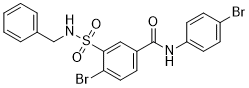
RS-1 (formerly known as RAD51-Stimulatory Compound-1) is a small molecule RAD51 activator that enhances hRAD51 binding in a wide range of biochemical conditions. Moreover, it has the ability to boost the knock-in efficiencies of CRISPR/Cas9 (clustered regularly interspaced short palindromic repeats/CRISPR-associated protein 9) and may have anticancer properties. It was demonstrated by salt titration experiments that RS-1 can improve filament stability. The length of protein-DNA complexes and the pitch of helical filament turns can both be increased by RS-1, according to an ultrastructural study of filaments formed on ssDNA. hRAD51-mediated homologous strand assimilation (D-loop) activity was at least 5- to 11-fold enhanced by RS-1, depending on the circumstance. It appears that the mechanism of stimulation was different from that conferred by Ca(2+) and/or inhibition of ATPase because this D-loop stimulation happened even in the presence of Ca(2+) or adenylyl-imidodiphosphate. The compound does not replace the need for a nucleotide triphosphate cofactor, as no D-loop activity was seen in the absence of one. These findings suggest that RS-1 stimulates the development of active presynaptic filaments, which in turn increases the homologous recombination activity of hRAD51. Assays for cell survival in normal newborn human dermal fibroblasts have shown that RS-1 induces a dose-dependent resistance to cisplatin, a cross-linking chemotherapy drug. RS-1 appears to function in vivo to promote homologous recombination repair proficiency, which is not surprising considering that RAD51-dependent recombination is a major determinant of cisplatin resistance. Numerous potential uses for RS-1 exist in both medical and research contexts.
Physicochemical Properties
| Molecular Formula | C20H16BR2N2O3S | |
| Molecular Weight | 524.23 | |
| Exact Mass | 521.925 | |
| Elemental Analysis | C, 45.82; H, 3.08; Br, 30.48; N, 5.34; O, 9.16; S, 6.12 | |
| CAS # | 312756-74-4 | |
| Related CAS # |
|
|
| PubChem CID | 1039737 | |
| Appearance | White to off-white solid powder | |
| LogP | 6.487 | |
| Hydrogen Bond Donor Count | 2 | |
| Hydrogen Bond Acceptor Count | 4 | |
| Rotatable Bond Count | 6 | |
| Heavy Atom Count | 28 | |
| Complexity | 611 | |
| Defined Atom Stereocenter Count | 0 | |
| SMILES | BrC1C([H])=C([H])C(C(N([H])C2C([H])=C([H])C(=C([H])C=2[H])Br)=O)=C([H])C=1S(N([H])C([H])([H])C1C([H])=C([H])C([H])=C([H])C=1[H])(=O)=O |
|
| InChi Key | SWKAVEUTKGKHSR-UHFFFAOYSA-N | |
| InChi Code | InChI=1S/C20H16Br2N2O3S/c21-16-7-9-17(10-8-16)24-20(25)15-6-11-18(22)19(12-15)28(26,27)23-13-14-4-2-1-3-5-14/h1-12,23H,13H2,(H,24,25) | |
| Chemical Name | 3-(benzylsulfamoyl)-4-bromo-N-(4-bromophenyl)benzamide | |
| Synonyms |
|
|
| HS Tariff Code | 2934.99.9001 | |
| Storage |
Powder-20°C 3 years 4°C 2 years In solvent -80°C 6 months -20°C 1 month |
|
| Shipping Condition | Room temperature (This product is stable at ambient temperature for a few days during ordinary shipping and time spent in Customs) |
Biological Activity
| Targets | RAD51; CRISPR/Cas9 | ||
| ln Vitro |
|
||
| ln Vivo |
|
||
| Enzyme Assay | In summary, preincubated for 5 minutes at 37°C, a DNA strand exchange protein (0.8 μM) is combined with 1 μM (nucleotide concentration) 32P-labeled oligonucleotide 306.7 in a reaction buffer that also contains different concentrations of RS-1 and 20 mM Hepes (pH 7.5), 1 mM DTT, 2 mM nucleotide cofactor, and 1 mM MgCl2. In experimental buffer conditions containing calcium, 1 mM CaCl2 is added to (1 mM MgCl2) or substituted (for RecA and scRAD51, in the case of hRAD51). There is also 110 nM scRAD54 in conditions with scRAD51. Following this initial binding reaction, 10.μL of target plasmid DNA (pRS306) that contains a supercoiled homologue at a base pair concentration of 19.75 μM is added, along with enough magnesium acetate to provide a final concentration of 10 mM[1]. | ||
| Cell Assay | Human dermal fibroblasts from early passage neonates were kept in Medium 106 with low serum growth supplement added. The sulforhodamine B assay was used in cell-survival experiments. After being incubated for 24 hours in either cisplatin or RS-1, the cells are then left to incubate for an extra 6 days in regular media that does not contain either agent. Using a Synergy plate reader, cells stained with sulforhodamine B are quantified. | ||
| Animal Protocol |
|
||
| References |
[1]. A chemical compound that stimulates the human homologous recombination protein RAD51. Proc Natl Acad Sci U S A. 2008 Oct 14;105(41):15848-53. [2]. RS-1 enhances CRISPR/Cas9- and TALEN-mediated knock-in efficiency. Nat Commun. 2016 Jan 28;7:10548. |
Solubility Data
| Solubility (In Vitro) |
|
|||
| Solubility (In Vivo) |
Solubility in Formulation 1: ≥ 3 mg/mL (5.72 mM) (saturation unknown) in 10% DMSO + 40% PEG300 + 5% Tween80 + 45% Saline (add these co-solvents sequentially from left to right, and one by one), clear solution. For example, if 1 mL of working solution is to be prepared, you can add 100 μL of 30.0 mg/mL clear DMSO stock solution to 400 μL PEG300 and mix evenly; then add 50 μL Tween-80 to the above solution and mix evenly; then add 450 μL normal saline to adjust the volume to 1 mL. Preparation of saline: Dissolve 0.9 g of sodium chloride in 100 mL ddH₂ O to obtain a clear solution. Solubility in Formulation 2: ≥ 3 mg/mL (5.72 mM) (saturation unknown) in 10% DMSO + 90% Corn Oil (add these co-solvents sequentially from left to right, and one by one), clear solution. For example, if 1 mL of working solution is to be prepared, you can add 100 μL of 30.0 mg/mL clear DMSO stock solution to 900 μL of corn oil and mix evenly. (Please use freshly prepared in vivo formulations for optimal results.) |
| Preparing Stock Solutions | 1 mg | 5 mg | 10 mg | |
| 1 mM | 1.9076 mL | 9.5378 mL | 19.0756 mL | |
| 5 mM | 0.3815 mL | 1.9076 mL | 3.8151 mL | |
| 10 mM | 0.1908 mL | 0.9538 mL | 1.9076 mL |