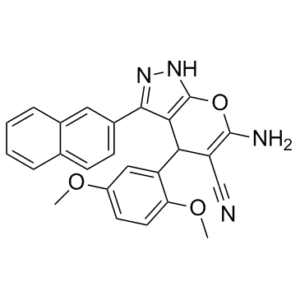
RBC8 is a novel and potent inhibitor of Ral GTPase with IC50 of 3.5 μM in H2122 cells and 3.4 μM in H358 cells. The Ras-like GTPases RalA and RalB play a significant role in the development and spread of tumors. Chemicals that inhibit Ral function have potential applications in cancer treatment and research. RBC8 and dual knockdown of RalA and RalB both reduced tumor growth to a comparable degree. RBC8 prevented Ral from binding to its effector RALBP1, as well as from causing human cancer cell lines to grow anchorage-independently and from spreading their cells through murine embryonic fibroblasts. When compared to the GTPases Ras and RhoA, RBC8 and BQU57 exhibit selectivity for Ral and inhibit the growth of tumor xenografts to a degree comparable to that of RNA interference-based Ral depletion.
Physicochemical Properties
| Molecular Formula | C25H20N4O3 | |
| Molecular Weight | 424.45 | |
| Exact Mass | 424.154 | |
| Elemental Analysis | C, 70.74; H, 4.75; N, 13.20; O, 11.31 | |
| CAS # | 361185-42-4 | |
| Related CAS # |
|
|
| PubChem CID | 6626226 | |
| Appearance | White to off-white solid powder | |
| LogP | 5.165 | |
| Hydrogen Bond Donor Count | 2 | |
| Hydrogen Bond Acceptor Count | 6 | |
| Rotatable Bond Count | 4 | |
| Heavy Atom Count | 32 | |
| Complexity | 764 | |
| Defined Atom Stereocenter Count | 0 | |
| SMILES | O1C(=C(C#N)C([H])(C2C([H])=C(C([H])=C([H])C=2OC([H])([H])[H])OC([H])([H])[H])C2C1=NN([H])C=2C1C([H])=C([H])C2=C([H])C([H])=C([H])C([H])=C2C=1[H])N([H])[H] |
|
| InChi Key | CLMQBVUFKIKYLU-UHFFFAOYSA-N | |
| InChi Code | InChI=1S/C25H20N4O3/c1-30-17-9-10-20(31-2)18(12-17)21-19(13-26)24(27)32-25-22(21)23(28-29-25)16-8-7-14-5-3-4-6-15(14)11-16/h3-12,21H,27H2,1-2H3,(H,28,29) | |
| Chemical Name | 6-amino-4-(2,5-dimethoxyphenyl)-3-naphthalen-2-yl-2,4-dihydropyrano[2,3-c]pyrazole-5-carbonitrile | |
| Synonyms |
|
|
| HS Tariff Code | 2934.99.9001 | |
| Storage |
Powder-20°C 3 years 4°C 2 years In solvent -80°C 6 months -20°C 1 month |
|
| Shipping Condition | Room temperature (This product is stable at ambient temperature for a few days during ordinary shipping and time spent in Customs) |
Biological Activity
| ln Vitro |
|
||
| ln Vivo |
|
||
| Enzyme Assay | For fifteen minutes at thirty degrees Celsius, His-RalA (100 ng) was incubated with gamma-labeled 32P-GTP (8 nM assay concentration), DMSO, or individual compounds (50 μM assay concentration) dissolved in DMSO with EDTA (20 mM). Filter binding was used to measure the amount of radiolabeled nucleotide incorporated after the reaction was halted by dilution into excess MgCl2. Nucleotide diphosphokinase changed 32P-GTP (alpha-labeled) into 32P-GDP, which was then utilized in the binding experiment with GDP. | ||
| Cell Assay | In soft agar, anchorage-independent conditions are used to measure the compounds' growth inhibition of human lung cancer cells. 15,000 cells per well of 3.0 mL of 0.4% low-melting-point agarose containing different drug concentrations are seeded into 6-well plates (which have been coated with a base layer of 2.0 ml of 1% low-melting-point agarose). The cells are stained with 1.0 mg ml−1 nitroblue tetrazolium two to four weeks (depending on the cell line) after incubation, and colonies are counted under a microscope. When compared to the DMSO-treated control, the drug concentration that caused a 50% decrease in colony number is known as the IC50 value. | ||
| Animal Protocol |
|
||
| References |
[1]. Discovery and characterization of small molecules that target the GTPase Ral. Nature. 2014 Nov 20;515(7527):443-7. |
Solubility Data
| Solubility (In Vitro) |
|
|||
| Solubility (In Vivo) |
Solubility in Formulation 1: ≥ 2.5 mg/mL (5.89 mM) (saturation unknown) in 10% DMSO + 40% PEG300 + 5% Tween80 + 45% Saline (add these co-solvents sequentially from left to right, and one by one), clear solution. For example, if 1 mL of working solution is to be prepared, you can add 100 μL of 25.0 mg/mL clear DMSO stock solution to 400 μL PEG300 and mix evenly; then add 50 μL Tween-80 to the above solution and mix evenly; then add 450 μL normal saline to adjust the volume to 1 mL. Preparation of saline: Dissolve 0.9 g of sodium chloride in 100 mL ddH₂ O to obtain a clear solution. Solubility in Formulation 2: 2.5 mg/mL (5.89 mM) in 10% DMSO + 90% (20% SBE-β-CD in Saline) (add these co-solvents sequentially from left to right, and one by one), suspension solution; with ultrasonication. For example, if 1 mL of working solution is to be prepared, you can add 100 μL of 25.0 mg/mL clear DMSO stock solution to 900 μL of 20% SBE-β-CD physiological saline solution and mix evenly. Preparation of 20% SBE-β-CD in Saline (4°C,1 week): Dissolve 2 g SBE-β-CD in 10 mL saline to obtain a clear solution. Solubility in Formulation 3: ≥ 2.5 mg/mL (5.89 mM) (saturation unknown) in 10% DMSO + 90% Corn Oil (add these co-solvents sequentially from left to right, and one by one), clear solution. For example, if 1 mL of working solution is to be prepared, you can add 100 μL of 25.0 mg/mL clear DMSO stock solution to 900 μL of corn oil and mix evenly. (Please use freshly prepared in vivo formulations for optimal results.) |
| Preparing Stock Solutions | 1 mg | 5 mg | 10 mg | |
| 1 mM | 2.3560 mL | 11.7800 mL | 23.5599 mL | |
| 5 mM | 0.4712 mL | 2.3560 mL | 4.7120 mL | |
| 10 mM | 0.2356 mL | 1.1780 mL | 2.3560 mL |