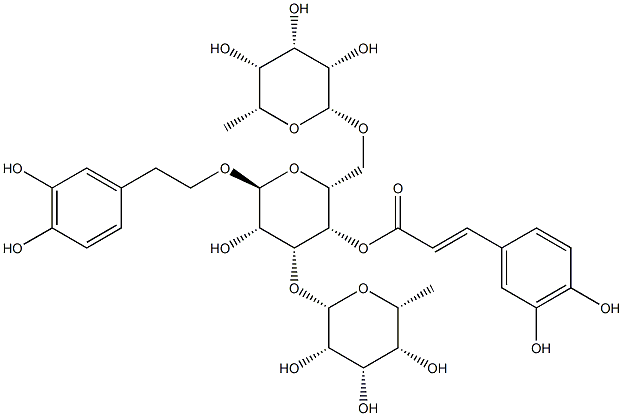
Poliumoside possesses significant antiinflammatory and antioxidant activity, It is a novel and potent natural compound and is isolated from Brandisia hancei stems and leaves. Poliumoside is an inhibitor of advanced glycation end product (AGE) formation and rat lens aldose reductase (RLAR) (IC50s =19.69 and 8.47 μM, respectively).
Physicochemical Properties
| Molecular Formula | C35H46O19 |
| Molecular Weight | 770.7284 |
| Exact Mass | 770.263 |
| CAS # | 94079-81-9 |
| PubChem CID | 10373017 |
| Appearance | Light yellow to yellow solid powder |
| Density | 1.6±0.1 g/cm3 |
| Boiling Point | 1023.2±65.0 °C at 760 mmHg |
| Flash Point | 316.2±27.8 °C |
| Vapour Pressure | 0.0±0.3 mmHg at 25°C |
| Index of Refraction | 1.685 |
| LogP | 2.63 |
| Hydrogen Bond Donor Count | 11 |
| Hydrogen Bond Acceptor Count | 19 |
| Rotatable Bond Count | 13 |
| Heavy Atom Count | 54 |
| Complexity | 1210 |
| Defined Atom Stereocenter Count | 15 |
| SMILES | C[C@H]1[C@@H]([C@H]([C@H]([C@@H](O1)OC[C@@H]2[C@H]([C@@H]([C@H]([C@@H](O2)OCCC3=CC(=C(C=C3)O)O)O)O[C@H]4[C@@H]([C@@H]([C@H]([C@@H](O4)C)O)O)O)OC(=O)/C=C/C5=CC(=C(C=C5)O)O)O)O)O |
| InChi Key | YMWRMAOPKNYHMZ-LLVTZOIGSA-N |
| InChi Code | InChI=1S/C35H46O19/c1-14-24(41)26(43)28(45)33(50-14)49-13-22-31(53-23(40)8-5-16-3-6-18(36)20(38)11-16)32(54-35-29(46)27(44)25(42)15(2)51-35)30(47)34(52-22)48-10-9-17-4-7-19(37)21(39)12-17/h3-8,11-12,14-15,22,24-39,41-47H,9-10,13H2,1-2H3/b8-5+/t14-,15-,22+,24-,25-,26+,27+,28+,29+,30+,31+,32+,33+,34+,35-/m0/s1 |
| Chemical Name | [(2R,3R,4R,5R,6R)-6-[2-(3,4-dihydroxyphenyl)ethoxy]-5-hydroxy-4-[(2R,3R,4R,5R,6S)-3,4,5-trihydroxy-6-methyloxan-2-yl]oxy-2-[[(2R,3R,4R,5R,6S)-3,4,5-trihydroxy-6-methyloxan-2-yl]oxymethyl]oxan-3-yl] (E)-3-(3,4-dihydroxyphenyl)prop-2-enoate |
| HS Tariff Code | 2934.99.9001 |
| Storage |
Powder-20°C 3 years 4°C 2 years In solvent -80°C 6 months -20°C 1 month |
| Shipping Condition | Room temperature (This product is stable at ambient temperature for a few days during ordinary shipping and time spent in Customs) |
Biological Activity
| ln Vitro | Poiumoside has an IC50 of 19.69 μM for AGE production and 8.47 μM for RLAR [1]. In vitro, poiumoside (5-30 μM; 3 hours) prevents rat erythrocytes from hemolyzing when exposed to AAPH [2]. In RAW 264.7 cells, poiumoside (12.5-100 μM; 2 hours pretreatment) suppresses the production of TNF-α and IL-6 produced by LPS [3]. |
| ln Vivo | In zebrafish larvae, poliumoside suppresses vasodilation [1]. |
| References |
[1]. Caffeoylated phenylpropanoid glycosides from Brandisia hancei inhibit advanced glycation end product formation and aldose reductase in vitro and vessel dilation in larval zebrafish in vivo. Planta Med. 2013 Dec;79(18):1705-9. [2]. Antioxidant activity of phenylethanoid glycosides from Brandisia hancei. J Ethnopharmacol. 2000 Aug;71(3):483-6. [3]. Natural phenylethanoid glycosides isolated from Callicarpa kwangtungensis suppressed lipopolysaccharide-mediated inflammatory response via activating Keap1/Nrf2/HO-1 pathway in RAW 264.7 macrophages cell. J Ethnopharmacol. 2020 Aug 10;258:112857. |
| Additional Infomation | [(2R,3R,4R,5R,6R)-6-[2-(3,4-dihydroxyphenyl)ethoxy]-5-hydroxy-4-[(2R,3R,4R,5R,6S)-3,4,5-trihydroxy-6-methyloxan-2-yl]oxy-2-[[(2R,3R,4R,5R,6S)-3,4,5-trihydroxy-6-methyloxan-2-yl]oxymethyl]oxan-3-yl] (E)-3-(3,4-dihydroxyphenyl)prop-2-enoate has been reported in Penstemon linarioides, Digitalis purpurea, and other organisms with data available. |
Solubility Data
| Solubility (In Vitro) |
DMSO : ~100 mg/mL (~129.75 mM) H2O : ~50 mg/mL (~64.87 mM) Ethanol : ~50 mg/mL (~64.87 mM) |
| Solubility (In Vivo) |
Solubility in Formulation 1: ≥ 2.5 mg/mL (3.24 mM) (saturation unknown) in 10% DMSO + 40% PEG300 + 5% Tween80 + 45% Saline (add these co-solvents sequentially from left to right, and one by one), clear solution. For example, if 1 mL of working solution is to be prepared, you can add 100 μL of 25.0 mg/mL clear DMSO stock solution to 400 μL PEG300 and mix evenly; then add 50 μL Tween-80 to the above solution and mix evenly; then add 450 μL normal saline to adjust the volume to 1 mL. Preparation of saline: Dissolve 0.9 g of sodium chloride in 100 mL ddH₂ O to obtain a clear solution. Solubility in Formulation 2: ≥ 2.5 mg/mL (3.24 mM) (saturation unknown) in 10% DMSO + 90% (20% SBE-β-CD in Saline) (add these co-solvents sequentially from left to right, and one by one), clear solution. For example, if 1 mL of working solution is to be prepared, you can add 100 μL of 25.0 mg/mL clear DMSO stock solution to 900 μL of 20% SBE-β-CD physiological saline solution and mix evenly. Preparation of 20% SBE-β-CD in Saline (4°C,1 week): Dissolve 2 g SBE-β-CD in 10 mL saline to obtain a clear solution. Solubility in Formulation 3: ≥ 2.5 mg/mL (3.24 mM) (saturation unknown) in 10% DMSO + 90% Corn Oil (add these co-solvents sequentially from left to right, and one by one), clear solution. For example, if 1 mL of working solution is to be prepared, you can add 100 μL of 25.0 mg/mL clear DMSO stock solution to 900 μL of corn oil and mix evenly. (Please use freshly prepared in vivo formulations for optimal results.) |
| Preparing Stock Solutions | 1 mg | 5 mg | 10 mg | |
| 1 mM | 1.2975 mL | 6.4874 mL | 12.9747 mL | |
| 5 mM | 0.2595 mL | 1.2975 mL | 2.5949 mL | |
| 10 mM | 0.1297 mL | 0.6487 mL | 1.2975 mL |