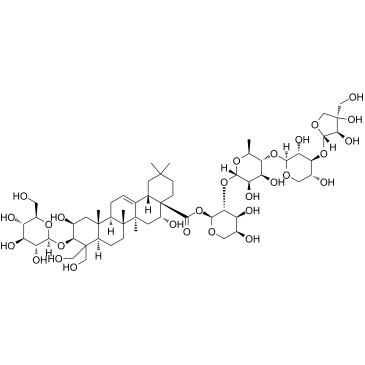
Physicochemical Properties
| Molecular Formula | C57H92O28 |
| Molecular Weight | 1225.3236 |
| Exact Mass | 1224.577 |
| CAS # | 58479-68-8 |
| PubChem CID | 162859 |
| Appearance | White to off-white solid powder |
| Density | 1.6±0.1 g/cm3 |
| Index of Refraction | 1.659 |
| LogP | -0.69 |
| Hydrogen Bond Donor Count | 17 |
| Hydrogen Bond Acceptor Count | 28 |
| Rotatable Bond Count | 15 |
| Heavy Atom Count | 85 |
| Complexity | 2380 |
| Defined Atom Stereocenter Count | 31 |
| SMILES | C[C@H]1[C@@H]([C@H]([C@H]([C@@H](O1)O[C@@H]2[C@H]([C@H](CO[C@H]2OC(=O)[C@]34CCC(C[C@H]3C5=CC[C@H]6[C@]([C@@]5(C[C@H]4O)C)(CC[C@@H]7[C@@]6(C[C@@H]([C@@H](C7(CO)CO)O[C@H]8[C@@H]([C@H]([C@@H]([C@H](O8)CO)O)O)O)O)C)C)(C)C)O)O)O)O)O[C@H]9[C@@H]([C@H]([C@@H](CO9)O)O[C@H]1[C@@H]([C@](CO1)(CO)O)O)O |
| InChi Key | CYBWUNOAQPMRBA-NDTOZIJESA-N |
| InChi Code | InChI=1S/C57H92O28/c1-23-40(81-45-39(72)41(28(64)18-76-45)82-49-43(73)56(75,21-61)22-78-49)36(69)38(71)46(79-23)83-42-33(66)27(63)17-77-48(42)85-50(74)57-12-11-51(2,3)13-25(57)24-7-8-30-52(4)14-26(62)44(84-47-37(70)35(68)34(67)29(16-58)80-47)55(19-59,20-60)31(52)9-10-53(30,5)54(24,6)15-32(57)65/h7,23,25-49,58-73,75H,8-22H2,1-6H3/t23-,25-,26-,27-,28+,29+,30+,31+,32+,33-,34+,35-,36-,37+,38+,39+,40-,41-,42+,43-,44-,45-,46-,47-,48-,49-,52+,53+,54+,56+,57+/m0/s1 |
| Chemical Name | [(2S,3R,4S,5S)-3-[(2S,3R,4S,5R,6S)-5-[(2S,3R,4S,5R)-4-[(2S,3R,4R)-3,4-dihydroxy-4-(hydroxymethyl)oxolan-2-yl]oxy-3,5-dihydroxyoxan-2-yl]oxy-3,4-dihydroxy-6-methyloxan-2-yl]oxy-4,5-dihydroxyoxan-2-yl] (4aR,5R,6aR,6aS,6bR,8aR,10R,11S,12aR,14bS)-5,11-dihydroxy-9,9-bis(hydroxymethyl)-2,2,6a,6b,12a-pentamethyl-10-[(2R,3R,4S,5S,6R)-3,4,5-trihydroxy-6-(hydroxymethyl)oxan-2-yl]oxy-1,3,4,5,6,6a,7,8,8a,10,11,12,13,14b-tetradecahydropicene-4a-carboxylate |
| HS Tariff Code | 2934.99.9001 |
| Storage |
Powder-20°C 3 years 4°C 2 years In solvent -80°C 6 months -20°C 1 month |
| Shipping Condition | Room temperature (This product is stable at ambient temperature for a few days during ordinary shipping and time spent in Customs) |
Biological Activity
| Targets |
The target of Platycodin D includes AMP-activated protein kinase (AMPK); no specific IC50, Ki, or EC50 values were reported [1] The target of Platycodin D involves the WNT/β-catenin signaling pathway, including key proteins β-catenin and glycogen synthase kinase-3β (GSK-3β)[2] |
| ln Vitro |
In 3T3-L1 adipocytes, platycodin D (4 μM; 24 h) reduces the expression of adipokine genes Fabp4, Adipoq, and Lipin1, and inhibits Fabp4, Adipoq, and Lipin1 in hAMSCs. It also raises the expression of Ucp1, Pgc1a, Sirt3, Cytc, Nrf1, and Prdm16. Platycodon D (2 and 10 μM) increases the expression of UCP1, PGC1α, and SIRT3 antibodies while suppressing the protein expression of PPARγ and C/EBPα, respectively [1]. Platycodon D (10 μM) suppresses lipid droplets and lowers the expression levels of PPARγ, C/EBPα, and FABP4 protein, which is connected to lipid promotion [2]. PPARδ levels are raised and CCND1 mRNA levels are restored by platycodon D (10 μM; 0-7 d) [2]. 1. Inhibition of adipogenesis in 3T3-L1 preadipocytes (Reference [1]): Platycodin D (5, 10, 20 μM) was added during the differentiation of 3T3-L1 cells (induced by IBMX, dexamethasone, and insulin). After 8 days, Oil Red O staining showed Platycodin D dose-dependently reduced lipid droplet accumulation, with the 20 μM group showing a 60% reduction compared to the control. qPCR results showed downregulated mRNA expression of adipogenic markers (PPARγ, C/EBPα, FAS) by 45%, 52%, and 48% respectively [1] 2. Activation of AMPK signaling (Reference [1]): Western blot analysis showed Platycodin D (5, 10, 20 μM) increased the phosphorylation level of AMPK (p-AMPK) in 3T3-L1 cells after 24 hours of treatment, with the 20 μM group showing a 2.3-fold increase in p-AMPK/AMPK ratio. It also upregulated the expression of thermogenic genes (UCP1, PGC-1α) in brown adipocytes, with UCP1 mRNA increased by 2.1-fold at 20 μM [1] 3. Inhibition of adipogenesis via WNT/β-catenin pathway (Reference [2]): 3T3-L1 cells were treated with Platycodin D (1, 5, 10 μM) during differentiation. Western blot showed Platycodin D (10 μM) increased the nuclear translocation of β-catenin (2.5-fold increase in nuclear β-catenin) and decreased the phosphorylation of GSK-3β (p-GSK-3β/GSK-3β ratio reduced by 60%). Oil Red O staining showed a 55% reduction in lipid droplets at 10 μM [2] 4. Regulation of WNT target genes (Reference [2]): qPCR analysis in 3T3-L1 cells treated with Platycodin D (10 μM) showed upregulated mRNA expression of WNT target genes (c-Myc, cyclin D1) by 1.8-fold and 1.6-fold respectively, and downregulated adipogenic marker C/EBPδ by 40% [2] |
| ln Vivo |
Mice's body weight is decreased with platycodin D (5 mg/kg; monthly, five times each week for five weeks) [1]. 1. Attenuation of obesity in db/db mice (Reference [1]): Male db/db mice (6-week-old) were divided into 3 groups (n=8): control (vehicle), Platycodin D 10 mg/kg, and Platycodin D 20 mg/kg (oral gavage, once daily for 8 weeks). The 20 mg/kg group showed: (1) 18% reduction in body weight (from 52 ± 3 g to 43 ± 2 g); (2) 40% reduction in epididymal fat pad weight; (3) 25% decrease in fasting blood glucose; (4) increased p-AMPK level in adipose tissue (2.1-fold) and upregulated UCP1 expression (1.9-fold) in brown adipose tissue [1] 2. Improvement of lipid metabolism (Reference [1]): Serum lipid analysis of db/db mice in the 20 mg/kg Platycodin D group showed: (1) 30% reduction in total cholesterol; (2) 28% reduction in triglycerides; (3) 22% increase in HDL-cholesterol. Hepatic lipid accumulation (detected by Oil Red O staining) was reduced by 35% [1] |
| Enzyme Assay |
1. AMPK kinase activity assay (Reference [1]): Recombinant human AMPK (α1β1γ1 subtype) was mixed with Platycodin D (5, 10, 20 μM) in reaction buffer (containing ATP, MgCl₂, and AMPK substrate peptide). The mixture was incubated at 37°C for 30 minutes. The phosphorylation of the substrate peptide was detected using a phospho-specific antibody and ELISA. Platycodin D dose-dependently increased AMPK kinase activity, with the 20 μM group showing a 1.8-fold increase compared to the control [1] |
| Cell Assay |
1. 3T3-L1 preadipocyte differentiation assay (Reference [1]): 3T3-L1 cells were seeded in 24-well plates at 2×10⁴ cells/well. After confluence, differentiation was induced with medium containing IBMX (0.5 mM), dexamethasone (1 μM), and insulin (10 μg/mL), and Platycodin D (5, 10, 20 μM) was added simultaneously. The medium was replaced every 2 days. After 8 days, cells were fixed with 4% paraformaldehyde, stained with Oil Red O, and lipid content was quantified by extracting the dye with isopropanol and measuring absorbance at 510 nm [1] 2. Western blot for AMPK and thermogenic proteins (Reference [1]): 3T3-L1 cells or brown adipocytes were treated with Platycodin D (5, 10, 20 μM) for 24 hours. Total protein was extracted, quantified by BCA assay, and 30 μg protein per lane was separated by SDS-PAGE. Membranes were probed with antibodies against p-AMPK, AMPK, UCP1, PGC-1α, and β-actin (internal control). Bands were visualized by ECL and quantified with ImageJ [1] 3. 3T3-L1 adipogenesis assay with WNT pathway detection (Reference [2]): 3T3-L1 cells were seeded in 6-well plates at 5×10⁴ cells/well. Differentiation was induced with adipogenic medium, and Platycodin D (1, 5, 10 μM) was added. After 6 days, Oil Red O staining was performed to assess lipid accumulation. For nuclear β-catenin detection, cells were fractionated to isolate nuclear proteins, and Western blot was conducted with anti-β-catenin and anti-histone H3 (nuclear control) antibodies [2] 4. qPCR for gene expression (Reference [2]): 3T3-L1 cells treated with Platycodin D (10 μM) for 4 days were used for total RNA extraction (TRIzol reagent). cDNA was synthesized from 1 μg RNA, and qPCR was performed with SYBR Green Master Mix using primers for C/EBPδ, c-Myc, cyclin D1, and GAPDH (internal control). Reaction conditions: 95°C for 10 minutes, 40 cycles of 95°C for 15 seconds and 60°C for 1 minute. Relative expression was calculated by 2^(-ΔΔCt) method [2] |
| Animal Protocol |
Animal/Disease Models: genetically obese db/db mice [1] Doses: 5 mg/kg Route of Administration: oral administration; 5 mg/kg, 5 times a week for 5 weeks Experimental Results: Dramatically diminished weight gain in mice, And it does not affect the food intake of mice. Reduce liver tissue weight and increase brown adipose tissue (BAT) weight. 1. Obesity model in db/db mice (Reference [1]): Male db/db mice (6-week-old, C57BL/6 background) were housed under 12-hour light/dark cycle, with free access to food and water. Mice were randomly divided into 3 groups (n=8): (1) Control group: oral gavage of 0.5% carboxymethyl cellulose sodium (CMC-Na) solution; (2) Platycodin D 10 mg/kg group; (3) Platycodin D 20 mg/kg group. Platycodin D was dissolved in 0.5% CMC-Na to prepare the required concentrations. Gavage was performed once daily for 8 weeks. Body weight was recorded weekly, and fasting blood glucose was measured every 2 weeks [1] 2. Sample collection and analysis (Reference [1]): After 8 weeks, mice were euthanized. Epididymal fat pad, brown adipose tissue (BAT), and liver were excised and weighed. Serum was collected for lipid analysis (total cholesterol, triglycerides, HDL-cholesterol) using commercial kits. A portion of adipose tissue and liver was fixed in 4% paraformaldehyde for histological staining, and the remaining tissue was stored at -80°C for Western blot and qPCR analysis [1] |
| Toxicity/Toxicokinetics |
1. In vivo safety in db/db mice (Reference [1]): During 8-week treatment with Platycodin D (10, 20 mg/kg, oral), no significant changes in mouse behavior or mortality were observed. Serum levels of alanine transaminase (ALT), aspartate transaminase (AST), and creatinine were not significantly different from the control group. Histological examination of liver and kidney showed no obvious pathological damage [1] |
| References |
[1]. Platycodin D, a novel activator of AMP-activated protein kinase, attenuates obesity in db/db mice via regulation of adipogenesis and thermogenesis. Phytomedicine. 2019 Jan;52:254-263. [2]. WNT/β-catenin pathway mediates the anti-adipogenic effect of platycodin D, a natural compound found in Platycodon grandiflorum. Life Sci. 2011 Sep 12;89(11-12):388-94. |
| Additional Infomation |
Platycodin D is a triterpenoid saponin. It has a role as a metabolite. Platycodin D has been reported in Platycodon grandiflorus with data available. 1. Source and basic property: Platycodin D is a triterpenoid saponin isolated from the roots of Platycodon grandiflorum (Jacq.) A. DC., a traditional Chinese medicinal herb used for respiratory and digestive disorders [1][2] 2. Anti-obesity mechanism (Reference [1]): Platycodin D exerts anti-obesity effects by activating AMPK, which dual-regulates adipogenesis (inhibits 3T3-L1 differentiation via downregulating PPARγ/C/EBPα) and thermogenesis (promotes UCP1/PGC-1α expression in BAT), thereby reducing fat accumulation and improving energy metabolism [1] 3. Anti-adipogenic mechanism (Reference [2]): Platycodin D inhibits 3T3-L1 adipogenesis through the WNT/β-catenin pathway: it increases nuclear translocation of β-catenin (by inhibiting GSK-3β phosphorylation) and upregulates WNT target genes (c-Myc, cyclin D1), while downregulating the early adipogenic marker C/EBPδ [2] |
Solubility Data
| Solubility (In Vitro) | DMSO : ~50 mg/mL (~40.81 mM) |
| Solubility (In Vivo) |
Solubility in Formulation 1: ≥ 2.5 mg/mL (2.04 mM) (saturation unknown) in 10% DMSO + 40% PEG300 + 5% Tween80 + 45% Saline (add these co-solvents sequentially from left to right, and one by one), clear solution. For example, if 1 mL of working solution is to be prepared, you can add 100 μL of 25.0 mg/mL clear DMSO stock solution to 400 μL PEG300 and mix evenly; then add 50 μL Tween-80 to the above solution and mix evenly; then add 450 μL normal saline to adjust the volume to 1 mL. Preparation of saline: Dissolve 0.9 g of sodium chloride in 100 mL ddH₂ O to obtain a clear solution. Solubility in Formulation 2: ≥ 2.5 mg/mL (2.04 mM) (saturation unknown) in 10% DMSO + 90% (20% SBE-β-CD in Saline) (add these co-solvents sequentially from left to right, and one by one), clear solution. For example, if 1 mL of working solution is to be prepared, you can add 100 μL of 25.0 mg/mL clear DMSO stock solution to 900 μL of 20% SBE-β-CD physiological saline solution and mix evenly. Preparation of 20% SBE-β-CD in Saline (4°C,1 week): Dissolve 2 g SBE-β-CD in 10 mL saline to obtain a clear solution. Solubility in Formulation 3: ≥ 2.5 mg/mL (2.04 mM) (saturation unknown) in 10% DMSO + 90% Corn Oil (add these co-solvents sequentially from left to right, and one by one), clear solution. For example, if 1 mL of working solution is to be prepared, you can add 100 μL of 25.0 mg/mL clear DMSO stock solution to 900 μL of corn oil and mix evenly. Solubility in Formulation 4: 20 mg/mL (16.32 mM) in 50% PEG300 50% Saline (add these co-solvents sequentially from left to right, and one by one), clear solution; with ultrasonication. Preparation of saline: Dissolve 0.9 g of sodium chloride in 100 mL ddH₂ O to obtain a clear solution. Solubility in Formulation 5: 20 mg/mL (16.32 mM) in 0.5% CMC-Na/saline water (add these co-solvents sequentially from left to right, and one by one), clear solution; with ultrasonication. Preparation of saline: Dissolve 0.9 g of sodium chloride in 100 mL ddH₂ O to obtain a clear solution. (Please use freshly prepared in vivo formulations for optimal results.) |
| Preparing Stock Solutions | 1 mg | 5 mg | 10 mg | |
| 1 mM | 0.8161 mL | 4.0806 mL | 8.1611 mL | |
| 5 mM | 0.1632 mL | 0.8161 mL | 1.6322 mL | |
| 10 mM | 0.0816 mL | 0.4081 mL | 0.8161 mL |