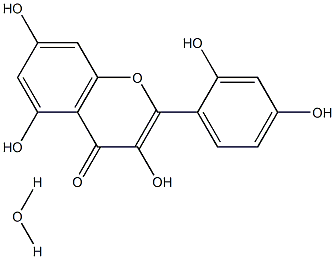
Morin Hydrate (AI3 38057; NSC19801; AI3-38057; NSC-19801) is a naturally occurring and bioactive flavanoid extracted from Maclura pomifera (Osage orange). Morin induces caspase-dependent apoptosis through extrinsic pathway by upregulating Fas receptor as well as through the intrinsic pathway by modulating Bcl-2 and IAP family members.
Physicochemical Properties
| Molecular Formula | C15H12O8 |
| Molecular Weight | 320.253 |
| Exact Mass | 320.053 |
| Elemental Analysis | C, 56.26; H, 3.78; O, 39.97 |
| CAS # | 654055-01-3 |
| Related CAS # | 654055-01-3 (hydrate);480-16-0; 6202-27-3 |
| PubChem CID | 18542136 |
| Appearance | Typically exists as solid at room temperature |
| Melting Point | 299-300 °C (dec.)(lit.) |
| Hydrogen Bond Donor Count | 7 |
| Hydrogen Bond Acceptor Count | 9 |
| Rotatable Bond Count | 1 |
| Heavy Atom Count | 24 |
| Complexity | 488 |
| Defined Atom Stereocenter Count | 0 |
| SMILES | O1C(=C(C(C2=C(C([H])=C(C([H])=C12)O[H])O[H])=O)O[H])C1C([H])=C([H])C(=C([H])C=1O[H])O[H].O([H])[H] |
| InChi Key | MYUBTSPIIFYCIU-UHFFFAOYSA-N |
| InChi Code | InChI=1S/C15H10O7.H2O/c16-6-1-2-8(9(18)3-6)15-14(21)13(20)12-10(19)4-7(17)5-11(12)22-15;/h1-5,16-19,21H;1H2 |
| Chemical Name | 2',3,4',5,7-Pentahydroxyflavone Hydrate |
| Synonyms | AI3 38057; NSC19801; AI3-38057; NSC-19801; Morin hydrate; 654055-01-3; 6202-27-3; Morin (monohydrate); 2-(2,4-dihydroxyphenyl)-3,5,7-trihydroxy-4H-chromen-4-one hydrate; MFCD00217054; Morin Hydrate (>85% purity); 2-(2,4-dihydroxyphenyl)-3,5,7-trihydroxychromen-4-one;hydrate; Morin Hydrate |
| HS Tariff Code | 2934.99.9001 |
| Storage |
Powder-20°C 3 years 4°C 2 years In solvent -80°C 6 months -20°C 1 month |
| Shipping Condition | Room temperature (This product is stable at ambient temperature for a few days during ordinary shipping and time spent in Customs) |
Biological Activity
| Targets | Natural flavone |
| ln Vitro | Over the last few decades, the number of people diagnosed with cancer has increased dramatically every year, making it a major cause of mortality today. Colon cancer is the third most common cancer worldwide, and the second in mortality rate. Current cancer treatment fails to treat colon cancer completely due to the remains of Cancer Stem Cells (CSCs). Morin flavonoid present in figs (Ficus carica) and other plant sources, was found to have an anti-proliferative effect on the colon cancer model and cell line, but it is not studied for its effect on the colon CSCs. In this study, we have tested the potency of morin to inhibit CSCs. We found that morin has significantly reduced colon cancer cell proliferation, colony formation, migration, and colonospheroid formation in a dose-dependent manner. Pumilio-1 (PUM1) has been shown to play an important role in colon CSCs maintenance. We found that morin has a good binding affinity with PUM1 protein with one hydrophobic and two hydrogen bond interactions. Further, the immunofluorescence results have also shown a reduction in PUM1 expression in colon cancer cell lines after morin treatment. CD133 is overexpressed in colon CSCs and morin treatment has reduced the CD133 expression in HCT116 and CT26 colon cancer cell lines. Our research outcome has explored the anti-cancer stem cell potency of morin via targeting the PUM1 protein and further reducing the colon spheroids formation and reducing the CD133 expression in colon cancer cells[1]. |
| ln Vivo | Rats were subjected to oral treatment of morin (50 and 100 mg/kg body weight) for 10 days. Hepatotoxicity was induced by single intraperitoneal injection of MTX (20 mg/kg body weight) on the 5th day. MTX related hepatic injury was associated with increased MDA while decreased GSH levels, the activities of endogen antioxidants (glutathione peroxidase, superoxide dismutase and catalase) and mRNA levels of HO-1 and Nrf2 in the hepatic tissue. MTX treatment also resulted in apoptosis in the liver tissue via increasing mRNA transcript levels of Bax, caspase-3, Apaf-1 and downregulation of Bcl-2. Conversely, treatment with morin at different doses (50 and 100 mg/kg) considerably mitigated MTX-induced oxidative stress and apoptosis in the liver tissue. Morin also mitigated MTX-induced increases of ALT, ALP and AST levels, downregulated mRNA expressions of matrix metalloproteinases (MMP-2 and MMP-9), MAPK14 and MAPK15, JNK, Akt2 and FOXO1 genes[2]. |
| Enzyme Assay | Mindray Perfect Plus 400 was used to measure the activities of aspartate aminotransferase (AST), alkaline phosphatase (ALP), and alanine aminotransferase (ALT) in the serum. The results were given in units of U/L[2]. |
| Cell Assay |
MTT cell proliferation assay[1] Morin’s effect on the proliferation of HCT116 and CT26 was determined using 3-(4,5-Dimethylthiazol-2-YI)-2,5-Diphenyltetrazolium Bromide (MTT) based colorimetric assay. Wells were seeded with 5000 cells/well and allowed to grow overnight. Cells were treated with different concentrations of morin (50 μM,100 μM,150 μM, 200 μM, and 400 μM) and incubated for 48 h. After the incubation time, MTT reagent was added and incubated in the incubator for 4 h. Later DMSO is added to dissolve the formazan crystals and incubated in dark for 30 min, absorbance at 570 nm is measured. Colony formation assay[1] HCT116 and CT26 cells (500 cells/well) were seeded on a 6-well plate and allowed to grow overnight. The next day the plates were treated with IC50 concentration of morin for respective cell lines. After 48 h of incubation, the medium was changed and incubated for 10 days. Colonies were fixed with 10% formalin and stained with 1% crystal violet in 10% ethanol. Images were documented and colonies were counted using ImageJ software and graphs were plotted using GraphPad Prism. Wound healing assay[1] For wound healing assay, 1 × 10⁵ cells were seeded in each well of a 6-well plate and cultured until it reaches 75–80% confluency. A wound was made using a 100 μl pipette tip, washed the detached cells with PBS, and cells were overlayed with reduced serum medium. Images were captured at 0 h, 24 h, and 48 h, the wound area was quantitatively measured using ImageJ software. |
| Animal Protocol |
35 male Wistar albino rats (weighing between 280 and 300 g, 11–12 weeks old) were separated into five groups of 7 male rats each at random:[2] Control group: The animals received 0.9% saline via oral gavage for 10 days and a single intraperitoneal injection of saline on day 5 only. Morin group: The animals were given 100 mg/kg morin hydrate orally for 10 days and intraperitoneal saline injection was given on the 5th day of the experiment. MTX group: The animals were administered saline orally for 10 days and on the 5th day of the experiment, a single dose of 20 mg/kg MTX was injected intraperitoneally. MTX + Morin 50 group: Rats were given 50 mg/kg morin hydrate orally for 10 days and a single dose of 20 mg/kg MTX was injected intraperitoneally on the 5th day of the experiment. MTX + Morin 100 group: Rats were given 100 mg/kg morin hydrate orally for 10 days and a single dose of 20 mg/kg MTX was injected intraperitoneally on the 5th day of the experiment. Following day, the rats were sacrificed under mild sevoflurane anesthesia. Blood serum was separated by centrifugation at 3000×g for 10 min, and the serum samples were then tested for liver function analysis. Livers were immediately removed and washed with ice-cold physiological saline solution for biochemical and molecular analysis and then stored at -20 °C. |
| ADME/Pharmacokinetics |
Metabolism / Metabolites Morin has known human metabolites that include (2S,3S,4S,5R)-6-[2-(2,4-dihydroxyphenyl)-5,7-dihydroxy-4-oxochromen-3-yl]oxy-3,4,5-trihydroxyoxane-2-carboxylic acid. |
| Toxicity/Toxicokinetics |
mouse LD50 intraperitoneal 555 mg/kg BEHAVIORAL: SOMNOLENCE (GENERAL DEPRESSED ACTIVITY); BEHAVIORAL: MUSCLE WEAKNESS; LUNGS, THORAX, OR RESPIRATION: RESPIRATORY DEPRESSION Archives Internationales de Pharmacodynamie et de Therapie., 123(395), 1960 [PMID:13796312] Adverse Effects Occupational hepatotoxin - Secondary hepatotoxins: the potential for toxic effect in the occupational setting is based on cases of poisoning by human ingestion or animal experimentation. |
| References |
[1]. Morin inhibits colon cancer stem cells by inhibiting PUM1 expression in vitro. Med Oncol . 2022 Oct 12;39(12):251. [2]. Morin ameliorates methotrexate-induced hepatotoxicity via targeting Nrf2/HO-1 and Bax/Bcl2/Caspase-3 signaling pathways. Mol Biol Rep . 2023 Apr;50(4):3479-3488. |
| Additional Infomation |
Background: Organ toxicity limits the therapeutic efficacy of methotrexate (MTX), an anti-metabolite therapeutic that is frequently used as an anti-cancer and immunosuppressive medicine. Hepatocellular toxicity is among the most severe side effects of long-term MTX use. The present study unveils new confirmations as regards the remedial effects of morin on MTX-induced hepatocellular injury through regulation of oxidative stress, apoptosis and MAPK signaling.[2] Methods and results: Rats were subjected to oral treatment of morin (50 and 100 mg/kg body weight) for 10 days. Hepatotoxicity was induced by single intraperitoneal injection of MTX (20 mg/kg body weight) on the 5th day. MTX related hepatic injury was associated with increased MDA while decreased GSH levels, the activities of endogen antioxidants (glutathione peroxidase, superoxide dismutase and catalase) and mRNA levels of HO-1 and Nrf2 in the hepatic tissue. MTX treatment also resulted in apoptosis in the liver tissue via increasing mRNA transcript levels of Bax, caspase-3, Apaf-1 and downregulation of Bcl-2. Conversely, treatment with morin at different doses (50 and 100 mg/kg) considerably mitigated MTX-induced oxidative stress and apoptosis in the liver tissue. Morin also mitigated MTX-induced increases of ALT, ALP and AST levels, downregulated mRNA expressions of matrix metalloproteinases (MMP-2 and MMP-9), MAPK14 and MAPK15, JNK, Akt2 and FOXO1 genes.2] Conclusion: According to the findings of this study, morin may be a potential way to shield the liver tissue from the oxidative damage and apoptosis. |
Solubility Data
| Solubility (In Vitro) | May dissolve in DMSO (in most cases), if not, try other solvents such as H2O, Ethanol, or DMF with a minute amount of products to avoid loss of samples |
| Solubility (In Vivo) |
Note: Listed below are some common formulations that may be used to formulate products with low water solubility (e.g. < 1 mg/mL), you may test these formulations using a minute amount of products to avoid loss of samples. Injection Formulations (e.g. IP/IV/IM/SC) Injection Formulation 1: DMSO : Tween 80: Saline = 10 : 5 : 85 (i.e. 100 μL DMSO stock solution → 50 μL Tween 80 → 850 μL Saline) *Preparation of saline: Dissolve 0.9 g of sodium chloride in 100 mL ddH ₂ O to obtain a clear solution. Injection Formulation 2: DMSO : PEG300 :Tween 80 : Saline = 10 : 40 : 5 : 45 (i.e. 100 μL DMSO → 400 μLPEG300 → 50 μL Tween 80 → 450 μL Saline) Injection Formulation 3: DMSO : Corn oil = 10 : 90 (i.e. 100 μL DMSO → 900 μL Corn oil) Example: Take the Injection Formulation 3 (DMSO : Corn oil = 10 : 90) as an example, if 1 mL of 2.5 mg/mL working solution is to be prepared, you can take 100 μL 25 mg/mL DMSO stock solution and add to 900 μL corn oil, mix well to obtain a clear or suspension solution (2.5 mg/mL, ready for use in animals). Injection Formulation 4: DMSO : 20% SBE-β-CD in saline = 10 : 90 [i.e. 100 μL DMSO → 900 μL (20% SBE-β-CD in saline)] *Preparation of 20% SBE-β-CD in Saline (4°C,1 week): Dissolve 2 g SBE-β-CD in 10 mL saline to obtain a clear solution. Injection Formulation 5: 2-Hydroxypropyl-β-cyclodextrin : Saline = 50 : 50 (i.e. 500 μL 2-Hydroxypropyl-β-cyclodextrin → 500 μL Saline) Injection Formulation 6: DMSO : PEG300 : castor oil : Saline = 5 : 10 : 20 : 65 (i.e. 50 μL DMSO → 100 μLPEG300 → 200 μL castor oil → 650 μL Saline) Injection Formulation 7: Ethanol : Cremophor : Saline = 10: 10 : 80 (i.e. 100 μL Ethanol → 100 μL Cremophor → 800 μL Saline) Injection Formulation 8: Dissolve in Cremophor/Ethanol (50 : 50), then diluted by Saline Injection Formulation 9: EtOH : Corn oil = 10 : 90 (i.e. 100 μL EtOH → 900 μL Corn oil) Injection Formulation 10: EtOH : PEG300:Tween 80 : Saline = 10 : 40 : 5 : 45 (i.e. 100 μL EtOH → 400 μLPEG300 → 50 μL Tween 80 → 450 μL Saline) Oral Formulations Oral Formulation 1: Suspend in 0.5% CMC Na (carboxymethylcellulose sodium) Oral Formulation 2: Suspend in 0.5% Carboxymethyl cellulose Example: Take the Oral Formulation 1 (Suspend in 0.5% CMC Na) as an example, if 100 mL of 2.5 mg/mL working solution is to be prepared, you can first prepare 0.5% CMC Na solution by measuring 0.5 g CMC Na and dissolve it in 100 mL ddH2O to obtain a clear solution; then add 250 mg of the product to 100 mL 0.5% CMC Na solution, to make the suspension solution (2.5 mg/mL, ready for use in animals). Oral Formulation 3: Dissolved in PEG400 Oral Formulation 4: Suspend in 0.2% Carboxymethyl cellulose Oral Formulation 5: Dissolve in 0.25% Tween 80 and 0.5% Carboxymethyl cellulose Oral Formulation 6: Mixing with food powders Note: Please be aware that the above formulations are for reference only. InvivoChem strongly recommends customers to read literature methods/protocols carefully before determining which formulation you should use for in vivo studies, as different compounds have different solubility properties and have to be formulated differently. (Please use freshly prepared in vivo formulations for optimal results.) |
| Preparing Stock Solutions | 1 mg | 5 mg | 10 mg | |
| 1 mM | 3.1226 mL | 15.6128 mL | 31.2256 mL | |
| 5 mM | 0.6245 mL | 3.1226 mL | 6.2451 mL | |
| 10 mM | 0.3123 mL | 1.5613 mL | 3.1226 mL |