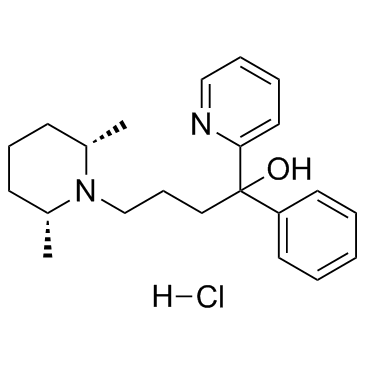
Pirmenol HCl (Cl-845) is a potent antiarrhythmic agent that inhibits muscarinic acetylcholine receptor-operated K+ current in the guinea pig heart. Pirmenol has an IC50 of 0.1 μM for inhibiting Carbachol-induced IK.ACh. Pirmenol has a favorable therapeutic index when compared to other class I agents and is active in a variety of experimental arrhythmic models with different etiologies. Pirmenol has a high degree of effectiveness regardless of the type of arrhythmia—atrial, ventricular, chemically, mechanically, electrically, or reentrant.
Physicochemical Properties
| Molecular Formula | C₂₂H₃₁CLN₂O |
| Molecular Weight | 374.95 |
| Exact Mass | 374.212 |
| Elemental Analysis | C, 70.47; H, 8.33; Cl, 9.45; N, 7.47; O, 4.27 |
| CAS # | 61477-94-9 |
| Related CAS # | Pirmenol; 68252-19-7 |
| PubChem CID | 65501 |
| Appearance | White to yellow solid powder |
| Boiling Point | 499.6ºC at 760 mmHg |
| Flash Point | 256ºC |
| LogP | 5.1 |
| Hydrogen Bond Donor Count | 2 |
| Hydrogen Bond Acceptor Count | 3 |
| Rotatable Bond Count | 6 |
| Heavy Atom Count | 26 |
| Complexity | 386 |
| Defined Atom Stereocenter Count | 2 |
| SMILES | OC(C1=CC=CC=C1)(CCCN2[C@@H](C)CCC[C@H]2C)C3=CC=CC=N3.Cl[H] |
| InChi Key | HFIHPVIVQSWZBV-ROSXHPEZSA-N |
| InChi Code | InChI=1S/C22H30N2O.ClH/c1-18-10-8-11-19(2)24(18)17-9-15-22(25,20-12-4-3-5-13-20)21-14-6-7-16-23-21;/h3-7,12-14,16,18-19,25H,8-11,15,17H2,1-2H3;1H/t18-,19+,22?; |
| Chemical Name | 4-[(2S,6R)-2,6-dimethylpiperidin-1-yl]-1-phenyl-1-pyridin-2-ylbutan-1-ol;hydrochloride |
| Synonyms | Cl-845; Cl 845Cl845; (±)-Pirmenol hydrochloride |
| HS Tariff Code | 2934.99.9001 |
| Storage |
Powder-20°C 3 years 4°C 2 years In solvent -80°C 6 months -20°C 1 month Note: Please store this product in a sealed and protected environment (e.g. under nitrogen), avoid exposure to moisture. |
| Shipping Condition | Room temperature (This product is stable at ambient temperature for a few days during ordinary shipping and time spent in Customs) |
Biological Activity
| Targets | IK.ACh ( IC50 = 40.1 μM ) |
| ln Vitro |
Pirmenol (1 μM) hydrochloride inhibits the IK.ACh triggered by carbachol or intracellular loading of GTPg S in in atrial cells[1]. Pirmenol (5 μM) hydrochloride prolongs the final repolarization of the action potentials and depresses the early portion of the plateau in ventricular myocytes[3]. Pirmenol (1 μM) hydrochloride extends the action potential duration at 90% repolarization in atrial muscles and Purkinje fibers[3]. |
| ln Vivo |
Pirmenol (2.5 and 5 mg/kg, p.o.) hydrochloride is efficient in treating arrhythmias in dogs with ligated coronary arteries who are conscious[4]. Pirmenol (rats) hydrochloride demonstrates LD50s of 359.9 mg/kg (p.o), 23.6 mg/kg (i.v.)[2]. Pirmenol (mice) hydrochloride demonstrates LD50s of 215.5 mg/kg (p.o), 20.8 mg/kg (i.v.)[2]. |
| Animal Protocol |
Conscious, coronary artery ligated dogs Oral administration (p.o.) 2.5 and 5 mg/kg |
| References |
[1]. Pirmenol inhibits muscarinic acetylcholine receptor-operated K+ current in the guinea pig heart. Eur J Pharmacol. 1997 Oct 29;338(1):71-4. [2]. Preclinical toxicology studies with a new antiarrhythmic agent: Pirmenol hydrochloride (CI-845). Toxicol Appl Pharmacol. 1980 Nov;56(2):294-301. [3]. Electrophysiologic and antiarrhythmic actions of pirmenol on rabbit and guinea pig cardiac preparations. J Cardiovasc Pharmacol. 1990 Dec;16(6):975-83. [4]. Pirmenol hydrochloride (CI-845): antiarrhythmic profile in coronary artery ligated conscious dogs. J Cardiovasc Pharmacol. 1980 Sep-Oct;2(5):527-41. |
Solubility Data
| Solubility (In Vitro) |
H2O: ~100 mg/mL (~266.7 mM) DMSO: ~66.7 mg/mL (~177.8 mM) |
| Solubility (In Vivo) |
Solubility in Formulation 1: ≥ 2.08 mg/mL (5.55 mM) (saturation unknown) in 10% DMSO + 40% PEG300 + 5% Tween80 + 45% Saline (add these co-solvents sequentially from left to right, and one by one), clear solution. For example, if 1 mL of working solution is to be prepared, you can add 100 μL of 20.8 mg/mL clear DMSO stock solution to 400 μL PEG300 and mix evenly; then add 50 μL Tween-80 to the above solution and mix evenly; then add 450 μL normal saline to adjust the volume to 1 mL. Preparation of saline: Dissolve 0.9 g of sodium chloride in 100 mL ddH₂ O to obtain a clear solution. Solubility in Formulation 2: ≥ 2.08 mg/mL (5.55 mM) (saturation unknown) in 10% DMSO + 90% (20% SBE-β-CD in Saline) (add these co-solvents sequentially from left to right, and one by one), clear solution. For example, if 1 mL of working solution is to be prepared, you can add 100 μL of 20.8 mg/mL clear DMSO stock solution to 900 μL of 20% SBE-β-CD physiological saline solution and mix evenly. Preparation of 20% SBE-β-CD in Saline (4°C,1 week): Dissolve 2 g SBE-β-CD in 10 mL saline to obtain a clear solution. Solubility in Formulation 3: ≥ 2.08 mg/mL (5.55 mM) (saturation unknown) in 10% DMSO + 90% Corn Oil (add these co-solvents sequentially from left to right, and one by one), clear solution. For example, if 1 mL of working solution is to be prepared, you can add 100 μL of 20.8 mg/mL clear DMSO stock solution to 900 μL of corn oil and mix evenly. (Please use freshly prepared in vivo formulations for optimal results.) |
| Preparing Stock Solutions | 1 mg | 5 mg | 10 mg | |
| 1 mM | 2.6670 mL | 13.3351 mL | 26.6702 mL | |
| 5 mM | 0.5334 mL | 2.6670 mL | 5.3340 mL | |
| 10 mM | 0.2667 mL | 1.3335 mL | 2.6670 mL |