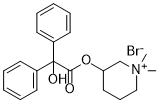
Mepenzolate Bromide is a muscarinic antagonist (Kis = 0.68 and 2.6 nM for human M2 and M3 receptors, respectively) used to treat gastrointestinal disorders. It lessens the degree of respiratory dysfunction and airspace enlargement caused by elastase.
Physicochemical Properties
| Molecular Formula | C21H26BRNO3 |
| Molecular Weight | 420.3400 |
| Exact Mass | 419.11 |
| Elemental Analysis | C, 60.00; H, 6.23; Br, 19.01; N, 3.33; O, 11.42 |
| CAS # | 76-90-4 |
| Related CAS # | 25990-43-6 (Parent) |
| PubChem CID | 6461 |
| Appearance | White to off-white solid powder |
| Melting Point | 228-229ºC dec. |
| Hydrogen Bond Donor Count | 1 |
| Hydrogen Bond Acceptor Count | 4 |
| Rotatable Bond Count | 5 |
| Heavy Atom Count | 26 |
| Complexity | 432 |
| Defined Atom Stereocenter Count | 0 |
| SMILES | [Br-].O(C(C(C1C([H])=C([H])C([H])=C([H])C=1[H])(C1C([H])=C([H])C([H])=C([H])C=1[H])O[H])=O)C1([H])C([H])([H])C([H])([H])C([H])([H])[N+](C([H])([H])[H])(C([H])([H])[H])C1([H])[H] |
| InChi Key | JRRNZNSGDSFFIR-UHFFFAOYSA-M |
| InChi Code | InChI=1S/C21H26NO3.BrH/c1-22(2)15-9-14-19(16-22)25-20(23)21(24,17-10-5-3-6-11-17)18-12-7-4-8-13-18;/h3-8,10-13,19,24H,9,14-16H2,1-2H3;1H/q+1;/p-1 |
| Chemical Name | (1,1-dimethylpiperidin-1-ium-3-yl) 2-hydroxy-2,2-diphenylacetate;bromide |
| Synonyms | Cantil; Gastropidil; Cantilaque; Cantilon; mepenzolate iodide; mepenzolic acid; Mepenzolate Bromide |
| HS Tariff Code | 2934.99.9001 |
| Storage |
Powder-20°C 3 years 4°C 2 years In solvent -80°C 6 months -20°C 1 month Note: Please store this product in a sealed and protected environment, avoid exposure to moisture. |
| Shipping Condition | Room temperature (This product is stable at ambient temperature for a few days during ordinary shipping and time spent in Customs) |
Biological Activity
| Targets | mAChR |
| ln Vitro | Mepenzolate not only has a muscarinic absorption mechanism that helps it reduce inflammation, but it also uses the same mechanism to help open up blood vessels. Mepenzoate, a non-muscarinic absorbent subtype, inhibits intestinal motility and dilates blood vessels, which are both attributed to its antagonistic action on M3R [1]. |
| ln Vivo | Mepenzolate bromide is a GPR109A absorbent that eliminates the beneficial effects of acid on body weight, ductal wet weight, and myeloperoxidase (MPO) and VEGF levels [2]. Mepenzolate bromide is a muscarinic antagonist. Intratracheal inhalation or inhalation of mezoxate bromide reduces the severity of elastic inflation-induced cavity dilation and respiratory dysfunction. Due to its anti-inflammatory and bronchodilator activity, mezofosate may be a promising treatment for chronic obstructive pulmonary disease. Animal Model: Adult male Wistar rat, body weight 150-200 g [2] Dosage: 5 mg/kg Administration: Intraperitoneal injection Results : Eliminates niacin as an effective drug for chronic obstructive pulmonary disease (COPD) caused by iodoacetamide [3]. Colon wet weight and colonic MPO and VEGF levels. Animal models: ICR mice (4-6 weeks old, male) and DBA/2 mice (5 weeks old, female) [3] Doses: 0.04, 0.38, 3.8, 38 μg/kg; 45.2 and 226 μg per chamber Administration: "Intratracheal administration once daily for 14 days 0.04, 0.38, 3.8, 38 μg/kg Inhaled 45.2 and 226 μg per chamber once daily for 14 days" Results: Simultaneous daily intratracheal administration suppressed this This increase occurred in a dose-dependent manner. The inhalation route was similar to that observed with the intratracheal administration mode. |
| Animal Protocol |
Adult male Wistar rats, weighing 150-200 g 5 mg/kg Intraperitoneal injection |
| References |
[1]. Yasunobu Yamashita,et al.Synthesis and biological comparison of enantiomers of mepenzolate bromide, a muscarinic receptor antagonist with bronchodilatory and anti-inflammatory activities. Bioorg Med Chem. 2014 Jul 1;22(13):3488-97. [2]. Effect of Niacin on Inflammation and Angiogenesis in a Murine Model of Ulcerative Colitis. Sci Rep. 2017 Aug 2;7(1):7139. [3]. Mepenzolate bromide displays beneficial effects in a mouse model of chronic obstructive pulmonary disease. Nat Commun. 2013;4:2686. |
| Additional Infomation | Mepenzolate bromide is a diarylmethane. |
Solubility Data
| Solubility (In Vitro) | DMSO: ~250 mg/mL (~594.8 mM) |
| Solubility (In Vivo) |
Solubility in Formulation 1: ≥ 2.08 mg/mL (4.95 mM) (saturation unknown) in 10% DMSO + 40% PEG300 + 5% Tween80 + 45% Saline (add these co-solvents sequentially from left to right, and one by one), clear solution. For example, if 1 mL of working solution is to be prepared, you can add 100 μL of 20.8 mg/mL clear DMSO stock solution to 400 μL PEG300 and mix evenly; then add 50 μL Tween-80 to the above solution and mix evenly; then add 450 μL normal saline to adjust the volume to 1 mL. Preparation of saline: Dissolve 0.9 g of sodium chloride in 100 mL ddH₂ O to obtain a clear solution. Solubility in Formulation 2: ≥ 2.08 mg/mL (4.95 mM) (saturation unknown) in 10% DMSO + 90% (20% SBE-β-CD in Saline) (add these co-solvents sequentially from left to right, and one by one), clear solution. For example, if 1 mL of working solution is to be prepared, you can add 100 μL of 20.8 mg/mL clear DMSO stock solution to 900 μL of 20% SBE-β-CD physiological saline solution and mix evenly. Preparation of 20% SBE-β-CD in Saline (4°C,1 week): Dissolve 2 g SBE-β-CD in 10 mL saline to obtain a clear solution. Solubility in Formulation 3: ≥ 2.08 mg/mL (4.95 mM) (saturation unknown) in 10% DMSO + 90% Corn Oil (add these co-solvents sequentially from left to right, and one by one), clear solution. For example, if 1 mL of working solution is to be prepared, you can add 100 μL of 20.8 mg/mL clear DMSO stock solution to 900 μL of corn oil and mix evenly. (Please use freshly prepared in vivo formulations for optimal results.) |
| Preparing Stock Solutions | 1 mg | 5 mg | 10 mg | |
| 1 mM | 2.3790 mL | 11.8951 mL | 23.7903 mL | |
| 5 mM | 0.4758 mL | 2.3790 mL | 4.7581 mL | |
| 10 mM | 0.2379 mL | 1.1895 mL | 2.3790 mL |