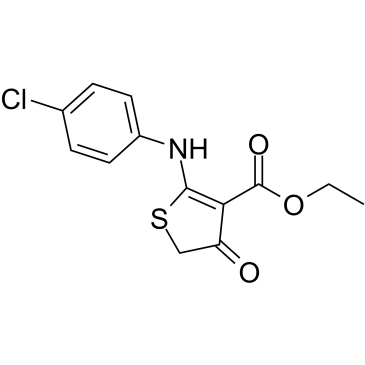
Physicochemical Properties
| Molecular Formula | C13H12NO3SCL |
| Molecular Weight | 297.757 |
| Exact Mass | 297.022 |
| CAS # | 425629-94-3 |
| PubChem CID | 135449276 |
| Appearance | Off-white to light yellow solid powder |
| Density | 1.5±0.1 g/cm3 |
| Boiling Point | 427.5±45.0 °C at 760 mmHg |
| Flash Point | 212.3±28.7 °C |
| Vapour Pressure | 0.0±1.0 mmHg at 25°C |
| Index of Refraction | 1.664 |
| LogP | 2.77 |
| Hydrogen Bond Donor Count | 1 |
| Hydrogen Bond Acceptor Count | 5 |
| Rotatable Bond Count | 4 |
| Heavy Atom Count | 19 |
| Complexity | 414 |
| Defined Atom Stereocenter Count | 0 |
| HS Tariff Code | 2934.99.9001 |
| Storage |
Powder-20°C 3 years 4°C 2 years In solvent -80°C 6 months -20°C 1 month |
| Shipping Condition | Room temperature (This product is stable at ambient temperature for a few days during ordinary shipping and time spent in Customs) |
Biological Activity
| ln Vitro | Plasmodium is the parasitic infectious disease that causes malaria worldwide. Of the parasites that cause malaria, Plasmodium falciparum is the most deadly and has the highest risk of complications and fatalities [1]. Overall selectivity for PfDHODH (IC50=1.113 µM) in comparison to hDHODH (IC50>50 µM) is demonstrated by PfDHODH-IN-2. In whole-cell experiments, PfDHODH-IN-2 demonstrated in vitro potency against the Plasmodium falciparum 3D7 and Dd2 strains, with IC50 values >20 µM, respectively [1]. |
| References |
[1]. Novel selective and potent inhibitors of malaria parasite dihydroorotate dehydrogenase: discovery and optimization of dihydrothiophenone derivatives. J Med Chem. 2013 Oct 24;56(20):7911-24. |
Solubility Data
| Solubility (In Vitro) | DMSO : ~12.5 mg/mL (~41.98 mM) |
| Solubility (In Vivo) |
Solubility in Formulation 1: 1.25 mg/mL (4.20 mM) in 10% DMSO + 40% PEG300 + 5% Tween80 + 45% Saline (add these co-solvents sequentially from left to right, and one by one), suspension solution; with sonication. For example, if 1 mL of working solution is to be prepared, you can add 100 μL of 12.5 mg/mL clear DMSO stock solution to 400 μL PEG300 and mix evenly; then add 50 μL Tween-80 to the above solution and mix evenly; then add 450 μL normal saline to adjust the volume to 1 mL. Preparation of saline: Dissolve 0.9 g of sodium chloride in 100 mL ddH₂ O to obtain a clear solution. Solubility in Formulation 2: 1.25 mg/mL (4.20 mM) in 10% DMSO + 90% (20% SBE-β-CD in Saline) (add these co-solvents sequentially from left to right, and one by one), suspension solution; with ultrasonication. For example, if 1 mL of working solution is to be prepared, you can add 100 μL of 12.5 mg/mL clear DMSO stock solution to 900 μL of 20% SBE-β-CD physiological saline solution and mix evenly. Preparation of 20% SBE-β-CD in Saline (4°C,1 week): Dissolve 2 g SBE-β-CD in 10 mL saline to obtain a clear solution. Solubility in Formulation 3: ≥ 1.25 mg/mL (4.20 mM) (saturation unknown) in 10% DMSO + 90% Corn Oil (add these co-solvents sequentially from left to right, and one by one), clear solution. For example, if 1 mL of working solution is to be prepared, you can add 100 μL of 12.5 mg/mL clear DMSO stock solution to 900 μL of corn oil and mix evenly. (Please use freshly prepared in vivo formulations for optimal results.) |
| Preparing Stock Solutions | 1 mg | 5 mg | 10 mg | |
| 1 mM | 3.3584 mL | 16.7920 mL | 33.5841 mL | |
| 5 mM | 0.6717 mL | 3.3584 mL | 6.7168 mL | |
| 10 mM | 0.3358 mL | 1.6792 mL | 3.3584 mL |