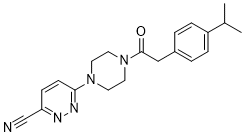
PZ-2891 (PZ2891) is an orally bioavailable, and brain penetrant allosteric activator of Pantothenate kinase (PANK) with neuroprotective activity. It acts as both an orthosteric inhibitor with IC50 of 1.3 nM and an allosteric activator of PANK3 in the presence of acetyl-CoA in biochemical assays. Pantothenate kinase (PANK) is a metabolic enzyme that regulates cellular coenzyme A (CoA) levels. There are three human PANK genes, and inactivating mutations in PANK2 lead to pantothenate kinase associated neurodegeneration (PKAN). PZ-2891 occupies the pantothenate pocket and engages the dimer interface to form a PANK•ATP•Mg2+•PZ-2891 complex. The binding of PZ-2891 to one protomer locks the opposite protomer in a catalytically active conformation that is refractory to acetyl-CoA inhibition. Oral administration of PZ-2891 increases CoA levels in mouse liver and brain. A knockout mouse model of brain CoA deficiency exhibited weight loss, severe locomotor impairment and early death. Knockout mice on PZ-2891 therapy gain weight, and have improved locomotor activity and life span establishing pantazines as novel therapeutics for the treatment of PKAN.
Physicochemical Properties
| Molecular Formula | C20H23N5O | |
| Molecular Weight | 349.44 | |
| Exact Mass | 349.19 | |
| CAS # | 2170608-82-7 | |
| Related CAS # |
|
|
| PubChem CID | 132260806 | |
| Appearance | White to off-white solid powder | |
| LogP | 2.3 | |
| Hydrogen Bond Donor Count | 0 | |
| Hydrogen Bond Acceptor Count | 5 | |
| Rotatable Bond Count | 4 | |
| Heavy Atom Count | 26 | |
| Complexity | 512 | |
| Defined Atom Stereocenter Count | 0 | |
| InChi Key | LGWDVWIZDPGCFG-UHFFFAOYSA-N | |
| InChi Code | InChI=1S/C20H23N5O/c1-15(2)17-5-3-16(4-6-17)13-20(26)25-11-9-24(10-12-25)19-8-7-18(14-21)22-23-19/h3-8,15H,9-13H2,1-2H3 | |
| Chemical Name |
|
|
| Synonyms |
|
|
| HS Tariff Code | 2934.99.9001 | |
| Storage |
Powder-20°C 3 years 4°C 2 years In solvent -80°C 6 months -20°C 1 month |
|
| Shipping Condition | Room temperature (This product is stable at ambient temperature for a few days during ordinary shipping and time spent in Customs) |
Biological Activity
| Targets |
PZ-2891 targets pantothenate kinase 3 (PANK3) as an allosteric activator (IC50 = 1.3 ± 0.2 nM for PANK3 inhibition assay; KD = 0.203 nM determined by surface plasmon resonance in the presence of 1 mM ATP•Mg²+) [1] PZ-2891 also acts on PANK1β and PANK2 , which are associated with pantothenate kinase-associated neurodegeneration (PKAN) [1] |
| ln Vitro |
PZ-2891 inhibits the mouse pantothenate kinases PANK1β, PANK2, and PANK3 withIC50 values of 48.7±5.1 nM, 1.0±0.1 nM, and 1.9±0.2 nM, respectively[1]. 1. PZ-2891 binds to the PANK3•ATP•Mg²+ complex with nanomolar affinity, occupying the pantothenate pocket and engaging the dimer interface to form a PANK•ATP•Mg²+•PZ-2891 complex; the inactive analog PZ-3067 shows no such binding activity [1] 2. PZ-2891 locks one protomer of the PANK3 dimer in a catalytically active conformation, rendering the opposite protomer refractory to acetyl-CoA inhibition; in PANK3 activity assays, 2.5 μM PZ-2891 abrogates ~95% of acetyl-CoA (100 μM)-mediated inhibition of PANK3, and the activation is pantothenate-dependent (45 μM and 90 μM pantothenate enhance PANK3 activity in the presence of PZ-2891) [1] 3. In cellular thermal shift (CETSA) assays, 10 μM PZ-2891 stabilizes PANK3 protein in C3A cells, while PZ-3067 has no such effect [1] 4. In C3A cells, 10 μM PZ-2891 significantly increases intracellular coenzyme A (CoA) levels in a pantothenate-dependent manner; pantothenate-free medium abolishes this effect, and supplementation with pantothenate dose-dependently enhances CoA elevation [1] 5. In HEK293T cells transfected with PANK3, 10 μM PZ-2891 elevates CoA levels, but no effect is observed in cells transfected with catalytically inactive PANK3(E138A) or empty vector; PZ-2891 also increases CoA levels in PANK1β-transfected HEK293T cells [1] 6. C3A cells radiolabeled with [³H]pantothenate and treated with 10 μM PZ-2891 for 24 h show altered labeled metabolite profiles (detected by thin-layer chromatography), indicating enhanced CoA synthesis [1] |
| ln Vivo |
1. Oral administration of PZ-2891 (30 mg/kg, 5 doses at 12 h intervals) to mice increases CoA levels in the liver and brain; co-administration with 200 mg/kg pantothenate further potentiates CoA elevation in these tissues [1] 2. In male and female mice fed with chow fortified with 1000 ppm pantothenate and PZ-2891 for 4 weeks, CoA levels in the liver, forebrain, and hindbrain are dose-dependently increased (statistical significance confirmed by Student’s t-test) [1] 3. In SynCre+ PANK1/PANK2 neuronal knockout mice (a model of brain CoA deficiency and PKAN), PZ-2891 therapy reverses weight loss, improves locomotor activity (increased percent moving time and distance traveled in the 5 min open field test), and extends lifespan; forebrain and hindbrain CoA levels in knockout mice are restored to near-control levels with PZ-2891 treatment [1] |
| Enzyme Assay |
1. PANK3 inhibitioctivation assay: Purified PANK3 enzyme (1 μg/assay) was incubated with ATP (1 mM), acetyl-CoA (0–100 μM), and different concentrations of PZ-2891 (or PZ-3067 as a negative control). The enzyme activity was measured, and data were fit to the Morrison equation to calculate the IC50 of PZ-2891 for PANK3. Time-course assays were performed to assess pantothenate-dependent activation of PANK3 by PZ-2891 in the presence of acetyl-CoA [1] 2. Thermal stabilization assay of PANK3: PANK3 protein was incubated with 8 mM ATP, 8 μM PZ-2891, or 2 mM ATP plus 2 μM PZ-2891. Thermal denaturation curves were generated by monitoring protein unfolding, and the shift in melting temperature was calculated to evaluate PANK3 stabilization by PZ-2891 [1] 3. Gel filtration chromatography for complex isolation: PANK3 protein was incubated with [³H]ATP•Mg²+ and PZ-2891, then subjected to gel filtration chromatography. The elution profiles of PANK3 (A280) and [³H]ATP were detected to confirm the formation of the PANK3•[³H]ATP•Mg²+•PZ-2891 complex [1] 4. Surface plasmon resonance (SPR) binding assay: PZ-2891 binding to PANK3 was analyzed by SPR in the presence of 1 mM ATP•Mg²+. The association (ka = 2.37 × 10⁶ M⁻¹s⁻¹) and dissociation (kd = 4.82 × 10⁻⁴ s⁻¹) constants were calculated, and the equilibrium dissociation constant (KD) and residence time (1/kd = 34 min) were determined [1] |
| Cell Assay |
1. Cellular thermal shift assay (CETSA): C3A cells were treated with 10 μM PZ-2891 or vehicle, then subjected to gradient heat treatment. Cell lysates were analyzed by immunoblotting with anti-PANK antibody to assess PANK3 stability; the melting curve of PANK3 was plotted to quantify the stabilizing effect of PZ-2891 [1] 2. Intracellular CoA measurement in C3A cells: C3A cells were cultured in pantothenate-free DMEM + dialyzed FBS with graded pantothenate supplementation. Cells were treated with 10 μM PZ-2891 or PZ-3067 for 24 h, then harvested and lysed. CoA levels in cell extracts were quantified by biochemical assays [1] 3. CoA measurement in transfected HEK293T cells: HEK293T cells were transfected with vectors expressing PANK1β, PANK3, catalytically inactive PANK3(E138A), or empty vector. Triplicate dishes were treated with 10 μM PZ-2891 or DMSO for 24 h, then lysed to measure total intracellular CoA levels; PANK isoform expression was verified by immunoblotting [1] 4. [³H]pantothenate labeling assay: C3A cells were radiolabeled with [³H]pantothenate in the presence or absence of 10 μM PZ-2891 for 24 h. Cellular metabolites were extracted, separated by thin-layer chromatography, and imaged with a Bioscan detector to analyze CoA synthesis [1] |
| Animal Protocol |
1. Acute CoA elevation mouse model: Groups of 5 mice were orally administered PZ-2891 (30 mg/kg) every 12 h for 5 doses, either alone or with 200 mg/kg pantothenate. Four hours after the final dose, mice were euthanized, and liver, forebrain, and hindbrain tissues were harvested to measure CoA levels by biochemical assays [1] 2. Chronic dietary treatment mouse model: Groups of 5 mice were fed chow fortified with 1000 ppm pantothenate and graded doses of PZ-2891 for 4 weeks. Tissues were collected, and CoA levels in the liver, forebrain, and hindbrain were quantified [1] 3. PKAN knockout mouse model: SynCre+ PANK1,PANK2 neuronal knockout mice (male and female) were randomized to control diet or diet containing PZ-2891. Body weight was monitored weekly; lifespan was recorded for survival analysis. At day 45, open field tests (5 min duration) were performed to assess locomotor activity (percent moving time and distance traveled). Forebrain and hindbrain tissues were harvested to measure CoA levels [1] 4. Pantothenate concentration measurement: Mice were gavaged with 200 mg/kg pantothenate using the same regimen as the acute CoA elevation model. Plasma, liver, forebrain, and hindbrain tissues were collected, and pantothenate concentrations were measured by mass spectrometry [1] |
| ADME/Pharmacokinetics |
PZ-2891 crosses the blood-brain barrier (confirmed by increased CoA levels in mouse forebrain and hindbrain after oral administration) [1] |
| References |
[1]. A therapeutic approach to pantothenate kinase associated neurodegeneration. Nat Commun. 2018 Oct 23;9(1):4399. |
| Additional Infomation |
1. PZ-2891 is a pantazine-class small molecule developed via library screening and chemical optimization, with lipophilic ligand efficiency (LipE)-guided refinement from the initial hit PZ-2789 [1] 2. PZ-2891 exerts its therapeutic effect by activating pantothenate kinase, the metabolic enzyme regulating cellular CoA levels; its binding to PANK3 modulates the dimer interface to prevent feedback inhibition by acetyl-CoA [1] 3. PZ-2891 is a novel therapeutic candidate for pantothenate kinase-associated neurodegeneration (PKAN), a rare neurodegenerative disorder caused by inactivating mutations in PANK2 [1] 4. The inventors of PZ-2891 hold a pending patent application (PCT/US17/39037) for "Small molecule modulators of pantothenate kinases" covering the pantazine chemical series [1] 5. PZ-2891 is refractory to acetyl-CoA inhibition, a key advantage over endogenous pantothenate in restoring CoA synthesis in PKAN models [1] |
Solubility Data
| Solubility (In Vitro) |
|
|||
| Solubility (In Vivo) |
Solubility in Formulation 1: ≥ 2.5 mg/mL (7.15 mM) (saturation unknown) in 10% DMSO + 90% Corn Oil (add these co-solvents sequentially from left to right, and one by one), clear solution. For example, if 1 mL of working solution is to be prepared, you can add 100 μL of 25.0 mg/mL clear DMSO stock solution to 900 μL of corn oil and mix evenly. (Please use freshly prepared in vivo formulations for optimal results.) |
| Preparing Stock Solutions | 1 mg | 5 mg | 10 mg | |
| 1 mM | 2.8617 mL | 14.3086 mL | 28.6172 mL | |
| 5 mM | 0.5723 mL | 2.8617 mL | 5.7234 mL | |
| 10 mM | 0.2862 mL | 1.4309 mL | 2.8617 mL |