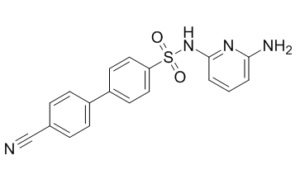
PF-915275 (PF915275) is a novel and selective inhibitor of human 11β-hydroxysteroid dehydrogenase type 1 (11betaHSD1) with Ki of<1 nM and good pharmacokinetics. 11betaHSD1 play a key role in ligand-induced activation of the GR through the production of cortisol. Evidence from genetically modified mice suggests that inhibition of 11betaHSD1 might be a therapeutic approach to treat the metabolic syndrome. PF-915275 maintains potency in our cellular assay against human 11βHSD1 (HEK293, EC50 = 5 nM) and is selective against human 11βHSD2 (HEK293, 1.5% inhibition 10 μM). PF-915275 displays only weak affinity for the rodent choline transporter (Ki = 9.6 μM) and the hamster melatonin MT3 receptor (Ki = 9.6 μM) in the Cerep Bioprint screening panel. PF-915275 has good in vitro pharmacokinetic properties.
Physicochemical Properties
| Molecular Formula | C18H14N4O2S | |
| Molecular Weight | 350.39 | |
| Exact Mass | 350.083 | |
| CAS # | 857290-04-1 | |
| Related CAS # |
|
|
| PubChem CID | 23725123 | |
| Appearance | White to pink solid powder | |
| Density | 1.4±0.1 g/cm3 | |
| Boiling Point | 610.9±65.0 °C at 760 mmHg | |
| Flash Point | 323.3±34.3 °C | |
| Vapour Pressure | 0.0±1.8 mmHg at 25°C | |
| Index of Refraction | 1.709 | |
| LogP | 2.06 | |
| Hydrogen Bond Donor Count | 2 | |
| Hydrogen Bond Acceptor Count | 6 | |
| Rotatable Bond Count | 4 | |
| Heavy Atom Count | 25 | |
| Complexity | 578 | |
| Defined Atom Stereocenter Count | 0 | |
| SMILES | N#CC1C=CC(C2C=CC(S(NC3C=CC=C(N)N=3)(=O)=O)=CC=2)=CC=1 |
|
| InChi Key | ZESFDAKNYJQYKO-UHFFFAOYSA-N | |
| InChi Code | InChI=1S/C18H14N4O2S/c19-12-13-4-6-14(7-5-13)15-8-10-16(11-9-15)25(23,24)22-18-3-1-2-17(20)21-18/h1-11H,(H3,20,21,22) | |
| Chemical Name | N-(6-aminopyridin-2-yl)-4-(4-cyanophenyl)benzenesulfonamide | |
| Synonyms |
|
|
| HS Tariff Code | 2934.99.9001 | |
| Storage |
Powder-20°C 3 years 4°C 2 years In solvent -80°C 6 months -20°C 1 month |
|
| Shipping Condition | Room temperature (This product is stable at ambient temperature for a few days during ordinary shipping and time spent in Customs) |
Biological Activity
| Targets |
The target of PF-915275 is 11β-hydroxysteroid dehydrogenase type 1 (11βHSD1). [1] The target of PF-915275 is 11β-hydroxysteroid dehydrogenase type 1 (11βHSD1). It belongs to the N-(Pyridin-2-yl) arylsulfonamide class of inhibitors targeting this enzyme, [2] The target of PF-915275 is 11β-hydroxysteroid dehydrogenase type 1 (11βHSD1), and it acts as a selective inhibitor of this enzyme. [3] |
| ln Vitro |
When coincubated with 300 nM enzyme substrate, PF-915275 is a potent inhibitor of 11βHSD1 (in vitro HEK293, EC50 of 15 nM) in this human 11βHSD1 overexpressed cell line. As expected from the species differences between humans and rodents found in biochemical assays, PF-915275 has an EC50 of 14,500 nM, making it a weak inhibitor of 11βHSD1 in rat FAO hepatoma cells. In primary hepatocytes from dogs, monkeys, and humans, PF-915275 exhibits species-dependent potency in blocking the cellular conversion of cortisone to cortisol. It also exhibits activity in human, monkey, and dog hepatocytes. At 10 μM, PF-915275 only exhibits 1.5% inhibition of 11βHSD2, suggesting a lack of significant inhibition. The impact of PF-915275, with an EC50 of 20 and 100 nM, respectively, on the conversion of cortisone to cortisol in primary human and monkey hepatocytes[1] is dose-dependent. 1. As an inhibitor of 11βHSD1, PF-915275 was evaluated for its ability to modulate the activity of 11βHSD1 in vitro. However, detailed experimental results such as the degree of enzyme inhibition, concentration-response relationships [1] 1. PF-915275, as a member of N-(Pyridin-2-yl) arylsulfonamide inhibitors, was designed to target 11βHSD1. In vitro assays focused on verifying its binding ability to 11βHSD1 and its inhibitory effect on enzyme activity, [2] 1. In vitro studies of PF-915275 primarily investigated its selective inhibitory activity against 11βHSD1. Although it was confirmed to be a selective inhibitor, [3] |
| ln Vivo |
Using cortisone and prednisone substrates, respectively, PF-915275 inhibits cortisone or prednisone turnover and produces EC50 values that are comparable to those in human hepatocytes in vivo 11βHSD1 activity (EC50 by PF-915275 is 18 and 13 nM, respectively). PF-915275 inhibits the conversion of prednisone to prednisolone mediated by 11βHSD1 in a dose-dependent manner. With a maximum tested dose of 3 mg/kg, an 87% inhibition is seen[1]. In monkeys, PF-915275 has a half-life of 22 hours [1]. After 8 hours of treatment, male cynomolgus monkeys given PF-915275 (0.1-3 mg/kg; oral administration; for 8 hours) show a trend in the dose-dependent reduction of fed plasma insulin. With PF-915275 treatment at 1 and 3 mg/kg, plasma insulin levels are significantly reduced (by 54 and 60%, respectively). Treatment has no effect on the levels of fat or plasma glucose[1]. 1. In cynomolgus monkeys, PF-915275 was used to demonstrate proof of mechanism (POM) related to 11βHSD1 inhibition. The study evaluated the pharmacokinetic-pharmacodynamic (PK-PD) relationship of the drug, [1] 1. PF-915275 was tested in vivo to assess its modulation of 11βHSD1 activity biomarkers. The study focused on changes in biomarkers related to 11βHSD1 activity (e.g., plasma or urine steroid metabolite levels) after drug administration[3] |
| Enzyme Assay |
1. For the enzyme activity assay of PF-915275 targeting 11βHSD1, the experimental system was constructed using recombinant 11βHSD1 enzyme (source not specified). The assay reaction system contained the enzyme, appropriate steroid substrates (e.g., cortisone, which is converted to cortisol by 11βHSD1), and cofactors required for the reaction. Different concentrations of PF-915275 were added to the reaction system, and the mixture was incubated at a suitable temperature for a specific period. After the reaction, the amount of product (cortisol) or remaining substrate (cortisone) was detected using a sensitive analytical method (e.g., liquid chromatography-tandem mass spectrometry or immunoassay) to calculate the inhibitory rate of PF-915275 on 11βHSD1 activity. [1] 1. The enzyme binding and activity inhibition assays of PF-915275 for 11βHSD1 involved immobilizing 11βHSD1 enzyme on a suitable platform (e.g., microplate or sensor chip) to measure the binding affinity of the drug to the enzyme. For the activity inhibition assay, the reaction system included 11βHSD1, substrate, cofactors, and various concentrations of PF-915275. After incubation, the enzyme activity was determined by detecting the formation of reaction products. [2] 1. The enzyme assay of PF-915275 for 11βHSD1 focused on evaluating its selective inhibitory effect. The assay compared the inhibitory activity of PF-915275 on 11βHSD1 with that on other related enzymes (e.g., 11βHSD2) to confirm its selectivity. The reaction system for each enzyme contained the corresponding enzyme, specific substrate, cofactors, and PF-915275 at different concentrations. After incubation, enzyme activity was measured by detecting substrate consumption or product formation[3] |
| Animal Protocol |
Animal/Disease Models: Adult male cynomolgus monkeys (2-5 kg)[1] Doses: 0.1 mg/kg, 0.3 mg/kg, 1 mg/kg, 3 mg/kg Route of Administration: Oral administration; for 8 hrs (hours) Experimental Results: There was a trend in dose-dependent lowering of fed plasma insulin after 8 h of dosing in these monkeys. Plasma insulin levels were Dramatically lowered (by 54 and 60%, respectively). 1. In cynomolgus monkeys, the animal protocol for PF-915275 included administering the drug via an unspecified route (likely oral or intravenous) at different doses. Blood samples were collected at multiple time points after administration to determine the plasma concentration of the drug (for pharmacokinetic analysis) and to measure biomarkers related to 11βHSD1 activity (for pharmacodynamic analysis). The study also involved monitoring the general health status of the monkeys during the experiment, but specific details (e.g., drug dissolution formula, dose levels, administration frequency, blood collection time points, or biomarker types) were not provided [1] |
| ADME/Pharmacokinetics |
1. In cynomolgus monkeys, pharmacokinetic studies of PF-915275 were conducted to analyze parameters such as plasma concentration-time profiles, clearance, volume of distribution, and half-life. The drug's absorption (if administered orally) or distribution characteristics were evaluated, but specific pharmacokinetic parameter values (e.g., half-life duration, volume of distribution, oral bioavailability) were not provided in the literature [1] |
| References |
[1]. Bhat BG, et al. Demonstration of proof of mechanism and pharmacokinetics and pharmacodynamic relationship with 4'-cyano-biphenyl-4-sulfonic acid (6-amino-pyridin-2-yl)-amide (PF-915275), an inhibitor of 11 -hydroxysteroid dehydrogenase type 1, in cynomolg [2]. Siu M, et al. N-(Pyridin-2-yl) arylsulfonamide inhibitors of 11beta-hydroxysteroid dehydrogenase type 1: Discovery of PF-915275. Bioorg Med Chem Lett. 2009 Jul 1;19(13):3493-7. [3]. Courtney R, et al. Modulation of 11beta-hydroxysteroid dehydrogenase (11betaHSD) activity biomarkers and pharmacokinetics of PF-00915275, a selective 11betaHSD1 inhibitor. J Clin Endocrinol Metab. 2008 Feb;93(2):550-6. |
| Additional Infomation |
1. PF-915275 is an inhibitor of 11βHSD1, and its development is based on the role of 11βHSD1 in steroid metabolism (e.g., converting cortisone to active cortisol). In cynomolgus monkeys, the drug was used to verify the proof of mechanism, which is crucial for confirming that inhibiting 11βHSD1 can produce the expected pharmacological effects and supporting further clinical development. However, specific information about its clinical indications (e.g., potential for treating metabolic diseases or inflammatory disorders) or FDA warning information was not provided [1] 1. PF-915275 belongs to the N-(Pyridin-2-yl) arylsulfonamide class of compounds, a structural class designed for targeting 11βHSD1. The discovery of this drug involved optimizing the chemical structure of N-(Pyridin-2-yl) arylsulfonamides to enhance binding affinity and selectivity for 11βHSD1, laying the foundation for subsequent preclinical and clinical studies. No information about its efficacy in disease models or regulatory status was provided [2] 1. The core value of PF-915275 lies in its selectivity as an 11βHSD1 inhibitor, which is important for reducing off-target effects (e.g., avoiding interference with other steroid-metabolizing enzymes). Its in vivo studies focused on modulating 11βHSD1 activity biomarkers, providing evidence for the drug's ability to act on the target in living organisms. However, no information about its therapeutic potential in specific diseases (e.g., type 2 diabetes, obesity) or safety profiles was provided [3] |
Solubility Data
| Solubility (In Vitro) |
|
|||
| Solubility (In Vivo) |
Solubility in Formulation 1: ≥ 0.83 mg/mL (2.37 mM) (saturation unknown) in 10% DMSO + 40% PEG300 + 5% Tween80 + 45% Saline (add these co-solvents sequentially from left to right, and one by one), clear solution. For example, if 1 mL of working solution is to be prepared, you can add 100 μL of 8.3 mg/mL clear DMSO stock solution to 400 μL of PEG300 and mix evenly; then add 50 μL of Tween-80 to the above solution and mix evenly; then add 450 μL of normal saline to adjust the volume to 1 mL. Preparation of saline: Dissolve 0.9 g of sodium chloride in 100 mL ddH₂ O to obtain a clear solution. Solubility in Formulation 2: ≥ 0.83 mg/mL (2.37 mM) (saturation unknown) in 10% DMSO + 90% (20% SBE-β-CD in Saline) (add these co-solvents sequentially from left to right, and one by one), clear solution. For example, if 1 mL of working solution is to be prepared, you can add 100 μL of 8.3 mg/mL clear DMSO stock solution to 900 μL of 20% SBE-β-CD physiological saline solution and mix evenly. Preparation of 20% SBE-β-CD in Saline (4°C,1 week): Dissolve 2 g SBE-β-CD in 10 mL saline to obtain a clear solution. Solubility in Formulation 3: ≥ 0.83 mg/mL (2.37 mM) (saturation unknown) in 10% DMSO + 90% Corn Oil (add these co-solvents sequentially from left to right, and one by one), clear solution. For example, if 1 mL of working solution is to be prepared, you can add 100 μL of 8.3 mg/mL clear DMSO stock solution to 900 μL of corn oil and mix evenly. (Please use freshly prepared in vivo formulations for optimal results.) |
| Preparing Stock Solutions | 1 mg | 5 mg | 10 mg | |
| 1 mM | 2.8540 mL | 14.2698 mL | 28.5396 mL | |
| 5 mM | 0.5708 mL | 2.8540 mL | 5.7079 mL | |
| 10 mM | 0.2854 mL | 1.4270 mL | 2.8540 mL |