Physicochemical Properties
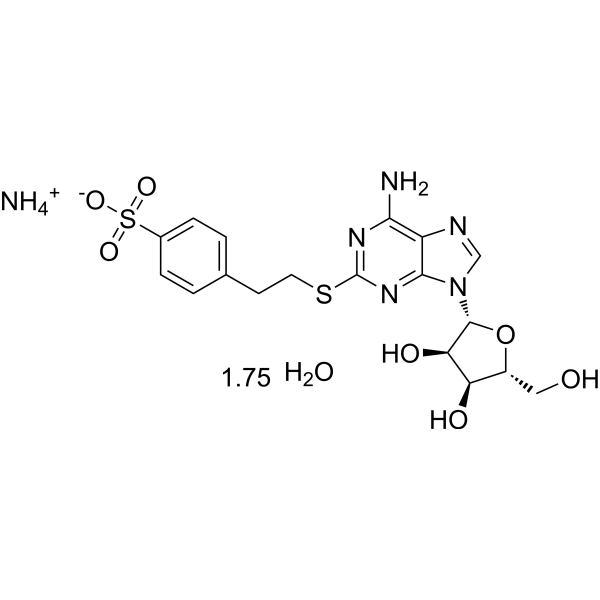
| Molecular Formula | C18H20N5O7S2.NH4.1.75H2O |
| Related CAS # | PSB 0777 ammonium;2122196-16-9 |
| Appearance | White to off-white solid powder |
| HS Tariff Code | 2934.99.9001 |
| Storage |
Powder-20°C 3 years 4°C 2 years In solvent -80°C 6 months -20°C 1 month Note: Please store this product in a sealed and protected environment, avoid exposure to moisture. |
| Shipping Condition | Room temperature (This product is stable at ambient temperature for a few days during ordinary shipping and time spent in Customs) |
Biological Activity
| Targets | Ki: 44.4 nM (rat A2A), 360 nM (human A2A), ≥10000 nM (rat A1) and 541 nM (human A1)[1] |
| ln Vitro | Compound 7, PSB 0777 ammonium hydrate, exhibits significant selectivity (>225-fold) for the A2AAR relative to the other AR subtypes (Ki values of ≫10000 for the human A3 receptor and >10000 nM for the human A2B receptor, respectively). In CHO-K1 cells, PSB 0777 ammonium hydrate exhibits full agonistic activity at A2AAR, with an EC50 value of 117 nM[1]. Human β1 (Ki = 4.4 μM) and β3 (Ki = 3.3 μM) adrenergic receptors are bound by PSB-0777 ammonium[2]. In untreated and inflamed rat ileum/jejunum preparations, PSB 0777 ammonium hydrate (0.1 µM, 1 µM, and 10 µM) enhances concentration-dependently Acetylcholine (Ach, 1 mM) contractions[1]. |
| ln Vivo | Ammonium hydrate (0.4 mg/kg/day; oral gavage; day 5 to day 10) administered via PSB 0777 results in a significant decrease in the infiltration of inflammatory cells and an improvement in the architecture of the colonic mucosa[3]. C57BL/6J mice are susceptible to dose-dependent hypothermia and hypoactivity when exposed to PSB 0777 ammonium hydrate (0.03, 0.3, and 3 mg/kg; ip)[2]. After being taken orally, PSB 0777 ammonium hydrate cannot be absorbed systemically by the mucosa of the digestive tract. Rats treated with PSB 0777 ammonium hydrate (0.4 mg/kg/day; PO) had very low plasma concentrations at 30 minutes (less than 5 nM) and no plasma concentrations at 60 minutes. Ammonium hydrate PSB 0777 (0.4 mg/kg/day; IP) produces plasma concentrations that are clearly visible after 30 minutes, start to decline after 60 minutes, and become undetectable after 120 and 240 minutes[3]. |
| References |
[1]. Ali El-Tayeb, et al. Development of Polar Adenosine A2A Receptor Agonists for Inflammatory Bowel Disease: Synergism with A2B Antagonists. ACS Med Chem Lett. 2011 Oct 10;2(12):890-5. [2]. Jesse Lea Carlin, et al.Activation of adenosine A 2A or A 2B receptors causes hypothermia in mice. Neuropharmacology. 2018 Sep 1;139:268-278. [3]. L Antonioli, et al. Anti-inflammatory effect of a novel locally acting A 2A receptor agonist in a rat model of oxazolone-induced colitis. Purinergic Signal. 2018 Mar;14(1):27-36. |
Solubility Data
| Solubility (In Vitro) | May dissolve in DMSO (in most cases), if not, try other solvents such as H2O, Ethanol, or DMF with a minute amount of products to avoid loss of samples |
| Solubility (In Vivo) |
Note: Listed below are some common formulations that may be used to formulate products with low water solubility (e.g. < 1 mg/mL), you may test these formulations using a minute amount of products to avoid loss of samples. Injection Formulations (e.g. IP/IV/IM/SC) Injection Formulation 1: DMSO : Tween 80: Saline = 10 : 5 : 85 (i.e. 100 μL DMSO stock solution → 50 μL Tween 80 → 850 μL Saline) *Preparation of saline: Dissolve 0.9 g of sodium chloride in 100 mL ddH ₂ O to obtain a clear solution. Injection Formulation 2: DMSO : PEG300 :Tween 80 : Saline = 10 : 40 : 5 : 45 (i.e. 100 μL DMSO → 400 μLPEG300 → 50 μL Tween 80 → 450 μL Saline) Injection Formulation 3: DMSO : Corn oil = 10 : 90 (i.e. 100 μL DMSO → 900 μL Corn oil) Example: Take the Injection Formulation 3 (DMSO : Corn oil = 10 : 90) as an example, if 1 mL of 2.5 mg/mL working solution is to be prepared, you can take 100 μL 25 mg/mL DMSO stock solution and add to 900 μL corn oil, mix well to obtain a clear or suspension solution (2.5 mg/mL, ready for use in animals). Injection Formulation 4: DMSO : 20% SBE-β-CD in saline = 10 : 90 [i.e. 100 μL DMSO → 900 μL (20% SBE-β-CD in saline)] *Preparation of 20% SBE-β-CD in Saline (4°C,1 week): Dissolve 2 g SBE-β-CD in 10 mL saline to obtain a clear solution. Injection Formulation 5: 2-Hydroxypropyl-β-cyclodextrin : Saline = 50 : 50 (i.e. 500 μL 2-Hydroxypropyl-β-cyclodextrin → 500 μL Saline) Injection Formulation 6: DMSO : PEG300 : castor oil : Saline = 5 : 10 : 20 : 65 (i.e. 50 μL DMSO → 100 μLPEG300 → 200 μL castor oil → 650 μL Saline) Injection Formulation 7: Ethanol : Cremophor : Saline = 10: 10 : 80 (i.e. 100 μL Ethanol → 100 μL Cremophor → 800 μL Saline) Injection Formulation 8: Dissolve in Cremophor/Ethanol (50 : 50), then diluted by Saline Injection Formulation 9: EtOH : Corn oil = 10 : 90 (i.e. 100 μL EtOH → 900 μL Corn oil) Injection Formulation 10: EtOH : PEG300:Tween 80 : Saline = 10 : 40 : 5 : 45 (i.e. 100 μL EtOH → 400 μLPEG300 → 50 μL Tween 80 → 450 μL Saline) Oral Formulations Oral Formulation 1: Suspend in 0.5% CMC Na (carboxymethylcellulose sodium) Oral Formulation 2: Suspend in 0.5% Carboxymethyl cellulose Example: Take the Oral Formulation 1 (Suspend in 0.5% CMC Na) as an example, if 100 mL of 2.5 mg/mL working solution is to be prepared, you can first prepare 0.5% CMC Na solution by measuring 0.5 g CMC Na and dissolve it in 100 mL ddH2O to obtain a clear solution; then add 250 mg of the product to 100 mL 0.5% CMC Na solution, to make the suspension solution (2.5 mg/mL, ready for use in animals). Oral Formulation 3: Dissolved in PEG400 Oral Formulation 4: Suspend in 0.2% Carboxymethyl cellulose Oral Formulation 5: Dissolve in 0.25% Tween 80 and 0.5% Carboxymethyl cellulose Oral Formulation 6: Mixing with food powders Note: Please be aware that the above formulations are for reference only. InvivoChem strongly recommends customers to read literature methods/protocols carefully before determining which formulation you should use for in vivo studies, as different compounds have different solubility properties and have to be formulated differently. (Please use freshly prepared in vivo formulations for optimal results.) |