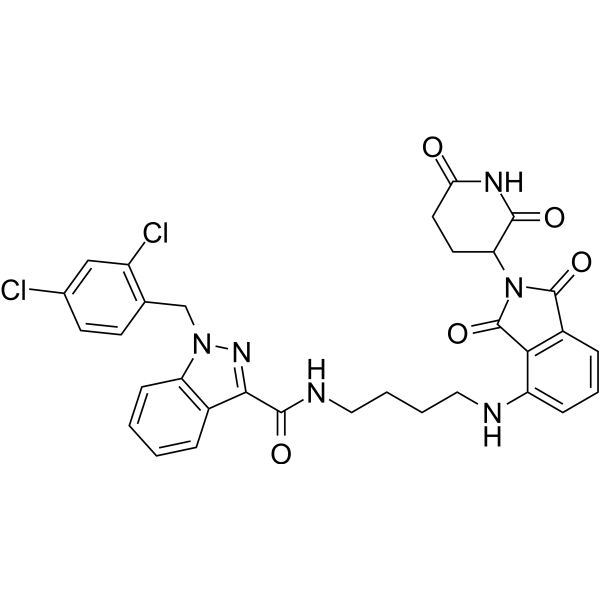
Physicochemical Properties
| Molecular Formula | C32H28CL2N6O5 |
| Molecular Weight | 647.51 |
| CAS # | 3033812-84-6 |
| PubChem CID | 171361405 |
| Appearance | Light yellow to yellow solid powder |
| Density | 1.53±0.1 g/cm3(Temp: 20 °C; Press: 760 Torr)(predicted) |
| Boiling Point | 954.7±65.0 °C(predicted) |
| LogP | 0 |
| Hydrogen Bond Donor Count | 3 |
| Hydrogen Bond Acceptor Count | 7 |
| Rotatable Bond Count | 10 |
| Heavy Atom Count | 45 |
| Complexity | 1160 |
| Defined Atom Stereocenter Count | 0 |
| HS Tariff Code | 2934.99.9001 |
| Storage |
Powder-20°C 3 years 4°C 2 years In solvent -80°C 6 months -20°C 1 month |
| Shipping Condition | Room temperature (This product is stable at ambient temperature for a few days during ordinary shipping and time spent in Customs) |
Biological Activity
| Targets | DC50: 2.56 μM (Hexokinase 2, HK2 in 4T1); 0.79 μM ((Hexokinase 2, HK2 in MDA-MB-231) |
| ln Vitro | PROTAC HK2 Degrader-1 has an IC50 of 34.07 μM, 5.08 μM, 31.53 μM, 6.11 μM, and 21.65 μM for suppressing the growth of 786-O, 4T1, PANC-1, HGC-27, and MCF-1 cells, respectively [1]. PROTAC HK2 Degrader-1's DC50 against HK2 is 2.56 μM (4T1) and 0.79 μM (MDA-MB-231) [1]. Time- and concentration-dependent, PROTAC HK2 Degrader-1 (0.01-200 μM, 36 h) specifically suppresses the growth of breast cancer cells and promotes the ubiquitin-mediated proteasome pathway-mediated degradation of HK2 protein [1]. To degrade the HK2 protein, PROTAC HK2 Degrader-1 forms a ternary complex through the ubiquitin-proteasome system (10 μM for 4T1, 0.5 μM for MDA-MB-231, 24 h) [1]. This phrase can be included in the general product description and utilized as a mechanism. By degrading HK2, PROTAC HK2 Degrader-1 (20 μM, 36 h) activates caspase-3, releases cytochrome C, cleaves GSDME, induces a thermal coma, and causes cells to produce harmful signals like ATP, HMGB1, CRT, etc., ultimately resulting in caused cell death. immunity to demise [1]. The overall amount of PD-L1 protein can be decreased by inducing the internalization of the protein from the cell membrane to the cytoplasm using PROTAC HK2 Degrader-1 (20 μM, 36 h) [1]. |
| ln Vivo | In the 4T1 tumor model, PROTAC HK2 Degrader-1 (50 mg/kg, intraperitoneal injection, bid, for nine times, six-week-old female BALB/c mice) suppresses tumor growth [1]. PROTAC HK2 Degrader-1 (50 mg/kg, intraperitoneal injection, daily, nine times, in six-week-old female BALB/c mice) can successfully limit the growth of breast tumors and produce a GSDME-dependent heat reaction as well as elicit a tumor immunological response. [1]. Protac HK2 Degrader-1 (Cisplatin (HY-17394) 10mg/kg, iv, C-02 50mg/kg, ip, 25 days, six-week-old female BALB/c mice) has the potential to be clinically useful since it can sensitize cisplatin while lowering its intestinal adverse effects [1]. |
| Cell Assay |
Cell Cytotoxicity Assay[1] Cell Types: 4T1, MDA-MB-231, PUMC-HUVEC-T1 Tested Concentrations: 20 μM Incubation Duration: 72 h(MTT), 48 h(CCK-8) Experimental Results: demonstrated the greatest impact on 4T1 and HGC-27 cells, with IC50 dosages of 5.08 and 6.11 μM. Selectively suppressed breast cancer cell proliferation and stimulates HK2 protein degradation. Prevented 4T1 cells to form a colony and had little influence on HUVECT-1. Western Blot Analysis[1] Cell Types: 4T1, MDAMB-231 Tested Concentrations: 20 μM; 0.01, 0.05, 0.1, 0.5, 1.0, 2.0, 5.0, 10, 20, 50, 100, 150, 200 μM; 10 μM; 0.5 μM. Incubation Duration: 36 h ; 24 h Experimental Results: Degraded 71.06% of HK2 at 20 μM in 4T1 and MDAMB-231 cells. DC50=2.56 μM(4T1) and 0.79 μM(MDA-MB-231), respectivley. Promoted the degradation of HK2 protein within 12 h, with the greatest degradation impact at 36 h in 4T1 cells and MDA-MB-231 cells. Degradation capacity was decreased, because pretreatment with Tha and LND occupy the protein pocket and disrupt the formation of the ternary complex of HK2, CRB |
| Animal Protocol |
Animal/Disease Models: xenograft models, into six-weekold female balb/c (Bagg ALBino) mouse[1] Doses: 50 mg/kg Route of Administration: intraperitoneal (ip)injection, bid, for nine times. Experimental Results: decreased proliferation and damaged nuclei in mouse models. Increased the levels of Cytokines IL-1β, IFN-γ, and TNF-α Dramatically and diminished the level of TGF-β and IL-10. Elevated levels of cleaved-Casp-3 and GSDME-N in tumor tissues of mouse. Animal/Disease Models: breast tumor model in mice by injecting 4T1 cells subcutaneously (sc) into six-weekold female balb/c (Bagg ALBino) mouse[1] Doses: Cisplatin (HY-17394) 10mg/kg, 50mg/kg Route of Administration: Cisplatin (HY-17394) (10mg/kg, iv) , 50mg/kg, ip, 25 days Experimental Results: Inhibited tumor growth and tumor volume. diminished HK2 protein level, while co- treated with Cisplatin (HY-17394). Could alleviate Cisplatin (HY-17394) aggravated colon damage. |
| References |
[1]. Degradation of Hexokinase 2 Blocks Glycolysis and Induces GSDME-Dependent Pyroptosis to Amplify Immunogenic Cell Death for Breast Cancer Therapy. J Med Chem. 2023 Jun 27. |
Solubility Data
| Solubility (In Vitro) | DMSO :~100 mg/mL (~154.44 mM) |
| Solubility (In Vivo) |
Note: Listed below are some common formulations that may be used to formulate products with low water solubility (e.g. < 1 mg/mL), you may test these formulations using a minute amount of products to avoid loss of samples. Injection Formulations (e.g. IP/IV/IM/SC) Injection Formulation 1: DMSO : Tween 80: Saline = 10 : 5 : 85 (i.e. 100 μL DMSO stock solution → 50 μL Tween 80 → 850 μL Saline) *Preparation of saline: Dissolve 0.9 g of sodium chloride in 100 mL ddH ₂ O to obtain a clear solution. Injection Formulation 2: DMSO : PEG300 :Tween 80 : Saline = 10 : 40 : 5 : 45 (i.e. 100 μL DMSO → 400 μLPEG300 → 50 μL Tween 80 → 450 μL Saline) Injection Formulation 3: DMSO : Corn oil = 10 : 90 (i.e. 100 μL DMSO → 900 μL Corn oil) Example: Take the Injection Formulation 3 (DMSO : Corn oil = 10 : 90) as an example, if 1 mL of 2.5 mg/mL working solution is to be prepared, you can take 100 μL 25 mg/mL DMSO stock solution and add to 900 μL corn oil, mix well to obtain a clear or suspension solution (2.5 mg/mL, ready for use in animals). Injection Formulation 4: DMSO : 20% SBE-β-CD in saline = 10 : 90 [i.e. 100 μL DMSO → 900 μL (20% SBE-β-CD in saline)] *Preparation of 20% SBE-β-CD in Saline (4°C,1 week): Dissolve 2 g SBE-β-CD in 10 mL saline to obtain a clear solution. Injection Formulation 5: 2-Hydroxypropyl-β-cyclodextrin : Saline = 50 : 50 (i.e. 500 μL 2-Hydroxypropyl-β-cyclodextrin → 500 μL Saline) Injection Formulation 6: DMSO : PEG300 : castor oil : Saline = 5 : 10 : 20 : 65 (i.e. 50 μL DMSO → 100 μLPEG300 → 200 μL castor oil → 650 μL Saline) Injection Formulation 7: Ethanol : Cremophor : Saline = 10: 10 : 80 (i.e. 100 μL Ethanol → 100 μL Cremophor → 800 μL Saline) Injection Formulation 8: Dissolve in Cremophor/Ethanol (50 : 50), then diluted by Saline Injection Formulation 9: EtOH : Corn oil = 10 : 90 (i.e. 100 μL EtOH → 900 μL Corn oil) Injection Formulation 10: EtOH : PEG300:Tween 80 : Saline = 10 : 40 : 5 : 45 (i.e. 100 μL EtOH → 400 μLPEG300 → 50 μL Tween 80 → 450 μL Saline) Oral Formulations Oral Formulation 1: Suspend in 0.5% CMC Na (carboxymethylcellulose sodium) Oral Formulation 2: Suspend in 0.5% Carboxymethyl cellulose Example: Take the Oral Formulation 1 (Suspend in 0.5% CMC Na) as an example, if 100 mL of 2.5 mg/mL working solution is to be prepared, you can first prepare 0.5% CMC Na solution by measuring 0.5 g CMC Na and dissolve it in 100 mL ddH2O to obtain a clear solution; then add 250 mg of the product to 100 mL 0.5% CMC Na solution, to make the suspension solution (2.5 mg/mL, ready for use in animals). Oral Formulation 3: Dissolved in PEG400 Oral Formulation 4: Suspend in 0.2% Carboxymethyl cellulose Oral Formulation 5: Dissolve in 0.25% Tween 80 and 0.5% Carboxymethyl cellulose Oral Formulation 6: Mixing with food powders Note: Please be aware that the above formulations are for reference only. InvivoChem strongly recommends customers to read literature methods/protocols carefully before determining which formulation you should use for in vivo studies, as different compounds have different solubility properties and have to be formulated differently. (Please use freshly prepared in vivo formulations for optimal results.) |
| Preparing Stock Solutions | 1 mg | 5 mg | 10 mg | |
| 1 mM | 1.5444 mL | 7.7219 mL | 15.4438 mL | |
| 5 mM | 0.3089 mL | 1.5444 mL | 3.0888 mL | |
| 10 mM | 0.1544 mL | 0.7722 mL | 1.5444 mL |