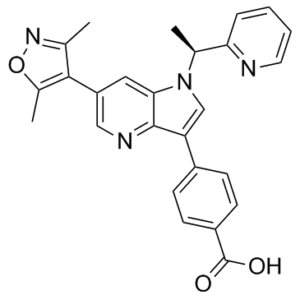
PLX51107 is a novel, potent and selective BET (Bromodomain and Extra-Terminal motif) inhibitor, also called BRD4 (bromodomain and extra terminal domain) inhibitor with Kd values of 1.6, 2.1, 1.7, and 5 nM for BD1 and 5.9, 6.2, 6.1, and 120 nM for BD2 of BRD2, BRD3, BRD4, and BRDT, respectively; BRD4 is overexpressed in CLL and is enriched proximal to genes upregulated or de novo expressed in CLL with known functions in disease pathogenesis and progression. PLX51107 also interacts with the bromodomains of CBP and EP300 with Kd in the 100 nM range. As a structurally distinct BET inhibitor, PLX51107 demonstrated potent in vitro and in vivo pharmacologic properties that emulates or exceeds the efficacy of BCR signaling agents in preclinical models of CLL. PLX51107 binds to the acetylated lysine recognition motifs in the bromodomains of the BRD4 protein, thereby preventing the binding of BRD4 to acetylated lysines on histones, which disrupts chromatin remodeling and gene expression. The discovery of the involvement of BRD4 in the core CLL transcriptional program provides a compelling rationale for clinical investigation of PLX51107 as epigenetic therapy in CLL and application of BRD4 profiling in other cancers.
Physicochemical Properties
| Molecular Formula | C26H22N4O3 | |
| Molecular Weight | 438.477885723114 | |
| Exact Mass | 438.169 | |
| Elemental Analysis | C, 71.22; H, 5.06; N, 12.78; O, 10.95 | |
| CAS # | 1627929-55-8 | |
| Related CAS # |
|
|
| PubChem CID | 90448953 | |
| Appearance | White to off-white solid powder | |
| LogP | 4 | |
| Hydrogen Bond Donor Count | 1 | |
| Hydrogen Bond Acceptor Count | 6 | |
| Rotatable Bond Count | 5 | |
| Heavy Atom Count | 33 | |
| Complexity | 684 | |
| Defined Atom Stereocenter Count | 1 | |
| SMILES | O1C(C)=C(C(C)=N1)C1=CN=C2C(C3C=CC(C(=O)O)=CC=3)=CN(C2=C1)[C@H](C1C=CC=CN=1)C |
|
| InChi Key | AMSUHYUVOVCWTP-INIZCTEOSA-N | |
| InChi Code | InChI=1S/C26H22N4O3/c1-15-24(17(3)33-29-15)20-12-23-25(28-13-20)21(18-7-9-19(10-8-18)26(31)32)14-30(23)16(2)22-6-4-5-11-27-22/h4-14,16H,1-3H3,(H,31,32)/t16-/m0/s1 | |
| Chemical Name |
|
|
| Synonyms |
|
|
| HS Tariff Code | 2934.99.9001 | |
| Storage |
Powder-20°C 3 years 4°C 2 years In solvent -80°C 6 months -20°C 1 month |
|
| Shipping Condition | Room temperature (This product is stable at ambient temperature for a few days during ordinary shipping and time spent in Customs) |
Biological Activity
| Targets | BRD2-BD1 (Kd = 1.6 nM); BRD3-BD1 (Kd = 2.1 nM); BRD4-BD1 (Kd = 1.7 nM); 5 nM (BRDT-BD1), 5.9 nM (BRD2-BD2), 6.2 nM (BRD3-BD2), 6.1 nM (BRD4-BD2), 120 nM (BRDT-BD2), ∼100 nM (CBP), ∼100 nM (EP300) | ||
| ln Vitro | With Kds of 1.6, 2.1, 1.7, and 5 nM for BD1, 5.9, 6.2, 6.1, and 120 nM for BRD2, BRD3, and BRD4, respectively, and BRDT, PLX51107 is a strong and selective BET inhibitor. Additionally, PLX51107 interacts with EP300's and CBP's bromodomains (Kd, within a 100 nM range). PLX51107 (0.156-10 μM) prevents primary chronic lymphocytic leukemia (CLL) cells from proliferating when exposed to CpG. In addition, PLX51107 lowers c-MYC levels, increases p21 and IκBα accumulation, and modifies pro- and anti-apoptotic proteins. CLL driver genes are specifically regulated by PLX51107 [1]. | ||
| ln Vivo | In the Ba/F3 (mouse IL3-dependent pre-B cell line) splenomegaly mouse model, PLX51107 (2 mg/kg, orally) reduced splenomegaly by 75%, with results resembling those of 25 mg/kg OTX015. When taken orally once daily, PLX51107 (20 mg/kg, qd, po) shows strong antileukemia effects in models of Richter transformation (RT) and aggressive chronic lymphocytic leukemia (CLL) [1]. | ||
| Cell Assay |
ChIP-Seq and Data Processing[1] Primary CLL cells (1E7 cells per condition) were treated with vehicle (DMSO), or 1μM PLX51107 with or without CpG oligonucleotides (3.2 μM) for 4 h. Cells were fixed with 1% formaldehyde for 15 min and quenched with 0.125 M glycine. Chromatin was isolated by the addition of lysis buffer, followed by disruption with a Dounce homogenizer. Lysates were sonicated and the DNA sheared to an average length of 300–500 bp. See supplementary information for detailed cross-link procedure. Genomic DNA regions of interest were isolated using 4μg antibody against BRD4, H3K27ac and RNA Pol II. Complexes were washed, eluted from the beads with SDS buffer, and subjected to RNase and proteinase K treatment. Crosslinks were reversed by incubation overnight at 65°C, and ChIP DNA was purified by phenol-chloroform extraction and ethanol precipitation. |
||
| Animal Protocol |
|
||
| References |
[1]. BRD4 Profiling Identifies Critical Chronic Lymphocytic Leukemia Oncogenic Circuits and Reveals Sensitivity to PLX51107, a Novel Structurally Distinct BET Inhibitor. Cancer Discov. 2018 Apr;8(4):458-477. |
||
| Additional Infomation |
PLX51107 is a potent and selective inhibitor of the bromodomain and extraterminal (BET) protein family. PLX51107 is under investigation in clinical trial NCT04022785 (PLX51107 and Azacitidine in Treating Patients With Acute Myeloid Leukemia or Myelodysplastic Syndrome). BRD4 Inhibitor PLX51107 is an inhibitor of the bromodomain-containing protein 4 (BRD4), with potential antineoplastic activity. Upon administration, the BRD4 inhibitor PLX51107 binds to the acetylated lysine recognition motifs in the bromodomains of the BRD4 protein, thereby preventing the binding of BRD4 to acetylated lysines on histones. This disrupts chromatin remodeling and gene expression. Prevention of the expression of certain growth-promoting genes may lead to an induction of apoptosis and an inhibition of proliferation in BRD4-overexpressing tumor cells. BRD4, a member of the human bromodomain and extra-terminal (BET) family of proteins, is a transcriptional regulator that is overexpressed in certain tumor cells and plays an important role in cellular proliferation. Bromodomain and extra-terminal (BET) family proteins are key regulators of gene expression in cancer. Herein, we utilize BRD4 profiling to identify critical pathways involved in pathogenesis of chronic lymphocytic leukemia (CLL). BRD4 is overexpressed in CLL and is enriched proximal to genes upregulated or de novo expressed in CLL with known functions in disease pathogenesis and progression. These genes, including key members of the B-cell receptor (BCR) signaling pathway, provide a rationale for this therapeutic approach to identify new targets in alternative types of cancer. Additionally, we describe PLX51107, a structurally distinct BET inhibitor with novel in vitro and in vivo pharmacologic properties that emulates or exceeds the efficacy of BCR signaling agents in preclinical models of CLL. Herein, the discovery of the involvement of BRD4 in the core CLL transcriptional program provides a compelling rationale for clinical investigation of PLX51107 as epigenetic therapy in CLL and application of BRD4 profiling in other cancers.Significance: To date, functional studies of BRD4 in CLL are lacking. Through integrated genomic, functional, and pharmacologic analyses, we uncover the existence of BRD4-regulated core CLL transcriptional programs and present preclinical proof-of-concept studies validating BET inhibition as an epigenetic approach to target BCR signaling in CLL. Cancer Discov; 8(4); 458-77. ©2018 AACR.This article is highlighted in the In This Issue feature, p. 371.[1] |
Solubility Data
| Solubility (In Vitro) |
|
|||
| Solubility (In Vivo) |
Solubility in Formulation 1: ≥ 2.5 mg/mL (5.70 mM) (saturation unknown) in 10% DMSO + 40% PEG300 + 5% Tween80 + 45% Saline (add these co-solvents sequentially from left to right, and one by one), clear solution. For example, if 1 mL of working solution is to be prepared, you can add 100 μL of 25.0 mg/mL clear DMSO stock solution to 400 μL PEG300 and mix evenly; then add 50 μL Tween-80 to the above solution and mix evenly; then add 450 μL normal saline to adjust the volume to 1 mL. Preparation of saline: Dissolve 0.9 g of sodium chloride in 100 mL ddH₂ O to obtain a clear solution. Solubility in Formulation 2: ≥ 2.5 mg/mL (5.70 mM) (saturation unknown) in 10% DMSO + 90% (20% SBE-β-CD in Saline) (add these co-solvents sequentially from left to right, and one by one), clear solution. For example, if 1 mL of working solution is to be prepared, you can add 100 μL of 25.0 mg/mL clear DMSO stock solution to 900 μL of 20% SBE-β-CD physiological saline solution and mix evenly. Preparation of 20% SBE-β-CD in Saline (4°C,1 week): Dissolve 2 g SBE-β-CD in 10 mL saline to obtain a clear solution. Solubility in Formulation 3: ≥ 2.5 mg/mL (5.70 mM) (saturation unknown) in 10% DMSO + 90% Corn Oil (add these co-solvents sequentially from left to right, and one by one), clear solution. For example, if 1 mL of working solution is to be prepared, you can add 100 μL of 25.0 mg/mL clear DMSO stock solution to 900 μL of corn oil and mix evenly. (Please use freshly prepared in vivo formulations for optimal results.) |
| Preparing Stock Solutions | 1 mg | 5 mg | 10 mg | |
| 1 mM | 2.2806 mL | 11.4030 mL | 22.8061 mL | |
| 5 mM | 0.4561 mL | 2.2806 mL | 4.5612 mL | |
| 10 mM | 0.2281 mL | 1.1403 mL | 2.2806 mL |