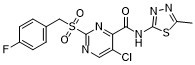
PK11007 is a novel and potent anti-p53 compound with anti-tumor activities through activation of unstable p53 (tumor suppressor p53). PK11007 acted by two routes: p53 dependent and p53 independent. PK11007 stabilized p53 in vitro via selective alkylation of two surface-exposed cysteines without compromising its DNA binding activity. Unstable p53 was reactivated by PK11007 in some cancer cell lines, leading to up-regulation of p53 target genes such as p21 and PUMA. More generally, there was cell death that was independent of p53 but dependent on glutathione depletion and associated with highly elevated levels of reactive oxygen species and induction of endoplasmic reticulum (ER) stress, as also found for the anticancer agent PRIMA-1(MET)(APR-246). PK11007 may be a lead for anticancer drugs that target cells with nonfunctional p53 or impaired reactive oxygen species (ROS) detoxification in a wide variety of mutant p53 cells.
Physicochemical Properties
| Molecular Formula | C15H11CLFN5O3S2 | |
| Molecular Weight | 427.86094212532 | |
| Exact Mass | 427 | |
| Elemental Analysis | C, 42.11; H, 2.59; Cl, 8.29; F, 4.44; N, 16.37; O, 11.22; S, 14.99 | |
| CAS # | 874146-69-7 | |
| Related CAS # |
|
|
| PubChem CID | 16446482 | |
| Appearance | White to off-white solid powder | |
| LogP | 2.3 | |
| Hydrogen Bond Donor Count | 1 | |
| Hydrogen Bond Acceptor Count | 9 | |
| Rotatable Bond Count | 5 | |
| Heavy Atom Count | 27 | |
| Complexity | 629 | |
| Defined Atom Stereocenter Count | 0 | |
| InChi Key | IVZQUWCWXYFPOQ-UHFFFAOYSA-N | |
| InChi Code | InChI=1S/C15H11ClFN5O3S2/c1-8-21-22-14(26-8)20-13(23)12-11(16)6-18-15(19-12)27(24,25)7-9-2-4-10(17)5-3-9/h2-6H,7H2,1H3,(H,20,22,23) | |
| Chemical Name |
|
|
| Synonyms |
|
|
| HS Tariff Code | 2934.99.9001 | |
| Storage |
Powder-20°C 3 years 4°C 2 years In solvent -80°C 6 months -20°C 1 month |
|
| Shipping Condition | Room temperature (This product is stable at ambient temperature for a few days during ordinary shipping and time spent in Customs) |
Biological Activity
| ln Vitro | In the concentration range of 15 to 30 µM, treatment with PK11007 (0-120 µM; 24 hours; four p53 wild-type cell lines and four p53 mutant cell lines) significantly reduced the viability of the mutant p53 cell lines MKN1 (V143A), HUH-7 (Y220C), NUGC-3 (Y220C), and SW480 (R273H/P309S). PK11007 mostly causes cell death that is not dependent on caspase [1]. In NUGC-3 (p53-Y220C), HUH-7 (p53-Y220C), and MKN1 (p53-V143A) cells, PK11007 (0-60 µM; 3 hours or 6 hours; NUGC-4, NUGC-3, MKN1, HUH-6, and HUH-7 cancer cells) treatment upregulates protein levels of p53 target genes p21, MDM2, and p53 PUMA in a concentration-dependent manner. This suggests a partial restoration of the transcriptional activity of the unstable p53 mutant. Increased MDM2, PUMA, and p21 protein levels in HUH-6 and NUGC-4 cells demonstrate that PK11007 also boosts p53 function in these cells [1]. After treating three mutant p53 cell lines with PK11007 (15–20 µM; 4.5 or 6 hours; MKN1, HUH-7, NUGC-3, HUH-6 cells), transcription of p53 target genes increased. PUMA and p21 mRNA levels were elevated twofold following NOXA treatment of NUGC-3, MKN, and HUH-7 cells, as well as the latter two cells. MKN1 and NUGC-3 cells have halved MDM2 levels [1]. Depletion of glutathione intensifies the decline in PK11007 activity. PK11007 was incubated with NUGC-3, NUGC-4, HUH-6, HUH-7, and MKN1 cells for two hours in order to see if it also raised ROS levels. All cell lines showed an increase in ROS levels after two hours. Nevertheless, the rise in ROS at 60 µM PK11007 in mutant p53 cells MKN1, HUH-7, and NUGC-3 was greater than in NUGC-4 and HUH-6 cells, suggesting that the mutant p53 cell lines were more susceptible to PK11007. Increased induction of ROS is mediated. MKN1 cells had ROS levels that are at least twice as high as those of other cell lines, both basal and PK11007-induced [1]. In line with its capacity to reactivate mutant p53, PK11007 suppresses cell growth, triggers apoptosis, and modifies genes related to cell death [2]. |
| Cell Assay |
Cell viability assay [1] Cell Types: p53 wild-type cell lines (WI-38, HUH-6, NUGC-4, SJSA-1) and p53 mutant cell lines (HUH-7, NUGC-3, SW480, MKN1) concentration ) , NUGC-3 (Y220C) and SW480 (R273H/P309S), and the p53 WT cell line SJSA-1 at concentrations ranging from 15 to 30 µM. p53 WT cancer cell lines HUH-6, NUGC-4 and WI-38 were less sensitive, with diminished cell viability only at high concentrations of the compound (60 and 120 µM). Western Blot Analysis[1] Cell Types: NUGC-4, NUGC-3, MKN1, HUH-6, and HUH-7 Cancer cell Tested Concentrations: 0 μM, 15 μM, 30 μM, 60 μM Incubation Duration: 3 hrs (hours) or 6 hrs (hours) Experimental Results: Protein levels of p53 target genes p21, MDM2 and PUMA in NUGC-3 (p53-Y220C), HUH-7 (p53-Y220C) and MKN1 (p53-V143A) cells were upregulated in a concentration-dependent manner. Increased MDM2, PUMA, and p21 protein levels indicated that p53 activity was also increased in HUH-6 and NUGC-4 cells. RT-PCR[1] Cell Types: MKN1, HUH-7, NUGC-3, HUH-6 Cell Tested Concentrations: 15 μM, 20 μM Incub |
| References |
[1]. 2-Sulfonylpyrimidines: Mild alkylating agents with anticancer activity toward p53-compromised cells. Proc Natl Acad Sci U S A. 2016 Sep 6;113(36):E5271-80. [2]. Mutant p53 as a therapeutic target for the treatment of triple-negative breast cancer: Preclinical investigation with the anti-p53 drug, PK11007. Cancer Lett. 2018 Feb 1;414:99-106. |
Solubility Data
| Solubility (In Vitro) |
|
|||
| Solubility (In Vivo) |
Solubility in Formulation 1: ≥ 2.08 mg/mL (4.86 mM) (saturation unknown) in 10% DMSO + 40% PEG300 + 5% Tween80 + 45% Saline (add these co-solvents sequentially from left to right, and one by one), clear solution. For example, if 1 mL of working solution is to be prepared, you can add 100 μL of 20.8 mg/mL clear DMSO stock solution to 400 μL PEG300 and mix evenly; then add 50 μL Tween-80 to the above solution and mix evenly; then add 450 μL normal saline to adjust the volume to 1 mL. Preparation of saline: Dissolve 0.9 g of sodium chloride in 100 mL ddH₂ O to obtain a clear solution. Solubility in Formulation 2: ≥ 2.08 mg/mL (4.86 mM) (saturation unknown) in 10% DMSO + 90% Corn Oil (add these co-solvents sequentially from left to right, and one by one), clear solution. For example, if 1 mL of working solution is to be prepared, you can add 100 μL of 20.8 mg/mL clear DMSO stock solution to 900 μL of corn oil and mix evenly. (Please use freshly prepared in vivo formulations for optimal results.) |
| Preparing Stock Solutions | 1 mg | 5 mg | 10 mg | |
| 1 mM | 2.3372 mL | 11.6861 mL | 23.3721 mL | |
| 5 mM | 0.4674 mL | 2.3372 mL | 4.6744 mL | |
| 10 mM | 0.2337 mL | 1.1686 mL | 2.3372 mL |