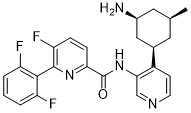
PIM447 (also known as LGH447) is a novel and potent pan-PIM (proviral insertion site of Moloney murine leukemia) kinase inhibitor with Ki values of 6 pM, 18 pM, 9 pM for PIM1, PIM2, PIM3 respectively. It also inhibits GSK3β, PKN1, and PKCτ, but at a significantly lower potency with IC50 between 1 and 5 μM (>105-fold differential relative to the Ki on PIMs). PIM447 is cytotoxic for myeloma cells due to cell cycle disruption and induction of apoptosis mediated by a decrease in phospho-Bad (Ser112) and c-Myc levels and the inhibition of mTORC1 pathway. PIM447 is currently undergoing several clinical trials.
Physicochemical Properties
| Molecular Formula | C24H23F3N4O.HCL | |
| Molecular Weight | 476.92 | |
| Exact Mass | 440.182 | |
| CAS # | 1210608-43-7 | |
| Related CAS # | PIM-447 dihydrochloride;1820565-69-2;(1S,3R,5R)-PIM447 dihydrochloride | |
| PubChem CID | 44814409 | |
| Appearance | White to off-white solid powder | |
| Density | 1.3±0.1 g/cm3 | |
| Boiling Point | 493.7±45.0 °C at 760 mmHg | |
| Flash Point | 252.4±28.7 °C | |
| Vapour Pressure | 0.0±1.3 mmHg at 25°C | |
| Index of Refraction | 1.593 | |
| LogP | 5.2 | |
| Hydrogen Bond Donor Count | 2 | |
| Hydrogen Bond Acceptor Count | 7 | |
| Rotatable Bond Count | 4 | |
| Heavy Atom Count | 32 | |
| Complexity | 630 | |
| Defined Atom Stereocenter Count | 3 | |
| SMILES | C[C@H]1C[C@H](C[C@H](C1)N)C2=C(C=NC=C2)NC(=O)C3=NC(=C(C=C3)F)C4=C(C=CC=C4F)F |
|
| InChi Key | VRQXRVAKPDCRCI-ZNMIVQPWSA-N | |
| InChi Code | InChI=1S/C24H23F3N4O/c1-13-9-14(11-15(28)10-13)16-7-8-29-12-21(16)31-24(32)20-6-5-19(27)23(30-20)22-17(25)3-2-4-18(22)26/h2-8,12-15H,9-11,28H2,1H3,(H,31,32)/t13-,14+,15-/m0/s1 | |
| Chemical Name | N-[4-[(1R,3S,5S)-3-amino-5-methylcyclohexyl]pyridin-3-yl]-6-(2,6-difluorophenyl)-5-fluoropyridine-2-carboxamide | |
| Synonyms |
|
|
| HS Tariff Code | 2934.99.9001 | |
| Storage |
Powder-20°C 3 years 4°C 2 years In solvent -80°C 6 months -20°C 1 month |
|
| Shipping Condition | Room temperature (This product is stable at ambient temperature for a few days during ordinary shipping and time spent in Customs) |
Biological Activity
| ln Vitro | On multiple myeloma (MM) cells, PIM447 (0.05–10 μM; 24-72 hours) exhibits an antiproliferative effect[2]. Apoptosis is induced by PIM447 (10 μM; 6-24 hours)[2]. In the two cell lines (MM1S and OPM-2 cells), PIM447 (0.1–10 μM; 48 hours) reduces the proliferative phases (S and G2–M) of the cell cycle and raises the percentage of cells in the G0-G1 phase[2]. |
| ln Vivo | Tumor burden is decreased by PIM447 (100 mg/kg; po; 5 times per week)[2]. |
| Cell Assay |
Cell Viability Assay[2] Cell Types: MM1S, MM1R, RPMI-8226, MM144, U266, NCI-H929, OPM-2, RPMI-LR5, U266-Dox4, and U266-LR7 cells Tested Concentrations: 0.05, 0.1, 0.5, 1, 5, 10 μM Incubation Duration: 24, 48, 72 hrs (hours) Experimental Results: Sensitive cell lines with IC50 values at 48 hrs (hours) ranging from 0.2 to 3.3 μM (MM1S, MM1R, RPMI-8226, MM144, U266, and NCI-H929 ) and less sensitive cell lines with IC50 values at 48 hrs (hours) >7 μmol/L (OPM-2, RPMI-LR5, U266-Dox4, and U266-LR7). Western Blot Analysis[2] Cell Types: MM1S cells Tested Concentrations: 10 μM Incubation Duration: 6, 12, 24 hrs (hours) Experimental Results: Promoted the cleavage of initiator caspases, such as caspases 8 and 9, and also the cleavage of the effector caspases 3 and 7, together with PARP cleavage. |
| Animal Protocol |
Animal/Disease Models: 6weeks old female NOD-SCID-IL-2Rγ−/− (NSG) mice (bearing RPMI-8226 -luc cells)[2] Doses: 100 mg/kg Route of Administration: po; 5 times for a week Experimental Results: Clearly controlled tumor progression as measured by bioluminescence. |
| References |
[1]. Identification of N-(4-((1R,3S,5S)-3-Amino-5-methylcyclohexyl)pyridin-3-yl)-6-(2,6-difluorophenyl)-5-fluoropicolinamide (PIM447), a Potent and Selective Proviral Insertion Site of Moloney Murine Leukemia (PIM) 1, 2, and 3 Kinase Inhibito. [2]. The novel pan-PIM kinase inhibitor, PIM447, displays dual anti-myeloma and bone protective effects, and potently synergizes with current standards of care. Clin Cancer Res. 2016 Jul 20. [3]. Control of translational activation by PIM kinase in activated B-cell diffuse large B-cell lymphoma confers sensitivity to inhibition by PIM447. Oncotarget. 2016 Aug 20. |
| Additional Infomation |
LGH-447 is under investigation in clinical trial NCT02160951 (Dose Escalation Study of LGH447 in Japanese Patients With Relapsed and/or Refractory Hematologic Malignancies). PIM Kinase Inhibitor LGH447 is an orally available pan-PIM protein kinase inhibitor with potential antineoplastic activity. PIM kinase inhibitor LGH447 binds to and inhibits the activities of PIM-1, -2 and -3 serine/threonine kinases, which may result in the interruption of the G1/S phase cell cycle transition, the expression of the pro-apoptotic Bcl2 protein and tumor cell apoptosis in cells that overexpress PIMs. PIM kinases, downstream effectors of many cytokine and growth factor signaling pathways, play key roles in cell cycle progression and apoptosis inhibition and may be overexpressed in various malignancies. |
Solubility Data
| Solubility (In Vitro) |
|
|||
| Solubility (In Vivo) |
Note: Listed below are some common formulations that may be used to formulate products with low water solubility (e.g. < 1 mg/mL), you may test these formulations using a minute amount of products to avoid loss of samples. Injection Formulations (e.g. IP/IV/IM/SC) Injection Formulation 1: DMSO : Tween 80: Saline = 10 : 5 : 85 (i.e. 100 μL DMSO stock solution → 50 μL Tween 80 → 850 μL Saline) *Preparation of saline: Dissolve 0.9 g of sodium chloride in 100 mL ddH ₂ O to obtain a clear solution. Injection Formulation 2: DMSO : PEG300 :Tween 80 : Saline = 10 : 40 : 5 : 45 (i.e. 100 μL DMSO → 400 μLPEG300 → 50 μL Tween 80 → 450 μL Saline) Injection Formulation 3: DMSO : Corn oil = 10 : 90 (i.e. 100 μL DMSO → 900 μL Corn oil) Example: Take the Injection Formulation 3 (DMSO : Corn oil = 10 : 90) as an example, if 1 mL of 2.5 mg/mL working solution is to be prepared, you can take 100 μL 25 mg/mL DMSO stock solution and add to 900 μL corn oil, mix well to obtain a clear or suspension solution (2.5 mg/mL, ready for use in animals). Injection Formulation 4: DMSO : 20% SBE-β-CD in saline = 10 : 90 [i.e. 100 μL DMSO → 900 μL (20% SBE-β-CD in saline)] *Preparation of 20% SBE-β-CD in Saline (4°C,1 week): Dissolve 2 g SBE-β-CD in 10 mL saline to obtain a clear solution. Injection Formulation 5: 2-Hydroxypropyl-β-cyclodextrin : Saline = 50 : 50 (i.e. 500 μL 2-Hydroxypropyl-β-cyclodextrin → 500 μL Saline) Injection Formulation 6: DMSO : PEG300 : castor oil : Saline = 5 : 10 : 20 : 65 (i.e. 50 μL DMSO → 100 μLPEG300 → 200 μL castor oil → 650 μL Saline) Injection Formulation 7: Ethanol : Cremophor : Saline = 10: 10 : 80 (i.e. 100 μL Ethanol → 100 μL Cremophor → 800 μL Saline) Injection Formulation 8: Dissolve in Cremophor/Ethanol (50 : 50), then diluted by Saline Injection Formulation 9: EtOH : Corn oil = 10 : 90 (i.e. 100 μL EtOH → 900 μL Corn oil) Injection Formulation 10: EtOH : PEG300:Tween 80 : Saline = 10 : 40 : 5 : 45 (i.e. 100 μL EtOH → 400 μLPEG300 → 50 μL Tween 80 → 450 μL Saline) Oral Formulations Oral Formulation 1: Suspend in 0.5% CMC Na (carboxymethylcellulose sodium) Oral Formulation 2: Suspend in 0.5% Carboxymethyl cellulose Example: Take the Oral Formulation 1 (Suspend in 0.5% CMC Na) as an example, if 100 mL of 2.5 mg/mL working solution is to be prepared, you can first prepare 0.5% CMC Na solution by measuring 0.5 g CMC Na and dissolve it in 100 mL ddH2O to obtain a clear solution; then add 250 mg of the product to 100 mL 0.5% CMC Na solution, to make the suspension solution (2.5 mg/mL, ready for use in animals). Oral Formulation 3: Dissolved in PEG400 Oral Formulation 4: Suspend in 0.2% Carboxymethyl cellulose Oral Formulation 5: Dissolve in 0.25% Tween 80 and 0.5% Carboxymethyl cellulose Oral Formulation 6: Mixing with food powders Note: Please be aware that the above formulations are for reference only. InvivoChem strongly recommends customers to read literature methods/protocols carefully before determining which formulation you should use for in vivo studies, as different compounds have different solubility properties and have to be formulated differently. (Please use freshly prepared in vivo formulations for optimal results.) |
| Preparing Stock Solutions | 1 mg | 5 mg | 10 mg | |
| 1 mM | 2.0968 mL | 10.4839 mL | 20.9679 mL | |
| 5 mM | 0.4194 mL | 2.0968 mL | 4.1936 mL | |
| 10 mM | 0.2097 mL | 1.0484 mL | 2.0968 mL |