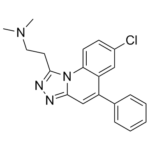
PF-9366 (PF9366) is a novel, potent and allosteric inhibitor of human methionine adenosyltransferase 2A (Mat2A) with anticancer activity. It inhibits Mat2A with an IC50 of 420 nM and a Kd of 170 nM. Human methionine adenosyltransferase 2A (Mat2A), the extrahepatic isoform, is often deregulated in cancer. We identified a Mat2A inhibitor, PF-9366, binds an allosteric site on Mat2A that overlaps with the binding site for the Mat2A regulator, Mat2B. Studies exploiting PF-9366 suggested a general mode of Mat2A allosteric regulation. Allosteric binding of PF-9366 or Mat2B altered the Mat2A active site, resulting in increased substrate affinity and decreased enzyme turnover. These data support a model whereby Mat2B functions as an inhibitor of Mat2A activity when methionine or SAM levels are high, yet functions as an activator of Mat2A when methionine or SAM levels are low.
Physicochemical Properties
| Molecular Formula | C20H19CLN4 |
| Molecular Weight | 350.8447 |
| Exact Mass | 350.129 |
| CAS # | 72882-78-1 |
| PubChem CID | 12612431 |
| Appearance | White to off-white solid powder |
| LogP | 5.1 |
| Hydrogen Bond Donor Count | 0 |
| Hydrogen Bond Acceptor Count | 3 |
| Rotatable Bond Count | 4 |
| Heavy Atom Count | 25 |
| Complexity | 439 |
| Defined Atom Stereocenter Count | 0 |
| SMILES | ClC1C=CC2=C(C=1)C(C1C=CC=CC=1)=CC1=NN=C(CCN(C)C)N21 |
| InChi Key | LYLASWLQCMKZAT-UHFFFAOYSA-N |
| InChi Code | InChI=1S/C20H19ClN4/c1-24(2)11-10-19-22-23-20-13-16(14-6-4-3-5-7-14)17-12-15(21)8-9-18(17)25(19)20/h3-9,12-13H,10-11H2,1-2H3 |
| Chemical Name | 2-(7-Chloro-5-phenyl-[1,2,4]triazolo[4,3-a]quinolin-1-yl)-N,N-dimethylethan-1-amine |
| Synonyms | PF-9366; PF 9366; PF9366. |
| HS Tariff Code | 2934.99.9001 |
| Storage |
Powder-20°C 3 years 4°C 2 years In solvent -80°C 6 months -20°C 1 month |
| Shipping Condition | Room temperature (This product is stable at ambient temperature for a few days during ordinary shipping and time spent in Customs) |
Biological Activity
| Targets |
|
|
| ln Vitro | Mat2A inhibitor PF-9366 has a 420 nM IC50 and a 170 nM Kd. There is no significant off-target action of PF-9366 in phosphodiesterases, ion channels, neurotransporters, or GPCRs. In cancer cells, PF-9366 exhibits inhibitory action against Mat2A. With an IC50 of 1.2 μM, PF-9366 suppresses the synthesis of S-Adenosyl-L-methionine (SAM) in H520 lung cancer cells. With an IC50 of 255 nM, PF-9366 is more effective against SAM synthesis in Huh-7 cells. It also inhibits cell proliferation with an IC50 of 10 μM. | |
| Cell Assay |
|
|
| References |
[1]. Targeting S-adenosylmethionine biosynthesis with a novel allosteric inhibitor of Mat2A. Nat Chem Biol. 2017 Jul;13(7):785-792. |
Solubility Data
| Solubility (In Vitro) | DMSO : ~10 mg/mL (~28.50 mM) |
| Solubility (In Vivo) |
Solubility in Formulation 1: ≥ 2.5 mg/mL (7.13 mM) (saturation unknown) in 10% DMSO + 40% PEG300 + 5% Tween80 + 45% Saline (add these co-solvents sequentially from left to right, and one by one), clear solution. For example, if 1 mL of working solution is to be prepared, you can add 100 μL of 25.0 mg/mL clear DMSO stock solution to 400 μL PEG300 and mix evenly; then add 50 μL Tween-80 to the above solution and mix evenly; then add 450 μL normal saline to adjust the volume to 1 mL. Preparation of saline: Dissolve 0.9 g of sodium chloride in 100 mL ddH₂ O to obtain a clear solution. Solubility in Formulation 2: ≥ 2.5 mg/mL (7.13 mM) (saturation unknown) in 10% DMSO + 90% Corn Oil (add these co-solvents sequentially from left to right, and one by one), clear solution. For example, if 1 mL of working solution is to be prepared, you can add 100 μL of 25.0 mg/mL clear DMSO stock solution to 900 μL of corn oil and mix evenly. (Please use freshly prepared in vivo formulations for optimal results.) |
| Preparing Stock Solutions | 1 mg | 5 mg | 10 mg | |
| 1 mM | 2.8503 mL | 14.2515 mL | 28.5030 mL | |
| 5 mM | 0.5701 mL | 2.8503 mL | 5.7006 mL | |
| 10 mM | 0.2850 mL | 1.4252 mL | 2.8503 mL |