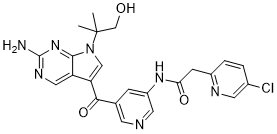
PF-06273340 is a potent, selective, and well-tolerated pan-Trk inhibitor with IC50 of 6, 4, 3 nM for TrkA, TrkB, Trk C respectively. It is tested in several in vitro safety assays and is found to have minimal cytotoxicity in HepG2 or THLE cell lines, with IC50 values of >300 μM and >42 μM, respectively. With the exception of COX-1 (IC50 = 2.7 μM), dopamine transporter assays (Ki = 5.2 μM), and PDEs 4D, 5A, 7B, 8B, and 11 (54−89% inhibition at 10 μM), all IC50/Ki values in a broad panel were >10 μM. The Invitrogen wide kinase panel, which contains 309 kinases, screens for PF-06273340. Of these, all were inhibited by less than 40% at 1 μM, with the exception of MUSK (IC50 53 nM), FLT-3 (IC50 395 nM), IRAK1 (IC50 2.5 μM), MKK (90% at 1 μM), and DDR1 (60% at 1 μM).
Physicochemical Properties
| Molecular Formula | C23H22CLN7O3 | |
| Molecular Weight | 479.92 | |
| Exact Mass | 479.147 | |
| Elemental Analysis | C, 57.56; H, 4.62; Cl, 7.39; N, 20.43; O, 10.00 | |
| CAS # | 1402438-74-7 | |
| Related CAS # |
|
|
| PubChem CID | 66571548 | |
| Appearance | Off-white to yellow to brown | |
| Density | 1.5±0.1 g/cm3 | |
| Index of Refraction | 1.711 | |
| LogP | 0.92 | |
| Hydrogen Bond Donor Count | 3 | |
| Hydrogen Bond Acceptor Count | 8 | |
| Rotatable Bond Count | 7 | |
| Heavy Atom Count | 34 | |
| Complexity | 741 | |
| Defined Atom Stereocenter Count | 0 | |
| SMILES | C1(CC(NC2=CC(C(C3C4=CN=C(N)N=C4N(C(C)(C)CO)C=3)=O)=CN=C2)=O)=NC=C(Cl)C=C1 |
|
| InChi Key | BPIWZDNVMQQBQX-UHFFFAOYSA-N | |
| InChi Code | InChI=1S/C23H22ClN7O3/c1-23(2,12-32)31-11-18(17-10-28-22(25)30-21(17)31)20(34)13-5-16(9-26-7-13)29-19(33)6-15-4-3-14(24)8-27-15/h3-5,7-11,32H,6,12H2,1-2H3,(H,29,33)(H2,25,28,30) | |
| Chemical Name | N-[5-[2-amino-7-(1-hydroxy-2-methylpropan-2-yl)pyrrolo[2,3-d]pyrimidine-5-carbonyl]pyridin-3-yl]-2-(5-chloropyridin-2-yl)acetamide | |
| Synonyms |
|
|
| HS Tariff Code | 2934.99.9001 | |
| Storage |
Powder-20°C 3 years 4°C 2 years In solvent -80°C 6 months -20°C 1 month |
|
| Shipping Condition | Room temperature (This product is stable at ambient temperature for a few days during ordinary shipping and time spent in Customs) |
Biological Activity
| Targets | TrkC (IC50 = 3 nM); TrkB (IC50 = 4 nM); TrkA (IC50 = 6 nM) | |
| ln Vitro |
|
|
| ln Vivo |
|
|
| Enzyme Assay | PF-06273340 is a potent well-tolerated pan-Trk inhibitor with IC50 values for TrkA, TrkB, and Trk C of 6, 4, and 3 nM, respectively. TPX-0005 successfully overcomes this primary resistance (IC50 100 nM in the cell proliferation assay) by strongly inhibiting the SRC substrate paxillin (IC50 107 nM) and EML4-ALK (IC50 13 nM) phosphorylation. In a wound healing assay, PX-0005 inhibits H2228 cell migration with activity comparable to that of saracatinib. The Invitrogen wide kinase panel, which contains 309 kinases, screens for PF-06273340. Of these, all were inhibited by less than 40% at 1 μM, with the exception of MUSK (IC50 53 nM), FLT-3 (IC50 395 nM), IRAK1 (IC50 2.5 μM), MKK (90% at 1 μM), and DDR1 (60% at 1 μM). | |
| Cell Assay | PF-06273340 is examined in a number of in vitro safety tests, demonstrating minimal cytotoxicity in HepG2 or THLE cell lines (IC50 > 300 μM and > 42 μM, respectively). Every IC50/Ki value in a wide panel was greater than 10 μM, with the exception of COX-1 (IC50 = 2.7 μM), dopamine transporter tests (Ki = 5.2 μM), and PDEs 4D, 5A, 7B, 8B, and 11 (54−89% inhibition at 10 μM). | |
| Animal Protocol |
Male SD rats 0.25, 2.5 and 25 mg/kg oral administration |
|
| References |
[1]. The Discovery of a Potent, Selective, and Peripherally Restricted Pan-Trk Inhibitor (PF-06273340) for the Treatment of Pain. |
|
| Additional Infomation | Pf 06273340 is under investigation in clinical trial NCT01934738 (A Study to Evaluate Safety, Toleration and Time Course of Plasma Concentration of Multiple Oral Doses of PF-06273340 in Healthy Subjects of Two AgeGroups, Aged 18-55 Years (Group 1) and Aged 56-75 Years (Group 2)). |
Solubility Data
| Solubility (In Vitro) |
|
|||
| Solubility (In Vivo) |
Note: Listed below are some common formulations that may be used to formulate products with low water solubility (e.g. < 1 mg/mL), you may test these formulations using a minute amount of products to avoid loss of samples. Injection Formulations (e.g. IP/IV/IM/SC) Injection Formulation 1: DMSO : Tween 80: Saline = 10 : 5 : 85 (i.e. 100 μL DMSO stock solution → 50 μL Tween 80 → 850 μL Saline) *Preparation of saline: Dissolve 0.9 g of sodium chloride in 100 mL ddH ₂ O to obtain a clear solution. Injection Formulation 2: DMSO : PEG300 :Tween 80 : Saline = 10 : 40 : 5 : 45 (i.e. 100 μL DMSO → 400 μLPEG300 → 50 μL Tween 80 → 450 μL Saline) Injection Formulation 3: DMSO : Corn oil = 10 : 90 (i.e. 100 μL DMSO → 900 μL Corn oil) Example: Take the Injection Formulation 3 (DMSO : Corn oil = 10 : 90) as an example, if 1 mL of 2.5 mg/mL working solution is to be prepared, you can take 100 μL 25 mg/mL DMSO stock solution and add to 900 μL corn oil, mix well to obtain a clear or suspension solution (2.5 mg/mL, ready for use in animals). Injection Formulation 4: DMSO : 20% SBE-β-CD in saline = 10 : 90 [i.e. 100 μL DMSO → 900 μL (20% SBE-β-CD in saline)] *Preparation of 20% SBE-β-CD in Saline (4°C,1 week): Dissolve 2 g SBE-β-CD in 10 mL saline to obtain a clear solution. Injection Formulation 5: 2-Hydroxypropyl-β-cyclodextrin : Saline = 50 : 50 (i.e. 500 μL 2-Hydroxypropyl-β-cyclodextrin → 500 μL Saline) Injection Formulation 6: DMSO : PEG300 : castor oil : Saline = 5 : 10 : 20 : 65 (i.e. 50 μL DMSO → 100 μLPEG300 → 200 μL castor oil → 650 μL Saline) Injection Formulation 7: Ethanol : Cremophor : Saline = 10: 10 : 80 (i.e. 100 μL Ethanol → 100 μL Cremophor → 800 μL Saline) Injection Formulation 8: Dissolve in Cremophor/Ethanol (50 : 50), then diluted by Saline Injection Formulation 9: EtOH : Corn oil = 10 : 90 (i.e. 100 μL EtOH → 900 μL Corn oil) Injection Formulation 10: EtOH : PEG300:Tween 80 : Saline = 10 : 40 : 5 : 45 (i.e. 100 μL EtOH → 400 μLPEG300 → 50 μL Tween 80 → 450 μL Saline) Oral Formulations Oral Formulation 1: Suspend in 0.5% CMC Na (carboxymethylcellulose sodium) Oral Formulation 2: Suspend in 0.5% Carboxymethyl cellulose Example: Take the Oral Formulation 1 (Suspend in 0.5% CMC Na) as an example, if 100 mL of 2.5 mg/mL working solution is to be prepared, you can first prepare 0.5% CMC Na solution by measuring 0.5 g CMC Na and dissolve it in 100 mL ddH2O to obtain a clear solution; then add 250 mg of the product to 100 mL 0.5% CMC Na solution, to make the suspension solution (2.5 mg/mL, ready for use in animals). Oral Formulation 3: Dissolved in PEG400 Oral Formulation 4: Suspend in 0.2% Carboxymethyl cellulose Oral Formulation 5: Dissolve in 0.25% Tween 80 and 0.5% Carboxymethyl cellulose Oral Formulation 6: Mixing with food powders Note: Please be aware that the above formulations are for reference only. InvivoChem strongly recommends customers to read literature methods/protocols carefully before determining which formulation you should use for in vivo studies, as different compounds have different solubility properties and have to be formulated differently. (Please use freshly prepared in vivo formulations for optimal results.) |
| Preparing Stock Solutions | 1 mg | 5 mg | 10 mg | |
| 1 mM | 2.0837 mL | 10.4184 mL | 20.8368 mL | |
| 5 mM | 0.4167 mL | 2.0837 mL | 4.1674 mL | |
| 10 mM | 0.2084 mL | 1.0418 mL | 2.0837 mL |