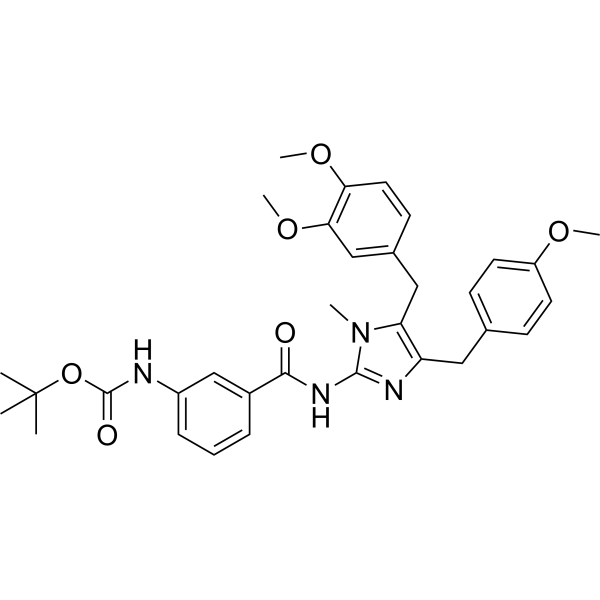
Physicochemical Properties
| Molecular Formula | C33H38N4O6 |
| Molecular Weight | 586.678028583527 |
| Exact Mass | 586.279 |
| CAS # | 2894733-91-4 |
| PubChem CID | 168355652 |
| Appearance | White to off-white solid powder |
| LogP | 5.6 |
| Hydrogen Bond Donor Count | 2 |
| Hydrogen Bond Acceptor Count | 7 |
| Rotatable Bond Count | 12 |
| Heavy Atom Count | 43 |
| Complexity | 891 |
| Defined Atom Stereocenter Count | 0 |
| InChi Key | WCBUHIGCYKSAAG-UHFFFAOYSA-N |
| InChi Code | InChI=1S/C33H38N4O6/c1-33(2,3)43-32(39)34-24-10-8-9-23(20-24)30(38)36-31-35-26(17-21-11-14-25(40-5)15-12-21)27(37(31)4)18-22-13-16-28(41-6)29(19-22)42-7/h8-16,19-20H,17-18H2,1-7H3,(H,34,39)(H,35,36,38) |
| Chemical Name | tert-butyl N-[3-[[5-[(3,4-dimethoxyphenyl)methyl]-4-[(4-methoxyphenyl)methyl]-1-methylimidazol-2-yl]carbamoyl]phenyl]carbamate |
| HS Tariff Code | 2934.99.9001 |
| Storage |
Powder-20°C 3 years 4°C 2 years In solvent -80°C 6 months -20°C 1 month |
| Shipping Condition | Room temperature (This product is stable at ambient temperature for a few days during ordinary shipping and time spent in Customs) |
Biological Activity
| ln Vitro | Compound 11c, PD-L1-IN-2, inhibits RKO cells with an IC50 value of 31.7μM[1]. In RKO cells, PD-L1 expression is inhibited by PD-L1-IN-2 (0-10 μM; 0-24 hours) in a way that is dependent on both dose and time [1]. PD-L1-IN-2 (0–10 μM; 0–24 hours) increases the turnover of the PD-L1 protein. The PD-L1 turnover rate in PD-L1-IN-2-treated cells was higher in CHX pulse chase compared to untreated cells[1]. |
| ln Vivo | GPR84 antagonist 3 (compound 42) (ip; 25/50 mg/kg; once daily; 16 days) had a 45% inhibition rate in the 50 mg/kg group, suggesting that it can diminish tumor size. Compared to the PBS group, the group's average tumor weight was noticeably reduced[1]. |
| Cell Assay |
Western Blot Analysis[1] Cell Types: RKO cells Tested Concentrations: 5 μM Incubation Duration: 0h, 1h, 3h, 6h, 9h, 12h Experimental Results: Promoted the turnover of PD-L1 protein. |
| Animal Protocol |
Animal/Disease Models: C57BL/6 mice with subcutaneous (sc) MC38 tumors[1] Doses: 25/50 mg/kg Route of Administration: ip; 25/50 mg/kg; one time/day; 16 days Experimental Results: Suppressed MC38 tumor growth in vivo. |
| References |
[1]. Bioactivity-Driven Synthesis of the Marine Natural Product Naamidine J and Its Derivatives as Potential Tumor Immunological Agents by Inhibiting Programmed Death-Ligand 1. J Med Chem. 2023 Apr 27;66(8):5427-5438. |
Solubility Data
| Solubility (In Vitro) | DMSO: 50 mg/mL (85.23 mM) |
| Solubility (In Vivo) |
Solubility in Formulation 1: ≥ 2.5 mg/mL (4.26 mM) (saturation unknown) in 10% DMSO + 90% Corn Oil (add these co-solvents sequentially from left to right, and one by one), clear solution. For example, if 1 mL of working solution is to be prepared, you can add 100 μL of 25.0 mg/mL clear DMSO stock solution to 900 μL of corn oil and mix evenly. (Please use freshly prepared in vivo formulations for optimal results.) |
| Preparing Stock Solutions | 1 mg | 5 mg | 10 mg | |
| 1 mM | 1.7045 mL | 8.5225 mL | 17.0451 mL | |
| 5 mM | 0.3409 mL | 1.7045 mL | 3.4090 mL | |
| 10 mM | 0.1705 mL | 0.8523 mL | 1.7045 mL |