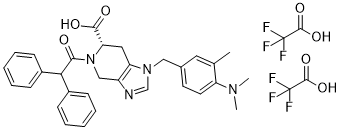
PD 123319 ditrifluoroacetate is a novel, potent, and selective nonpeptide AT2 (angiotensin II) receptor antagonist with IC50 of 34 nM. It causes rat adrenal preparations to lose 125I-labeled angiotensin II from a particular subset of angiotensin II binding sites. To investigate the distinct functions of AT1R and AT2R in models related to vascular research, including hypertension, PD 123319 has been employed. In the microsome binding assay, PD-123319 is found to have an IC50 value of 6.9nM, which inhibits Ang II from binding the bovine zona glomerulosa microsomal preparation.
Physicochemical Properties
| Molecular Formula | C35H34F6N4O7 | |
| Molecular Weight | 736.67 | |
| Exact Mass | 736.233 | |
| Elemental Analysis | C, 57.07; H, 4.65; F, 15.47; N, 7.61; O, 15.20 | |
| CAS # | 136676-91-0 | |
| Related CAS # | PD 123319; 130663-39-7 | |
| PubChem CID | 6604951 | |
| Appearance | White to yellow solid powder | |
| LogP | 5.047 | |
| Hydrogen Bond Donor Count | 3 | |
| Hydrogen Bond Acceptor Count | 15 | |
| Rotatable Bond Count | 7 | |
| Heavy Atom Count | 52 | |
| Complexity | 874 | |
| Defined Atom Stereocenter Count | 1 | |
| SMILES | FC(C(=O)O[H])(F)F.FC(C(=O)O[H])(F)F.O=C(C([H])(C1C([H])=C([H])C([H])=C([H])C=1[H])C1C([H])=C([H])C([H])=C([H])C=1[H])N1C([H])([H])C2=C(C([H])([H])[C@@]1([H])C(=O)O[H])N(C([H])=N2)C([H])([H])C1C([H])=C([H])C(=C(C([H])([H])[H])C=1[H])N(C([H])([H])[H])C([H])([H])[H] |
|
| InChi Key | GPKQIEZLHVGJQH-ZXVJYWQYSA-N | |
| InChi Code | InChI=1S/C31H32N4O3.2C2HF3O2/c1-21-16-22(14-15-26(21)33(2)3)18-34-20-32-25-19-35(28(31(37)38)17-27(25)34)30(36)29(23-10-6-4-7-11-23)24-12-8-5-9-13-24;2*3-2(4,5)1(6)7/h4-16,20,28-29H,17-19H2,1-3H3,(H,37,38);2*(H,6,7)/t28-;;/m0../s1 | |
| Chemical Name | (6S)-1-[[4-(dimethylamino)-3-methylphenyl]methyl]-5-(2,2-diphenylacetyl)-6,7-dihydro-4H-imidazo[4,5-c]pyridine-6-carboxylic acid;2,2,2-trifluoroacetic acid | |
| Synonyms |
|
|
| HS Tariff Code | 2934.99.9001 | |
| Storage |
Powder-20°C 3 years 4°C 2 years In solvent -80°C 6 months -20°C 1 month Note: Please store this product in a sealed and protected environment, avoid exposure to moisture. |
|
| Shipping Condition | Room temperature (This product is stable at ambient temperature for a few days during ordinary shipping and time spent in Customs) |
Biological Activity
| Targets | AT2 angiotensin II receptor (IC50 = 34 nM) |
| ln Vitro |
In vitro activity: PD 123319 ditrifluoroacetate is a new, strong, and selective nonpeptide AT2 (angiotensin II) receptor antagonist with IC50 of 34 nM. In rat adrenal preparations, it removes 125I-labeled angiotensin II from a particular subset of angiotensin II binding sites. The roles of AT1R and AT2R in hypertensive and other vascular research-related models have been specifically examined using PD 123319. In the binding assay using microsome, it is discovered that PD-123319 inhibits Ang II from binding the bovine zona glomerulosa microsomal preparation, with an IC50 value of 6.9nM. It has been demonstrated that in a variety of tissues, PD 123319 can distinguish between two subclasses of AII receptors. Two kinds of binding sites for AII in a membrane preparation of bovine adrenal glomerulosa cells are selectively labeled by 125I-AII. With a strong affinity (IC50 of 92.9 nM) for DuP-753, the first class (DuP-753 sensitive) accounts for around 85% of all AII binding sites. Regarding 125I-AII binding to this location, PD-123319 has no effect. With an IC50 of 6.9 nM for PD-123319 and an IC50 of approximately 10 microM for DuP-753, the second class of binding sites exhibits greater sensitivity[2]. Angiotensin II (AII) is an important regulator of aldosterone secretion by adrenal glomerulosa cells. All interacts with a specific receptor coupled to a guanine nucleotide-binding protein that controls the activity of phospholipase C. Recently, novel All nonpeptide antagonists (DuP-753 and PD-123319) have been shown to discriminate between two subclasses of All receptors in many different tissues. Our studies confirmed that 125I-All specifically labeled two classes of binding sites for All in a membrane preparation of bovine adrenal glomerulosa cells. The first class (DuP-753 sensitive) represented approximately 85% of the total binding sites for All and possessed a high affinity (IC50 of 92.9 +/- 19.5 nM) for DuP-753. PD-123319 did not have any effect on 125I-All binding to this site. The second class of binding sites was more sensitive to PD-123319, with an IC50 of 6.9 +/- 3.7 nM, and had a much lower affinity for DuP-753 (IC50 around 10 microM). The two classes of receptors had different affinities for All. All showed an affinity around 2 nM for All type 1 receptor (AT1)(DuP-753 sensitive) and a higher affinity, around 0.3 nM, for All type 2 receptor (AT2) (PD-123319 sensitive). All-induced steroidogenesis was completely abolished in the presence of 3 microM DuP-753, indicating that this activity was mediated through a DuP-753-sensitive receptor. We also found that polyvinyl sulfate (PVS), a polyanion, could partly inhibit the binding of 125I-All to bovine adrenal glomerulosa cell membranes, with half-maximal efficiency at 17.3 +/- 8.2 nM. The inhibitory effect of PVS was selective for AT1. The inhibitory effect of PVS was due to a change in the affinity state of the receptor. Unexpectedly, PVS had no effect on All-induced steroidogenesis or on All binding to intact bovine adrenal glomerulosa cells. However, the inhibitory effect of PVS on All binding was recovered after permeabilization of cells. Direct interaction of polyanions with AT1 was suggested by the capacity of solubilized photoaffinity-labeled 125I-AT1 to adsorb to heparin-agarose gels. The adsorption of 125I-AT1 to heparin-agarose was inhibited by prior incubation of solubilized receptor with heparin or PVS. These results suggest that All-induced steroidogenesis is mediated by a DuP-753-sensitive receptor and that PVS decreases the affinity of this receptor by interacting with an intracellular domain (possibly the positively charged domain responsible for coupling with guanine nucleotide-binding proteins) [2]. |
| ln Vivo |
PD 123319 has no effect on cerebral blood flow autoregulation. CBF autoregulation is unaffected by acute AT2-receptor blockade. When PD 123319 is administered intravenously to conscious hypertensive rats, there is an instantaneous, dose-dependent increase in MAP that lasts for about 7.4 minutes at a dose of 3 mg/kg. PD 123319 has no effect on cerebral blood flow autoregulation. Acute AT2-receptor blockade does not influence CBF autoregulation. Intravenous administration of PD 123319 to conscious hypertensive rats elicites an immediate dose-dependent increase in MAP that is sustained for approximately 7.4 min with 3 mg/kg PD 123319. Hence, the present study investigated the effect on CBF autoregulation of blocking of angiotensin AT2-receptors with PD-123319in spontaneously hypertensive rats (SHR). Anaesthetised and ventilated SHR were given PD 123319, 0.36 mg/kg/min, intravenously, and compared with a control group. CBF was measured by the intracarotid 133xenon injection method and BP was raised by noradrenaline infusion and lowered by controlled haemorrhage in separate groups of rats. The limits of autoregulation were determined by computed least-sum-of-squares analysis. PD 123319 did not influence baseline CBF, but resulted in a minor BP decrease (10 control and 10 treated rats). The lower limit of CBF autoregulation (eight treated and eight control) as well as the upper limit of CBF autoregulation (eight treated and eight control) were not significantly different in PD 123319 and control animals (lower limit treated 102+/-4 mmHg and control 94+/-4; NS, and upper limit treated 171 +/- 10 mmHg and control 162+/-7; NS). These findings indicate that acute AT2-receptor blockade does not influence CBF autoregularion.[3] Relatively little is known about the functional expression of cardiovascular angiotensin type 2 (AT2)-receptors in healthy young adult humans. We performed a randomised, placebo-controlled crossover study of the effects of intravenous administration of the selective AT2-receptor antagonist PD-123319 on haemodynamics and arterial stiffness in normal volunteers. Sixteen normal subjects aged 29.9+/-13.8 years (range 18-30 years) received an intravenous infusion of PD 123319 (10 mcg/minute for 5 minutes) and placebo, separated by one week. Haemodynamics (cardiac index, stroke index and systemic vascular resistance) were measured non-invasively using a BioZ.com thoracic impedance detection system. Blood pressure was measured from an arm cuff using oscillometry. Stiffness index, a measure of arterial stiffness, was measured using a Pulse Trace recorder. No significant changes in blood pressure (p=0.92), cardiac index (p=0.52), stroke index (p=0.61), systemic vascular resistance index (p=0.32) or stiffness index (p=0.57) was demonstrated following PD 123319 infusion, compared with placebo. The results of this study do not support the functional presence of cardiovascular AT2-receptors that mediate acute haemodynamic effects in healthy young adults. It remains possible that higher doses of PD 123319 may be required to demonstrate functional cardiovascular AT2-receptors in this population, if they are present [4]. |
| Enzyme Assay | It has been demonstrated that in a variety of tissues, PD 123319 can distinguish between two subclasses of AII receptors. Two classes of binding sites for AII in a membrane preparation of bovine adrenal glomerulosa cells were specifically labeled by 125I-AII. With a high affinity (IC50 of 92.9 nM) for DuP-753, the first class (DuP-753 sensitive) accounts for about 85% of all AII binding sites. Regarding 125I-AII binding to this site, PD-123319 has no effect. With an IC50 of 6.9 nM for PD-123319 and an IC50 of approximately 10 μM for DuP-753, the second class of binding sites exhibits greater sensitivity to the former. |
| Cell Assay |
Through inhibition of extracellular signal-regulated kinase signaling, PD123319 suppressed osteogenic differentiation of human mesenchymal stem cells.
Recent evidence indicates that the vasculature contains mesenchymal stem cells (MSCs). We hypothesized that angiotensin II (Ang II) type 2 receptors (AT2Rs) play a role in the osteogenesis of MSCs and may have a role in vascular calcification. Human MSCs were differentiated into osteoblasts. Expression of AT2R was significantly increased during osteogenesis, whereas the expression of Ang II type 1 receptors was not significantly changed. Incubation with the AT2R blocker PD123319 with or without Ang II significantly inhibited calcium deposition, whereas type 1 receptor blocker valsartan had no significant effect. PD123319 inhibited extracellular signal-regulated kinase (ERK) phosphorylation in the osteogenic process, whereas valsartan had no effect. Furthermore, PD123319 combined with Ang II also inhibited acute ERK phosphorylation in MSCs induced by insulin. In conclusion, AT2R is upregulated during osteogenesis. Blockade of AT2R inhibits osteogenesis and ERK phosphorylation of human MSCs. These results provide a novel insight into the pathophysiology of calcific vascular disease.[J Am Soc Hypertens. 2015 Jul;9(7):517-25. https://pubmed.ncbi.nlm.nih.gov/26188399/ ] |
| Animal Protocol |
The study examines the lower limit of cerebral blood flow (CBF) autoregulation in 16 spontaneously hypertensive rats (SHR). The animals are divided into two groups: eight receive PD-123319 intravenously, while the other eight serve as control subjects receiving saline. Following a 10-minute stabilization period post-injection, the autoregulation assessment begins. Hemorrhagic hypotension is induced through graded blood withdrawal via syringe, progressively reducing blood pressure to the minimal achievable level. CBF measurements are recorded at 10-15 mmHg blood pressure intervals throughout the experimental procedure.
Key methodological aspects include: 1) Use of PD-123319 (an AT2 receptor antagonist) versus saline control 2) Stepwise blood pressure reduction via controlled hemorrhage 3) Systematic CBF monitoring at defined BP intervals1 This protocol aligns with established techniques for evaluating autoregulatory thresholds in hypertensive models [3] |
| References |
[1]. Synthesis and structure-activity relationships of a novel series of non-peptide angiotensin II receptor binding inhibitors specific for the AT2 subtype. J Med Chem. 1991 Nov;34(11):3248-60. [2]. Modulation of angiotensin II binding affinity by allosteric interaction of polyvinyl sulfate with an intracellular domain of the DuP-753-sensitive angiotensin II receptor of bovine adrenal glomerulosa. Mol Pharmacol. 1992 Apr;41(4):809-15. [3]. No effect of angiotensin II AT(2)-receptor antagonist PD 123319 on cerebral blood flow autoregulation. J Renin Angiotensin Aldosterone Syst. 2001 Sep;2(3):188-92. [4]. Effects of intravenous PD 123319 on haemodynamic and arterial stiffness indices in healthy volunteers. J Renin Angiotensin Aldosterone Syst. 2005 Sep;6(2):102-6. |
| Additional Infomation |
PD123319 is an imidazopyridine consisting of 4,5,6,7-tetrahydro-1H-imidazo[4,5-c]pyridine having 4-(dimethylamino)-3-methylbenzyl, diphenylacetyl and carboxy and groups at positions 1, 5 and 6 respectively It has a role as a vasoconstrictor agent, an endothelin receptor antagonist and an angiotensin receptor antagonist.
Structure-activity relationships are reported for a novel class of 4,5,6,7-tetrahydro-1H-imidazo[4,5-c]pyridine-6-carboxylic acid derivatives that displace 125I-labeled angiotensin II from a specific subset of angiotensin II (Ang II) binding sites in rat adrenal preparations. This binding site is not the Ang II receptor mediating vascular contraction or aldosterone release, but, rather, is one whose function has not yet been fully elucidated. It has been identified in a number of tissues and has a similar affinity for Ang II and its peptide analogues as does the vascular receptor. The non-peptide compounds reported here are uniquely specific in displacing Ang II at this binding site and are inactive in antagonizing Ang II at the vascular receptor or in pharmacological assays measuring vascular effects. PD 123,319 (79), one of the most potent compounds, has an IC50 of 34 nM. Certain of these compounds may have utility in the definition and study of Ang II receptor subtypes. [1] |
Solubility Data
| Solubility (In Vitro) |
|
|||
| Solubility (In Vivo) |
Solubility in Formulation 1: 100 mg/mL (135.75 mM) in PBS (add these co-solvents sequentially from left to right, and one by one), clear solution; with sonication. (Please use freshly prepared in vivo formulations for optimal results.) |
| Preparing Stock Solutions | 1 mg | 5 mg | 10 mg | |
| 1 mM | 1.3575 mL | 6.7873 mL | 13.5746 mL | |
| 5 mM | 0.2715 mL | 1.3575 mL | 2.7149 mL | |
| 10 mM | 0.1357 mL | 0.6787 mL | 1.3575 mL |