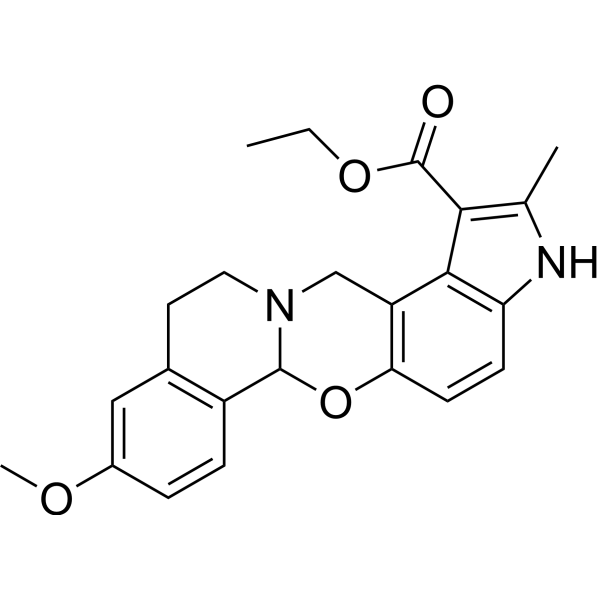
Physicochemical Properties
| Molecular Formula | C23H24N2O4 |
| Molecular Weight | 392.45 |
| Exact Mass | 392.174 |
| CAS # | 23062-91-1 |
| PubChem CID | 4995951 |
| Appearance | Off-white to light yellow solid powder |
| Density | 1.34g/cm3 |
| Boiling Point | 586ºC at 760 mmHg |
| Flash Point | 308.2ºC |
| Vapour Pressure | 1.02E-13mmHg at 25°C |
| Index of Refraction | 1.673 |
| LogP | 4.048 |
| Hydrogen Bond Donor Count | 1 |
| Hydrogen Bond Acceptor Count | 5 |
| Rotatable Bond Count | 4 |
| Heavy Atom Count | 29 |
| Complexity | 616 |
| Defined Atom Stereocenter Count | 0 |
| InChi Key | VDDUJINYXKGZLV-UHFFFAOYSA-N |
| InChi Code | InChI=1S/C23H24N2O4/c1-4-28-23(26)20-13(2)24-18-7-8-19-17(21(18)20)12-25-10-9-14-11-15(27-3)5-6-16(14)22(25)29-19/h5-8,11,22,24H,4,9-10,12H2,1-3H3 |
| Chemical Name | ethyl 17-methoxy-6-methyl-12-oxa-1,7-diazapentacyclo[11.8.0.03,11.04,8.014,19]henicosa-3(11),4(8),5,9,14(19),15,17-heptaene-5-carboxylate |
| HS Tariff Code | 2934.99.9001 |
| Storage |
Powder-20°C 3 years 4°C 2 years In solvent -80°C 6 months -20°C 1 month |
| Shipping Condition | Room temperature (This product is stable at ambient temperature for a few days during ordinary shipping and time spent in Customs) |
Biological Activity
| Targets | mAChR4 |
| ln Vitro | When compared to other receptors, PD 102807 (example 1) exhibits selectivity for the M4 muscarinic receptor that is 72-fold (M1), 38-fold (M2), 10-fold (M3), and 82-fold (M5) more selective[1]. In contrast to M1 (pKB=5.60), M2 (pKB=5.88), and M3 (pKB=6.39) receptor subtypes, PD 102807, a novel M4 selective antagonist, inhibits the M4 receptor-induced stimulation of [35S]-GTPγS binding to membrane G proteins with a pKB of 7.40, a value that is 63, 33, and 10 times higher[2]. A M4 mAChR preferring antagonist, PD-102807 has an affinity of 7–28 nM for M4 mAChRs, a selectivity of 14–36 for M4 over M3 mAChRs, and a selectivity of 76-2600 for M4 over M1, M2, and M5 mAChRs[3]. |
| ln Vivo | Levodopa-induced dyskinesia (LID) is lessened by striatal perfusion of PD-102807 (3 μM), which also reduces nigral GABA and Glu as well as striatal Glu release[3]. |
| Animal Protocol |
Animal/Disease Models: Male SD (Sprague-Dawley) rats[3] Doses: 3 μM Route of Administration: Perfusion started 40 min prior to L-DOPA (6 mg/Kg plus 12 mg/Kg benserazide, sc) administration and continued until the end of experiment. Experimental Results: Basal dialysate levels in PD-102807 experiment were 19.19±2.62 nM and 47.77±3.42 nM for GABA and Glu in SNr, respectively, and 41.38±4.25 nM for Glu in striatum. decreased global Axial Limb Orolingual (ALO) Abnormal Involuntary Movements (AIM) expression from 70.75±5.64 to 25.38±6.64, Dramatically attenuating limb , axial and orolingual AIMs at 3 μM. Inhibited the L-DOPA-induced rise of substantia nigra pars reticulata (SNr) GABA, SNr Glu, and striatal Glu at 3 μM. |
| References |
[1]. Identification and characterization of m4 selective muscarinic antagonists. Bioorg Med Chem Lett. 1998 Aug 4;8(15):1991-6. [2]. PD 102807, a novel muscarinic M4 receptor antagonist, discriminates between striatal and cortical muscarinic receptors coupled to cyclic AMP. Life Sci. 1999;65(21):2233-40. [3]. Striatal and nigral muscarinic type 1 and type 4 receptors modulate levodopa-induced dyskinesia and striato-nigral pathway activation in 6-hydroxydopamine hemilesioned rats. Neurobiol Dis. 2020 Oct;144:105044. |
| Additional Infomation | LSM-1888 is an indolyl carboxylic acid. |
Solubility Data
| Solubility (In Vitro) | May dissolve in DMSO (in most cases), if not, try other solvents such as H2O, Ethanol, or DMF with a minute amount of products to avoid loss of samples |
| Solubility (In Vivo) |
Note: Listed below are some common formulations that may be used to formulate products with low water solubility (e.g. < 1 mg/mL), you may test these formulations using a minute amount of products to avoid loss of samples. Injection Formulations (e.g. IP/IV/IM/SC) Injection Formulation 1: DMSO : Tween 80: Saline = 10 : 5 : 85 (i.e. 100 μL DMSO stock solution → 50 μL Tween 80 → 850 μL Saline) *Preparation of saline: Dissolve 0.9 g of sodium chloride in 100 mL ddH ₂ O to obtain a clear solution. Injection Formulation 2: DMSO : PEG300 :Tween 80 : Saline = 10 : 40 : 5 : 45 (i.e. 100 μL DMSO → 400 μLPEG300 → 50 μL Tween 80 → 450 μL Saline) Injection Formulation 3: DMSO : Corn oil = 10 : 90 (i.e. 100 μL DMSO → 900 μL Corn oil) Example: Take the Injection Formulation 3 (DMSO : Corn oil = 10 : 90) as an example, if 1 mL of 2.5 mg/mL working solution is to be prepared, you can take 100 μL 25 mg/mL DMSO stock solution and add to 900 μL corn oil, mix well to obtain a clear or suspension solution (2.5 mg/mL, ready for use in animals). Injection Formulation 4: DMSO : 20% SBE-β-CD in saline = 10 : 90 [i.e. 100 μL DMSO → 900 μL (20% SBE-β-CD in saline)] *Preparation of 20% SBE-β-CD in Saline (4°C,1 week): Dissolve 2 g SBE-β-CD in 10 mL saline to obtain a clear solution. Injection Formulation 5: 2-Hydroxypropyl-β-cyclodextrin : Saline = 50 : 50 (i.e. 500 μL 2-Hydroxypropyl-β-cyclodextrin → 500 μL Saline) Injection Formulation 6: DMSO : PEG300 : castor oil : Saline = 5 : 10 : 20 : 65 (i.e. 50 μL DMSO → 100 μLPEG300 → 200 μL castor oil → 650 μL Saline) Injection Formulation 7: Ethanol : Cremophor : Saline = 10: 10 : 80 (i.e. 100 μL Ethanol → 100 μL Cremophor → 800 μL Saline) Injection Formulation 8: Dissolve in Cremophor/Ethanol (50 : 50), then diluted by Saline Injection Formulation 9: EtOH : Corn oil = 10 : 90 (i.e. 100 μL EtOH → 900 μL Corn oil) Injection Formulation 10: EtOH : PEG300:Tween 80 : Saline = 10 : 40 : 5 : 45 (i.e. 100 μL EtOH → 400 μLPEG300 → 50 μL Tween 80 → 450 μL Saline) Oral Formulations Oral Formulation 1: Suspend in 0.5% CMC Na (carboxymethylcellulose sodium) Oral Formulation 2: Suspend in 0.5% Carboxymethyl cellulose Example: Take the Oral Formulation 1 (Suspend in 0.5% CMC Na) as an example, if 100 mL of 2.5 mg/mL working solution is to be prepared, you can first prepare 0.5% CMC Na solution by measuring 0.5 g CMC Na and dissolve it in 100 mL ddH2O to obtain a clear solution; then add 250 mg of the product to 100 mL 0.5% CMC Na solution, to make the suspension solution (2.5 mg/mL, ready for use in animals). Oral Formulation 3: Dissolved in PEG400 Oral Formulation 4: Suspend in 0.2% Carboxymethyl cellulose Oral Formulation 5: Dissolve in 0.25% Tween 80 and 0.5% Carboxymethyl cellulose Oral Formulation 6: Mixing with food powders Note: Please be aware that the above formulations are for reference only. InvivoChem strongly recommends customers to read literature methods/protocols carefully before determining which formulation you should use for in vivo studies, as different compounds have different solubility properties and have to be formulated differently. (Please use freshly prepared in vivo formulations for optimal results.) |
| Preparing Stock Solutions | 1 mg | 5 mg | 10 mg | |
| 1 mM | 2.5481 mL | 12.7405 mL | 25.4810 mL | |
| 5 mM | 0.5096 mL | 2.5481 mL | 5.0962 mL | |
| 10 mM | 0.2548 mL | 1.2740 mL | 2.5481 mL |