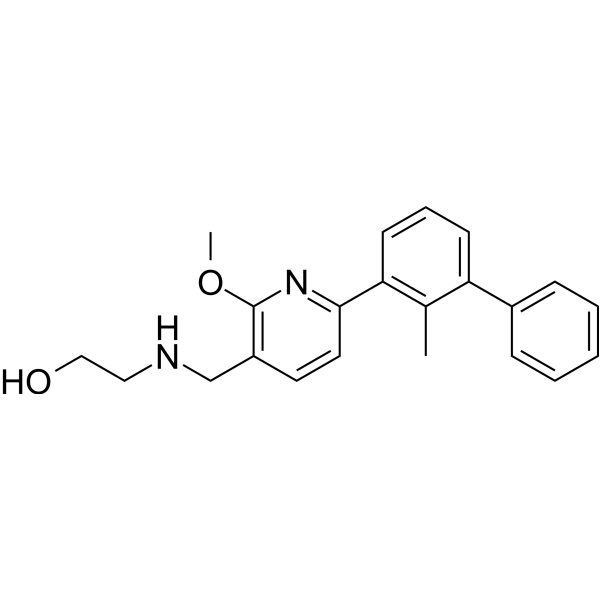
Physicochemical Properties
| Molecular Formula | C22H24N2O2 |
| Molecular Weight | 348.438165664673 |
| Exact Mass | 348.183 |
| CAS # | 2628506-54-5 |
| Related CAS # | PD-1/PD-L1-IN-9 hydrochloride |
| PubChem CID | 155925913 |
| Appearance | White to off-white solid powder |
| LogP | 3.5 |
| Hydrogen Bond Donor Count | 2 |
| Hydrogen Bond Acceptor Count | 4 |
| Rotatable Bond Count | 7 |
| Heavy Atom Count | 26 |
| Complexity | 400 |
| Defined Atom Stereocenter Count | 0 |
| SMILES | O(C)C1=C(C=CC(C2C=CC=C(C3C=CC=CC=3)C=2C)=N1)CNCCO |
| InChi Key | ANLIWBJMRQBWBM-UHFFFAOYSA-N |
| InChi Code | InChI=1S/C22H24N2O2/c1-16-19(17-7-4-3-5-8-17)9-6-10-20(16)21-12-11-18(15-23-13-14-25)22(24-21)26-2/h3-12,23,25H,13-15H2,1-2H3 |
| Chemical Name | 2-[[2-methoxy-6-(2-methyl-3-phenylphenyl)pyridin-3-yl]methylamino]ethanol |
| HS Tariff Code | 2934.99.9001 |
| Storage |
Powder-20°C 3 years 4°C 2 years In solvent -80°C 6 months -20°C 1 month |
| Shipping Condition | Room temperature (This product is stable at ambient temperature for a few days during ordinary shipping and time spent in Customs) |
Biological Activity
| Targets | IC50: 3.8 nM (PD-1/PD-L1)[1] |
| ln Vitro | Compound 24 (PD-1/PD-L1-IN-9; 46.9-1500 nM; 2 h pretreatment) dose-dependently stimulates the anti-tumor immunity of peripheral blood mononuclear cells (PBMCs) against MDB-MB 231 cells; the EC50 is roughly 100 nM[1]. |
| ln Vivo | PD-1/PD-L1-IN-9 (Compound 24; 40-80 mg/kg; PO; once daily for 2 weeks) does not result in weight loss or death[1], but it does limit tumor growth in a dose-dependent manner. PD-1/PD-L1-IN-9 (3 mg/kg; intravenous injection; single dosage) had a half-life of 4.2 hours, a plasma clearance of 11.5 L/h/kg, and a Cmax of 1233 ng/mL in rats[1]. Rats with Cmax = 192 ng/mL show moderate oral bioavailability (F = 22%) and half-life (t1/2 = 6.4 h) for PD-1/PD-L1-IN-9 (25 mg/kg; oral; single dose)[1]. |
| Animal Protocol |
Animal/Disease Models: Male balb/c (Bagg ALBino) mouse (5-6 weeks) were inoculated CT26 cells[1] Doses: 40 mg/kg, 80 mg/kg Route of Administration: Oral gavage; one time/day, for 2 weeks Experimental Results: Dramatically diminished the final tumor weight, with TGI values of 60 and 67% at the dose of 40 and 80 mg/kg, respectively. Animal/Disease Models: pharmacokinetic/PK analysis in SD (Sprague-Dawley) rats[1] Doses: 3 mg/kg and 25 mg/kg Route of Administration: intravenous (iv) injection or oral gavage; single dose Experimental Results: Route Dose (mg/kg) AUC(0-t) (ng·h/mL) Cmax (ng/mL) t1/2 (h) Tmax Cl (L·h /kg) Vz (L/kg) F (%) iv 3 430.5 1233 4.2 0.03 11.5 78.6 / po 25 787.4 192 6.4 0.69 28.8 249.3 22 |
| References |
[1]. Novel Biphenyl Pyridines as Potent Small-Molecule Inhibitors Targeting the Programmed Cell Death-1/Programmed Cell Death-Ligand 1 Interaction. J Med Chem. 2021 May 30. |
Solubility Data
| Solubility (In Vitro) | DMSO: 100 mg/mL (286.99 mM) |
| Solubility (In Vivo) |
Solubility in Formulation 1: ≥ 2.5 mg/mL (7.17 mM) (saturation unknown) in 10% DMSO + 40% PEG300 + 5% Tween80 + 45% Saline (add these co-solvents sequentially from left to right, and one by one), clear solution. For example, if 1 mL of working solution is to be prepared, you can add 100 μL of 25.0 mg/mL clear DMSO stock solution to 400 μL PEG300 and mix evenly; then add 50 μL Tween-80 to the above solution and mix evenly; then add 450 μL normal saline to adjust the volume to 1 mL. Preparation of saline: Dissolve 0.9 g of sodium chloride in 100 mL ddH₂ O to obtain a clear solution. Solubility in Formulation 2: ≥ 2.5 mg/mL (7.17 mM) (saturation unknown) in 10% DMSO + 90% (20% SBE-β-CD in Saline) (add these co-solvents sequentially from left to right, and one by one), clear solution. For example, if 1 mL of working solution is to be prepared, you can add 100 μL of 25.0 mg/mL clear DMSO stock solution to 900 μL of 20% SBE-β-CD physiological saline solution and mix evenly. Preparation of 20% SBE-β-CD in Saline (4°C,1 week): Dissolve 2 g SBE-β-CD in 10 mL saline to obtain a clear solution. Solubility in Formulation 3: ≥ 2.5 mg/mL (7.17 mM) (saturation unknown) in 10% DMSO + 90% Corn Oil (add these co-solvents sequentially from left to right, and one by one), clear solution. For example, if 1 mL of working solution is to be prepared, you can add 100 μL of 25.0 mg/mL clear DMSO stock solution to 900 μL of corn oil and mix evenly. (Please use freshly prepared in vivo formulations for optimal results.) |
| Preparing Stock Solutions | 1 mg | 5 mg | 10 mg | |
| 1 mM | 2.8699 mL | 14.3497 mL | 28.6993 mL | |
| 5 mM | 0.5740 mL | 2.8699 mL | 5.7399 mL | |
| 10 mM | 0.2870 mL | 1.4350 mL | 2.8699 mL |