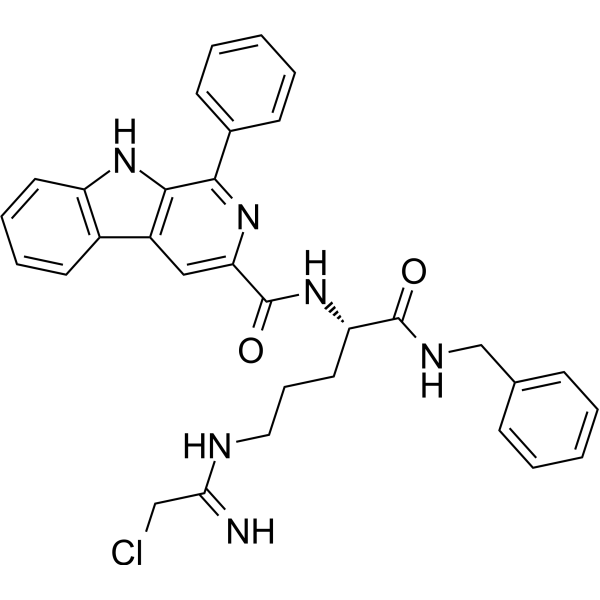
Physicochemical Properties
| Molecular Formula | C32H31CLN6O2 |
| Molecular Weight | 567.08 |
| Appearance | Typically exists as solid at room temperature |
| HS Tariff Code | 2934.99.9001 |
| Storage |
Powder-20°C 3 years 4°C 2 years In solvent -80°C 6 months -20°C 1 month |
| Shipping Condition | Room temperature (This product is stable at ambient temperature for a few days during ordinary shipping and time spent in Customs) |
Biological Activity
| Targets | PAD4 0.79 μM (IC50) PAD2 2.97 μM (IC50) |
| ln Vitro | PAD4-IN-4 showed strong inhibitory activity against PAD2 and PAD4 (IC50=2.97±0.29 μM and 0.79±0.09 μM), and had the highest selectivity for PAD4 (3.8 μM)[1]. PAD4-IN-4 significantly inhibited the proliferation of TNBC cells in vitro (4T1 IC50:2.39±0.54 μM; MDA-MB468 IC50: 2.34±0.23 μM), and had relatively low toxicity to normal breast cells (MCF-10A IC50: 8.39±0.60 μM)[1]. PAD4-IN-4 (0.5, 1, 2 μM; 48 h) had enhanced anti-metastatic activity against TNBC cells[1]. PAD4-IN-4 (0.5, 1, 2 μM; 48 h) is a potent PAD4 inhibitor that blocks histone citrullination and neutrophil extracellular trap (NET) formation[1]. Cell Proliferation Assay[1] Cell Line: TNBC cells Concentration: 0.5, 1, 2 μM Incubation Time: 48 h Result: Reduced the number of metastatic cells and wound closure rate less than that of 7 at the equivalent dose, indicating that compound 28 had enhanced antimetastasis activity. |
| ln Vivo | PAD4-IN-4 (1, 5, 10 mg/kg; iv.; once every 2 days for a total of 9 times) can inhibit TNBC lung metastasis in a dose-dependent manner and is a highly active compound against TNBC without obvious toxicity in BALB/c mice with an orthotopic 4T1-luc xenograft model [1]. PAD4-IN-4 changes the tumor microenvironment from a suppressive state to an anti-tumor environment by regulating the proportion of immune cells and reshaping the phenotype and function of neutrophils [1]. Pharmacokinetic Analysis in Male Sprague−Dawley rats[1] Compound Route Dose (mg/kg) AUC0_t (ng·h/mL) AUC0_INF (ng·h/mL) T1/2 (h) Tmax (h) Cmax (ng/mL) Cl (L·h/kg) 7 iv 3.5 14893.52 17214.17 0.13 0.08 251.2 5 71.87 28 iv 3.5 9525.86 17346.55 0.25 0.08 297.71 105.24 |
| Cell Assay |
Immunofluorescence[1] Cell Types: TNBC cells and neutrophils Concentration: 0.5, 1, 2 μM Incubation Duration: 48 h Experimental Results: Inhibited histone citrullination and NET formation. |
| Animal Protocol |
Animal/Disease Models:orthotopic 4T1-luc xenograft model in BALB/c mice[1]. Doses: 1, 5, 10 mg/kg Route of Administration: Intravenous injection (i.v.) Experimental Results: The tumor growth inhibition of the high-dose 28-treated group was 61.8%, whereas the positive control doxorubicin hydrochloride group reached 54.6%. Had no significant differences in viscero−somatic ratio and serum biochemical indices (ALT, AST, UREA, and CREA-S) were observed in the 28-treated group. Increased the proportion of mature TANs MHC-II+ TANs whereas it suppressed the proportion of pro-tumor phenotypes PD-L1+ /MHC-II+ TANs and MHC-II− TANs. |
| References |
[1]. A β-Carboline Derivate PAD4 Inhibitor Reshapes Neutrophil Phenotype and Improves the Tumor Immune Microenvironment against Triple-Negative Breast Cancer[J]. Journal of Medicinal Chemistry, 2024. |
Solubility Data
| Solubility (In Vitro) | May dissolve in DMSO (in most cases), if not, try other solvents such as H2O, Ethanol, or DMF with a minute amount of products to avoid loss of samples |
| Solubility (In Vivo) |
Note: Listed below are some common formulations that may be used to formulate products with low water solubility (e.g. < 1 mg/mL), you may test these formulations using a minute amount of products to avoid loss of samples. Injection Formulations (e.g. IP/IV/IM/SC) Injection Formulation 1: DMSO : Tween 80: Saline = 10 : 5 : 85 (i.e. 100 μL DMSO stock solution → 50 μL Tween 80 → 850 μL Saline) *Preparation of saline: Dissolve 0.9 g of sodium chloride in 100 mL ddH ₂ O to obtain a clear solution. Injection Formulation 2: DMSO : PEG300 :Tween 80 : Saline = 10 : 40 : 5 : 45 (i.e. 100 μL DMSO → 400 μLPEG300 → 50 μL Tween 80 → 450 μL Saline) Injection Formulation 3: DMSO : Corn oil = 10 : 90 (i.e. 100 μL DMSO → 900 μL Corn oil) Example: Take the Injection Formulation 3 (DMSO : Corn oil = 10 : 90) as an example, if 1 mL of 2.5 mg/mL working solution is to be prepared, you can take 100 μL 25 mg/mL DMSO stock solution and add to 900 μL corn oil, mix well to obtain a clear or suspension solution (2.5 mg/mL, ready for use in animals). Injection Formulation 4: DMSO : 20% SBE-β-CD in saline = 10 : 90 [i.e. 100 μL DMSO → 900 μL (20% SBE-β-CD in saline)] *Preparation of 20% SBE-β-CD in Saline (4°C,1 week): Dissolve 2 g SBE-β-CD in 10 mL saline to obtain a clear solution. Injection Formulation 5: 2-Hydroxypropyl-β-cyclodextrin : Saline = 50 : 50 (i.e. 500 μL 2-Hydroxypropyl-β-cyclodextrin → 500 μL Saline) Injection Formulation 6: DMSO : PEG300 : castor oil : Saline = 5 : 10 : 20 : 65 (i.e. 50 μL DMSO → 100 μLPEG300 → 200 μL castor oil → 650 μL Saline) Injection Formulation 7: Ethanol : Cremophor : Saline = 10: 10 : 80 (i.e. 100 μL Ethanol → 100 μL Cremophor → 800 μL Saline) Injection Formulation 8: Dissolve in Cremophor/Ethanol (50 : 50), then diluted by Saline Injection Formulation 9: EtOH : Corn oil = 10 : 90 (i.e. 100 μL EtOH → 900 μL Corn oil) Injection Formulation 10: EtOH : PEG300:Tween 80 : Saline = 10 : 40 : 5 : 45 (i.e. 100 μL EtOH → 400 μLPEG300 → 50 μL Tween 80 → 450 μL Saline) Oral Formulations Oral Formulation 1: Suspend in 0.5% CMC Na (carboxymethylcellulose sodium) Oral Formulation 2: Suspend in 0.5% Carboxymethyl cellulose Example: Take the Oral Formulation 1 (Suspend in 0.5% CMC Na) as an example, if 100 mL of 2.5 mg/mL working solution is to be prepared, you can first prepare 0.5% CMC Na solution by measuring 0.5 g CMC Na and dissolve it in 100 mL ddH2O to obtain a clear solution; then add 250 mg of the product to 100 mL 0.5% CMC Na solution, to make the suspension solution (2.5 mg/mL, ready for use in animals). Oral Formulation 3: Dissolved in PEG400 Oral Formulation 4: Suspend in 0.2% Carboxymethyl cellulose Oral Formulation 5: Dissolve in 0.25% Tween 80 and 0.5% Carboxymethyl cellulose Oral Formulation 6: Mixing with food powders Note: Please be aware that the above formulations are for reference only. InvivoChem strongly recommends customers to read literature methods/protocols carefully before determining which formulation you should use for in vivo studies, as different compounds have different solubility properties and have to be formulated differently. (Please use freshly prepared in vivo formulations for optimal results.) |
| Preparing Stock Solutions | 1 mg | 5 mg | 10 mg | |
| 1 mM | 1.7634 mL | 8.8171 mL | 17.6342 mL | |
| 5 mM | 0.3527 mL | 1.7634 mL | 3.5268 mL | |
| 10 mM | 0.1763 mL | 0.8817 mL | 1.7634 mL |