|
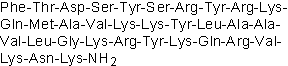
PACAP 6-38 is a novel and potent PACAP (pituitary adenylate cyclase-activating polypeptide) non-stimulating competitive antagonist with an IC50 value of 2 nM. It acts as a functional CARTp antagonist in vivo. It also prevents differentiated cells' ERK from being phosphorylated by CARTp. When the PAC1 receptor antagonist PACAP(6-38) (300 nM) was administered intravenously to NGF-OE mice, the intercontraction interval (2.0-fold) and void volume (2.5-fold) increased significantly (p ≤ 0.01). In NGF-OE mice, intravesical administration of PACAP(6-38) also reduced baseline bladder pressure. In WT mice, PACAP(6-38) had no effect on bladder function. When administered intravenously, 300 nM of PACAP(6-38) significantly (p ≤ 0.01) decreased pelvic sensitivity in NGF-OE mice, but had no effect on WT mice. The increased frequency of voiding and increased sensitivity to the pelvis seen in NGF-OE mice can be attributed to PACAP/receptor signaling.
|
Physicochemical Properties
| Molecular Formula |
C182H300N56O45S
|
| Molecular Weight |
4024.74259999997
|
| Exact Mass |
4023.27
|
| CAS # |
143748-18-9
|
| Related CAS # |
PACAP (6-38), human, ovine, rat TFA
|
| PubChem CID |
24868185
|
| Appearance |
Typically exists as solid at room temperature
|
| LogP |
-11.8
|
| Hydrogen Bond Donor Count |
64
|
| Hydrogen Bond Acceptor Count |
58
|
| Rotatable Bond Count |
146
|
| Heavy Atom Count |
284
|
| Complexity |
9190
|
| Defined Atom Stereocenter Count |
33
|
| SMILES |
C[C@H]([C@@H](C(=O)N[C@@H](CC(=O)O)C(=O)N[C@@H](CO)C(=O)N[C@@H](CC1=CC=C(C=C1)O)C(=O)N[C@@H](CO)C(=O)N[C@@H](CCCNC(=N)N)C(=O)N[C@@H](CC2=CC=C(C=C2)O)C(=O)N[C@@H](CCCNC(=N)N)C(=O)N[C@@H](CCCCN)C(=O)N[C@@H](CCC(=O)N)C(=O)N[C@@H](CCSC)C(=O)N[C@@H](C)C(=O)N[C@@H](C(C)C)C(=O)N[C@@H](CCCCN)C(=O)N[C@@H](CCCCN)C(=O)N[C@@H](CC3=CC=C(C=C3)O)C(=O)N[C@@H](CC(C)C)C(=O)N[C@@H](C)C(=O)N[C@@H](C)C(=O)N[C@@H](C(C)C)C(=O)N[C@@H](CC(C)C)C(=O)NCC(=O)N[C@@H](CCCCN)C(=O)N[C@@H](CCCNC(=N)N)C(=O)N[C@@H](CC4=CC=C(C=C4)O)C(=O)N[C@@H](CCCCN)C(=O)N[C@@H](CCC(=O)N)C(=O)N[C@@H](CCCNC(=N)N)C(=O)N[C@@H](C(C)C)C(=O)N[C@@H](CCCCN)C(=O)N[C@@H](CC(=O)N)C(=O)N[C@@H](CCCCN)C(=O)N)NC(=O)[C@H](CC5=CC=CC=C5)N)O
|
| InChi Key |
BGZYREVJBMQLGS-ONKNJJKASA-N
|
| InChi Code |
InChI=1S/C182H300N56O45S/c1-95(2)83-128(152(257)207-92-141(249)211-115(40-20-27-72-184)154(259)215-122(47-34-79-204-180(197)198)161(266)226-130(86-105-50-58-109(242)59-51-105)167(272)217-117(42-22-29-74-186)156(261)220-125(66-68-138(191)246)163(268)216-124(49-36-81-206-182(201)202)165(270)237-145(99(9)10)176(281)224-120(45-25-32-77-189)160(265)230-134(90-140(193)248)171(276)212-114(147(194)252)39-19-26-71-183)231-177(282)144(98(7)8)236-149(254)101(12)208-148(253)100(11)210-166(271)129(84-96(3)4)225-169(274)132(88-107-54-62-111(244)63-55-107)228-159(264)118(43-23-30-75-187)214-157(262)119(44-24-31-76-188)223-175(280)143(97(5)6)235-150(255)102(13)209-153(258)127(70-82-284-15)222-164(269)126(67-69-139(192)247)221-155(260)116(41-21-28-73-185)213-158(263)121(46-33-78-203-179(195)196)218-168(273)131(87-106-52-60-110(243)61-53-106)227-162(267)123(48-35-80-205-181(199)200)219-173(278)136(93-239)233-170(275)133(89-108-56-64-112(245)65-57-108)229-174(279)137(94-240)234-172(277)135(91-142(250)251)232-178(283)146(103(14)241)238-151(256)113(190)85-104-37-17-16-18-38-104/h16-18,37-38,50-65,95-103,113-137,143-146,239-245H,19-36,39-49,66-94,183-190H2,1-15H3,(H2,191,246)(H2,192,247)(H2,193,248)(H2,194,252)(H,207,257)(H,208,253)(H,209,258)(H,210,271)(H,211,249)(H,212,276)(H,213,263)(H,214,262)(H,215,259)(H,216,268)(H,217,272)(H,218,273)(H,219,278)(H,220,261)(H,221,260)(H,222,269)(H,223,280)(H,224,281)(H,225,274)(H,226,266)(H,227,267)(H,228,264)(H,229,279)(H,230,265)(H,231,282)(H,232,283)(H,233,275)(H,234,277)(H,235,255)(H,236,254)(H,237,270)(H,238,256)(H,250,251)(H4,195,196,203)(H4,197,198,204)(H4,199,200,205)(H4,201,202,206)/t100-,101-,102-,103+,113-,114-,115-,116-,117-,118-,119-,120-,121-,122-,123-,124-,125-,126-,127-,128-,129-,130-,131-,132-,133-,134-,135-,136-,137-,143-,144-,145-,146-/m0/s1
|
| Chemical Name |
(3S)-4-[[(2S)-1-[[(2S)-1-[[(2S)-1-[[(2S)-1-[[(2S)-1-[[(2S)-1-[[(2S)-6-amino-1-[[(2S)-5-amino-1-[[(2S)-1-[[(2S)-1-[[(2S)-1-[[(2S)-6-amino-1-[[(2S)-6-amino-1-[[(2S)-1-[[(2S)-1-[[(2S)-1-[[(2S)-1-[[(2S)-1-[[(2S)-1-[[2-[[(2S)-6-amino-1-[[(2S)-1-[[(2S)-1-[[(2S)-6-amino-1-[[(2S)-5-amino-1-[[(2S)-1-[[(2S)-1-[[(2S)-6-amino-1-[[(2S)-4-amino-1-[[(2S)-1,6-diamino-1-oxohexan-2-yl]amino]-1,4-dioxobutan-2-yl]amino]-1-oxohexan-2-yl]amino]-3-methyl-1-oxobutan-2-yl]amino]-5-carbamimidamido-1-oxopentan-2-yl]amino]-1,5-dioxopentan-2-yl]amino]-1-oxohexan-2-yl]amino]-3-(4-hydroxyphenyl)-1-oxopropan-2-yl]amino]-5-carbamimidamido-1-oxopentan-2-yl]amino]-1-oxohexan-2-yl]amino]-2-oxoethyl]amino]-4-methyl-1-oxopentan-2-yl]amino]-3-methyl-1-oxobutan-2-yl]amino]-1-oxopropan-2-yl]amino]-1-oxopropan-2-yl]amino]-4-methyl-1-oxopentan-2-yl]amino]-3-(4-hydroxyphenyl)-1-oxopropan-2-yl]amino]-1-oxohexan-2-yl]amino]-1-oxohexan-2-yl]amino]-3-methyl-1-oxobutan-2-yl]amino]-1-oxopropan-2-yl]amino]-4-methylsulfanyl-1-oxobutan-2-yl]amino]-1,5-dioxopentan-2-yl]amino]-1-oxohexan-2-yl]amino]-5-carbamimidamido-1-oxopentan-2-yl]amino]-3-(4-hydroxyphenyl)-1-oxopropan-2-yl]amino]-5-carbamimidamido-1-oxopentan-2-yl]amino]-3-hydroxy-1-oxopropan-2-yl]amino]-3-(4-hydroxyphenyl)-1-oxopropan-2-yl]amino]-3-hydroxy-1-oxopropan-2-yl]amino]-3-[[(2S,3R)-2-[[(2S)-2-amino-3-phenylpropanoyl]amino]-3-hydroxybutanoyl]amino]-4-oxobutanoic acid
|
| Synonyms |
| PACAP (6-38), human, ovine, rat |
|
| HS Tariff Code |
2934.99.9001
|
| Storage |
Powder-20°C 3 years
4°C 2 years
In solvent -80°C 6 months
-20°C 1 month
|
| Shipping Condition |
Room temperature (This product is stable at ambient temperature for a few days during ordinary shipping and time spent in Customs)
|
|
Biological Activity
| Targets |
PACAP type I receptor ( IC50 = 30 nM ); PACAP type II receptor VIP1 ( IC50 = 600 nM ); PACAP type II receptor VIP2 ( IC50 = 40 nM )
|
| ln Vitro |
In vitro activity: ACAP 6-38 is a novel and potent PACAP (pituitary adenylate cyclase-activating polypeptide) non-stimulating competitive antagonist with an IC50 value of 2 nM. It acts as a functional CARTp antagonist in vivo. Additionally, in differentiated cells, it prevents the phosphorylation of ERK induced by CARTp. When NGF-OE mice were given the PAC1 receptor antagonist PACAP(6-38) (300 nM) intravenously, their intercontraction interval (which increased by 2.0 times) and void volume (which increased by 2.5 times) were both significantly (p ≤ 0.01) higher. In addition, intravesical administration of PACAP(6-38) reduced the NGF-OE mice's baseline bladder pressure. WT mice's bladder function was unaffected by PACAP(6-38). Intravesical administration of 300 nM PACAP(6-38) reduced pelvic sensitivity in NGF-OE mice significantly (p ≤ 0.01), but had no effect on WT mice. The increased frequency and sensitivity of the pelvic area seen in NGF-OE mice during voiding is partly explained by PACAP/receptor signaling. |
|
| ln Vivo |
| NGF-OE mice exhibit a significant (p ≤ 0.01) increase in intercontraction interval (2.0-fold) and void volume (2.5-fold) upon intravesical administration of PACAP(6-38) (300 nM), an antagonist of the PAC1 receptor. On bladder function in WT mice, PACAP(6-38) has no effect. Pelvic sensitivity is significantly (p ≤ 0.01) reduced in NGF-OE mice after intravesical administration of 300 nM PACAP(6-38), but not in WT mice. |
|
| Enzyme Assay |
PACAP (6-38), human, ovine, and rat is a strong antagonist of PACAP receptors, with IC50 values for PACAP type I receptor, PACAP type II receptor VIP1, and PACAP type II receptor VIP2 of 30, 600, and 40 nM, respectively.
|
| Cell Assay |
In the presence or absence of the PACAP antagonist PACAP (6-38), cells are incubated with 300 nM PACAP-38 for 4 hours. The medium is then collected, and proteins are separated via SDS/PAGE and blotted onto PVDF membranes. Membranes are probed with antibody 6E10, then an anti-mouse antibody labeled with HRP is applied. The ECL plus system is used to detect APPsα.
|
| Animal Protocol |
| 0.9% saline;0.3 nmol, 0.6 nmol, 3 nmol (1.5 Μl/340g);i.c.v | | Male Sprague-Dawley rats | |
|
| References |
[1]. Eur J Biochem
. 1992 Jul 1;207(1):239-46.
[2]. PLoS One
. 2013 Aug 15;8(8):e72347.
|
|
Solubility Data
| Solubility (In Vitro) |
| DMSO: N/A | | Water: ~100 mg/mL (24.84 mM) | | Ethanol: N/A |
|
| Solubility (In Vivo) |
(Please use freshly prepared in vivo formulations for optimal results.)
|
| Preparing Stock Solutions |
|
1 mg |
5 mg |
10 mg |
| 1 mM |
0.2485 mL |
1.2423 mL |
2.4846 mL |
| 5 mM |
0.0497 mL |
0.2485 mL |
0.4969 mL |
| 10 mM |
0.0248 mL |
0.1242 mL |
0.2485 mL |
*Note: Please select an appropriate solvent for the preparation of stock solution based on your experiment needs. For most products, DMSO can be used for preparing stock solutions (e.g. 5 mM, 10 mM, or 20 mM concentration); some products with high aqueous solubility may be dissolved in water directly. Solubility information is available at the above Solubility Data section. Once the stock solution is prepared, aliquot it to routine usage volumes and store at -20°C or -80°C. Avoid repeated freeze and thaw cycles. |