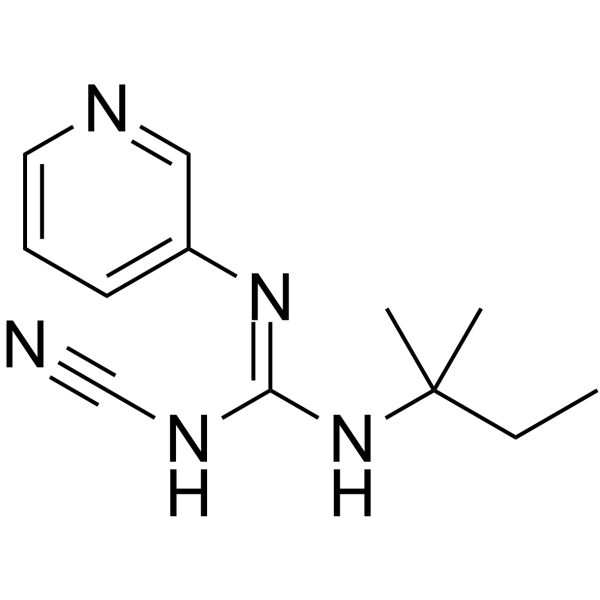
Physicochemical Properties
| Molecular Formula | C12H17N5 |
| Molecular Weight | 231.3 |
| Exact Mass | 231.148 |
| CAS # | 60559-98-0 |
| PubChem CID | 43345 |
| Appearance | White to off-white solid powder |
| Density | 1.07g/cm3 |
| Boiling Point | 347.6ºC at 760 mmHg |
| Melting Point | 186-187 °C |
| Flash Point | 164.1ºC |
| Index of Refraction | 1.556 |
| LogP | 2.572 |
| Hydrogen Bond Donor Count | 2 |
| Hydrogen Bond Acceptor Count | 3 |
| Rotatable Bond Count | 5 |
| Heavy Atom Count | 17 |
| Complexity | 312 |
| Defined Atom Stereocenter Count | 0 |
| InChi Key | HKZNADVVGXKQDL-UHFFFAOYSA-N |
| InChi Code | InChI=1S/C12H17N5/c1-4-12(2,3)17-11(15-9-13)16-10-6-5-7-14-8-10/h5-8H,4H2,1-3H3,(H2,15,16,17) |
| Chemical Name | 1-cyano-2-(2-methylbutan-2-yl)-3-pyridin-3-ylguanidine |
| Synonyms | U-83757; PNU-83757; P-1075 |
| HS Tariff Code | 2934.99.9001 |
| Storage |
Powder-20°C 3 years 4°C 2 years In solvent -80°C 6 months -20°C 1 month |
| Shipping Condition | Room temperature (This product is stable at ambient temperature for a few days during ordinary shipping and time spent in Customs) |
Biological Activity
| ln Vitro | Through competitive binding assays, P1075 (3 nM) causes a monophasic inhibition curve in the presence of MgATP [1]. In rabbit cardiomyocytes, P1075 (100 µM; 10 min) produces ROS in a KATP-dependent way [2]. In isolated rabbit hearts, P1075 (150 nM) decreased the extent of infarcts when compared to control animals (area at risk: 10.6% vs. 31.5%, P < 0.05) [2]. |
| ln Vivo | In ischemia models, P1075 (iv; 1 μg/kg; once) therapy resulted in a smaller infarct [3]. |
| Cell Assay |
Cell viability assay [1] Cell Types: COS-7 Cell Tested Concentrations: 3-15 nM Incubation Duration: Experimental Results: The IC50 value is 15 nM and the Hill coefficient is 1.0. Cell viability assay [2] Cell Types: Adult rabbit cardiomyocytes Tested Concentrations: 100 µM Incubation Duration: 10 minutes Experimental Results: Resulted in a 44% increase in ROS production (P<0.001 compared to untreated cells). |
| Animal Protocol |
Animal/Disease Models: Male SD (SD (Sprague-Dawley)) rats, ischemia for 30 minutes, reperfusion for 2 hrs (hrs (hours)) [3] Doses: 1μg/kg Route of Administration: intravenous (iv) (iv)injection; reperfusion after 2 hrs (hrs (hours)). 1 microgram/kg; Experimental Results: Infarct size was diminished (41.8%) compared to vehicle. |
| References |
[1]. Potassium channel openers require ATP to bind to and act through sulfonylurea receptors. EMBO J. 1998 Oct 1;17(19):5529-35. [2]. P1075 opens mitochondrial K(ATP) channels and generates reactive oxygen species resulting in cardioprotection of rabbit hearts. J Mol Cell Cardiol. 2003 Sep;35(9):1035-42. [3]. GSK3beta inhibition and K(ATP) channel opening mediate acute opioid-induced cardioprotection at reperfusion. Basic Res Cardiol. 2007 Jul;102(4):341-9. |
| Additional Infomation | 1-cyano-2-(2-methylbutan-2-yl)-3-(3-pyridinyl)guanidine is a member of pyridines. |
Solubility Data
| Solubility (In Vitro) | DMSO : ~250 mg/mL (~1080.85 mM) |
| Solubility (In Vivo) |
Solubility in Formulation 1: ≥ 2.08 mg/mL (8.99 mM) (saturation unknown) in 10% DMSO + 40% PEG300 + 5% Tween80 + 45% Saline (add these co-solvents sequentially from left to right, and one by one), clear solution. For example, if 1 mL of working solution is to be prepared, you can add 100 μL of 20.8 mg/mL clear DMSO stock solution to 400 μL PEG300 and mix evenly; then add 50 μL Tween-80 to the above solution and mix evenly; then add 450 μL normal saline to adjust the volume to 1 mL. Preparation of saline: Dissolve 0.9 g of sodium chloride in 100 mL ddH₂ O to obtain a clear solution. Solubility in Formulation 2: ≥ 2.08 mg/mL (8.99 mM) (saturation unknown) in 10% DMSO + 90% (20% SBE-β-CD in Saline) (add these co-solvents sequentially from left to right, and one by one), clear solution. For example, if 1 mL of working solution is to be prepared, you can add 100 μL of 20.8 mg/mL clear DMSO stock solution to 900 μL of 20% SBE-β-CD physiological saline solution and mix evenly. Preparation of 20% SBE-β-CD in Saline (4°C,1 week): Dissolve 2 g SBE-β-CD in 10 mL saline to obtain a clear solution. Solubility in Formulation 3: ≥ 2.08 mg/mL (8.99 mM) (saturation unknown) in 10% DMSO + 90% Corn Oil (add these co-solvents sequentially from left to right, and one by one), clear solution. For example, if 1 mL of working solution is to be prepared, you can add 100 μL of 20.8 mg/mL clear DMSO stock solution to 900 μL of corn oil and mix evenly. (Please use freshly prepared in vivo formulations for optimal results.) |
| Preparing Stock Solutions | 1 mg | 5 mg | 10 mg | |
| 1 mM | 4.3234 mL | 21.6169 mL | 43.2339 mL | |
| 5 mM | 0.8647 mL | 4.3234 mL | 8.6468 mL | |
| 10 mM | 0.4323 mL | 2.1617 mL | 4.3234 mL |