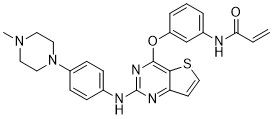
Olmutinib (also known as HM61713 and BI-1482694; Olita) is a novel, potent, orally bioavailable, third-generation and irreversible EFGR/epidermal growth factor receptor tyrosine kinase inhibitor (EGFR TKI). It binds to a cysteine residue near the kinase domain via a covalent bond which is irreveisible. Olmutinib is being developed by Boehringer Ingelheim and Hanmi Pharmaceutical Co. Ltd for the treatment of non-small cell lung cancer (NSCLC). Third-generation EGFR TKIs with covalent binding to the receptors demonstrate irreversible enzymatic inhibition of activating EGFR mutations and T790M mutation (a common reason for acquired EGFR TKI resistance), while sparing wild-type EGFR. In December 2015, olmutinib was granted breakthrough therapy designation in NSCLC by the US FDA. In May 2016, olmutinib received its first global approval in South Korea for the treatment of patients with locally advanced or metastatic EGFR T790M mutation-positive NSCLC.
Physicochemical Properties
| Molecular Formula | C26H26N6O2S |
| Molecular Weight | 486.5886 |
| Exact Mass | 486.183 |
| CAS # | 1353550-13-6 |
| Related CAS # | 1842366-97-5 (2HCl);2102670-48-2 (HCl);1353550-13-6;2102714-68-9 (HCl hydrate); |
| PubChem CID | 54758501 |
| Appearance | Light yellow to yellow solid powder |
| Density | 1.3±0.1 g/cm3 |
| Index of Refraction | 1.706 |
| LogP | 4.95 |
| Hydrogen Bond Donor Count | 2 |
| Hydrogen Bond Acceptor Count | 8 |
| Rotatable Bond Count | 7 |
| Heavy Atom Count | 35 |
| Complexity | 712 |
| Defined Atom Stereocenter Count | 0 |
| InChi Key | FDMQDKQUTRLUBU-UHFFFAOYSA-N |
| InChi Code | InChI=1S/C26H26N6O2S/c1-3-23(33)27-19-5-4-6-21(17-19)34-25-24-22(11-16-35-24)29-26(30-25)28-18-7-9-20(10-8-18)32-14-12-31(2)13-15-32/h3-11,16-17H,1,12-15H2,2H3,(H,27,33)(H,28,29,30) |
| Chemical Name | N-(3-((2-((4-(4-methylpiperazin-1-yl)phenyl)amino)thieno[3,2-d]pyrimidin-4-yl)oxy)phenyl)acrylamide |
| Synonyms | BI 1482694; HM61713; BI-1482694; HM 61713; BI1482694; HM-61713 |
| HS Tariff Code | 2934.99.9001 |
| Storage |
Powder-20°C 3 years 4°C 2 years In solvent -80°C 6 months -20°C 1 month |
| Shipping Condition | Room temperature (This product is stable at ambient temperature for a few days during ordinary shipping and time spent in Customs) |
Biological Activity
| ln Vitro | In HCC827 cells expressing EGFRDEL19 (IC50=9.2 nM) and H1975 cells expressing EGFRL858R/T790M (IC50=10 nM), olmutinib potently suppresses EGFR. By contrast, olmutinib's IC50 against EGFRWT-expressing cells is 2225 nM [1]. |
| ADME/Pharmacokinetics |
Absorption, Distribution and Excretion tmax of 3-4h with oral administration. Data not yet available. Data not yet available. Data not yet available. Metabolism / Metabolites Data not yet available. Biological Half-Life 8-11h. |
| Toxicity/Toxicokinetics |
Protein Binding Data not yet available. |
| References |
[1]. Olmutinib: First Global Approval. Drugs. 2016 Jul;76(11):1153-7. [2]. Detection and characterization of olmutinib reactive metabolites by LC‐MS/MS: Elucidation of bioactivation pathways. Journal of Separation science. 18 November 2019. |
| Additional Infomation |
Olmutinib is an orally active epidermal growth factor receptor inhibitor used in the treatment of T790M mutation positive non-small cell lung cancer. It is available under the brand name Olita made by Hanmi Pharmaceuticals. Olmutinib was developed by Hanmi Pharmaceuticals and Boehringer Ingelheim. Olmutinib recieved breakthrough therapy designation in the United States in December 2015 and was approved for use in Korea in May 2016. Olmutinib is an orally available small molecule, mutant-selective inhibitor of epidermal growth factor receptor (EGFR) with potential antineoplastic activity. Olmutinib binds to and inhibits mutant forms of EGFR, thereby leading to cell death of EGFR-expressing tumor cells. As this agent is selective towards mutant forms of EGFR, its toxicity profile may be reduced as compared to non-selective EGFR inhibitors which also inhibit the EGFR wild type form. Drug Indication For use in treatment of metastatic T790M mutation positive non-small cell lung cancer. Mechanism of Action Olmutinib covalently binds a cysteine residue near the kinase domain of mutant EGFRs to prevent phosphorylation of the receptor. This inhibits receptor signalling as phosphorylation is necessary for recruitment of signalling cascade proteins. Pharmacodynamics Olmutinib selectively and irreversibly binds and inhibits epidermal growth factor receptors (EGFR) with the T790M activating mutation. EGFRs are frequently over-expressed in lung cancer and contribute to activation of the phosphoinositide 3-kinase and mitogen activated protein kinase pathways which both promote cell survival and proliferation. By inhibiting EGFR activation, olmutinib attenuates the activation of these tumor promoting pathways. |
Solubility Data
| Solubility (In Vitro) | DMSO : ~125 mg/mL (~256.89 mM) |
| Solubility (In Vivo) |
Solubility in Formulation 1: ≥ 6.25 mg/mL (12.84 mM) (saturation unknown) in 10% DMSO + 40% PEG300 + 5% Tween80 + 45% Saline (add these co-solvents sequentially from left to right, and one by one), clear solution. For example, if 1 mL of working solution is to be prepared, you can add 100 μL of 62.5 mg/mL clear DMSO stock solution to 400 μL PEG300 and mix evenly; then add 50 μL Tween-80 to the above solution and mix evenly; then add 450 μL normal saline to adjust the volume to 1 mL. Preparation of saline: Dissolve 0.9 g of sodium chloride in 100 mL ddH₂ O to obtain a clear solution. Solubility in Formulation 2: 6.25 mg/mL (12.84 mM) in 10% DMSO + 90% (20% SBE-β-CD in Saline) (add these co-solvents sequentially from left to right, and one by one), clear solution; with ultrasonication. For example, if 1 mL of working solution is to be prepared, you can add 100 μL of 62.5 mg/mL clear DMSO stock solution to 900 μL of 20% SBE-β-CD physiological saline solution and mix evenly. Preparation of 20% SBE-β-CD in Saline (4°C,1 week): Dissolve 2 g SBE-β-CD in 10 mL saline to obtain a clear solution. Solubility in Formulation 3: 6.25 mg/mL (12.84 mM) in 10% DMSO + 90% Corn Oil (add these co-solvents sequentially from left to right, and one by one), suspension solution; with ultrasonication. For example, if 1 mL of working solution is to be prepared, you can add 100 μL of 62.5 mg/mL clear DMSO stock solution to 900 μL corn oil and mix evenly. (Please use freshly prepared in vivo formulations for optimal results.) |
| Preparing Stock Solutions | 1 mg | 5 mg | 10 mg | |
| 1 mM | 2.0551 mL | 10.2756 mL | 20.5512 mL | |
| 5 mM | 0.4110 mL | 2.0551 mL | 4.1102 mL | |
| 10 mM | 0.2055 mL | 1.0276 mL | 2.0551 mL |