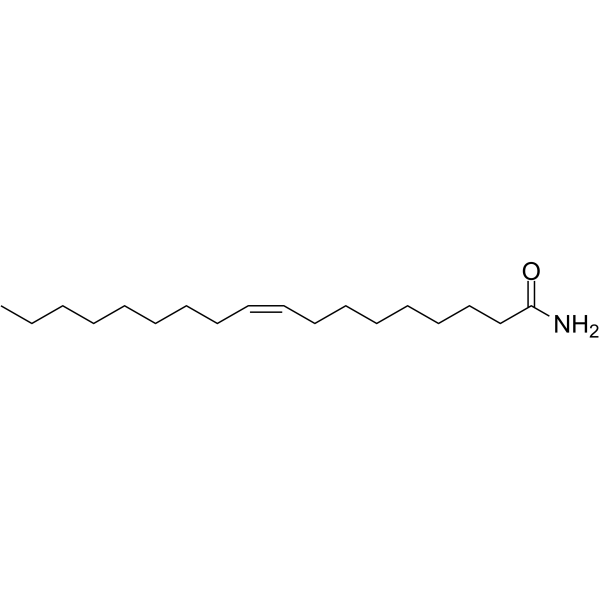
Oleamide is an endogenous fatty acid amide found in the nervous systems of mammalians, and can be detected in human plasma. It accumulates in the CSF of rats after six hours of sleep deprivation and induces sleep in naive rats and mice.
Physicochemical Properties
| Molecular Formula | C18H35NO |
| Molecular Weight | 281.4766 |
| Exact Mass | 281.271 |
| CAS # | 301-02-0 |
| PubChem CID | 5283387 |
| Appearance | IVORY-COLORED POWDER |
| Density | 0.9±0.1 g/cm3 |
| Boiling Point | 433.3±24.0 °C at 760 mmHg |
| Melting Point | 70°C |
| Flash Point | 215.9±22.9 °C |
| Vapour Pressure | 0.0±1.0 mmHg at 25°C |
| Index of Refraction | 1.469 |
| LogP | 6.75 |
| Hydrogen Bond Donor Count | 1 |
| Hydrogen Bond Acceptor Count | 1 |
| Rotatable Bond Count | 15 |
| Heavy Atom Count | 20 |
| Complexity | 236 |
| Defined Atom Stereocenter Count | 0 |
| SMILES | O=C(C([H])([H])C([H])([H])C([H])([H])C([H])([H])C([H])([H])C([H])([H])C([H])([H])/C(/[H])=C(/[H])\C([H])([H])C([H])([H])C([H])([H])C([H])([H])C([H])([H])C([H])([H])C([H])([H])C([H])([H])[H])N([H])[H] |
| InChi Key | FATBGEAMYMYZAF-KTKRTIGZSA-N |
| InChi Code | InChI=1S/C18H35NO/c1-2-3-4-5-6-7-8-9-10-11-12-13-14-15-16-17-18(19)20/h9-10H,2-8,11-17H2,1H3,(H2,19,20)/b10-9- |
| Chemical Name | (Z)-octadec-9-enamide |
| Synonyms | Oleamide; 301-02-0; Oleic acid amide; Oleylamide; Oleyl amide; (9Z)-octadec-9-enamide; Adogen 73; (Z)-octadec-9-enamide; |
| HS Tariff Code | 2934.99.9001 |
| Storage |
Powder-20°C 3 years 4°C 2 years In solvent -80°C 6 months -20°C 1 month |
| Shipping Condition | Room temperature (This product is stable at ambient temperature for a few days during ordinary shipping and time spent in Customs) |
Biological Activity
| Targets | Endogenous Metabolite |
| ln Vitro | After six hours of sleep deprivation, oleamide builds up in the cerebrospinal fluid (CSF) of rats and induces sleep in mice and naive rats. When administered centrally to rats and peripherally to mice, trifluoromethyl-octadecenone inhibits the primary catabolic enzyme of oleamide (fatty acid amide hydrolase), resulting in a reduction in sleep latency and an increase in total sleep duration.[1] |
| ln Vivo | Studies in rats indicate that oleamide enhances sleep (Table 1). Microinjection of 2.8 and 5.6 μg intraventricularly during daytime recordings significantly shortens EEG sleep latency (Basile et al. 1999). Presumably because of its very rapid metabolism, no significant effect is seen on total sleep in rats under these conditions. In mice, 10 mg/kg given intraperitoneally significantly shortens sleep latency and increases total sleep time, primarily by increasing NONREM sleep, with no significant effect on REM[1]. |
| Enzyme Assay | One way to explore which receptors might mediate the sleep-inducing effects of oleamide would of course be to observe sleep after administering it in combination with blockers for the receptors it is known to affect in vitro. One such agent is SR-141716, which selectively blocks the CB1 receptor with a Ki ∼5.6 nM, and which prevents such cannabinoid actions as memory disruption, analgesia and hypothermia (Terranova et al. 1996). Although higher peripheral doses may increase wakefulness (Santucci et al. 1996), low intraventricular doses (3 μg) were determined to have no effect on sleep in rats following daytime injections. When given in combination with 2.8 μg OA, SR-141716 was found to prevent the significant reduction in sleep latency observed when OA was given by itself[1]. |
| Cell Assay | Oleamide is found endogenously; it can be formed de novo in brain microsomes (Sugiura et al. 1996) and is detectable in human luteal phase plasma (Arafat et al. 1989). Fatty acid amide hydrolase, its major catabolic enzyme, has been isolated and localized in a number of brain regions (Thomas et al. 1997). OA does not directly affect ligand binding to serotonin and GABA receptors (Basile et al. 1999; Huidobro-Toro and Harris 1996). However, OA increases currents gated by 5-HT2a and 5-HT2c receptors at concentrations of 200 nM (Huidobro-Toro and Harris 1996) and it modulates GABA-induced chloride current amplitudes biphasically, enhancing currents in the hundreds of nanomolar range, but suppressing them at higher concentrations (Yost et al. 1998). Although OA does not appear to directly interact with cannabinoid receptors (Basile et al., 1999; Mechoulam et al., 1997), it raises concentrations of the endogenous CB-1 agonist anandamide (itself one of the family of unsaturated fatty acid amides) in vitro, possibly by interfering with hydrolysis (Mechoulam et al. 1997) or its cellular uptake (Hauer et al. 1998). Oleamide reportedly has little or no effect at muscarinic cholinergic, metabotropic glutamate, N-methyl-D-aspartate (NMDA), or α-amino-3-hydroxy-5-methyl-4-isoxozolepropionic acid (AMPA) receptors (Huidobro-Toro and Harris 1996). The mechanism by which OA induces these receptor effects is uncertain, though based on the experience with long chain, polyunsaturated free fatty acids (Meves 1994), it activates protein kinases, which phosphorylate consensus sites on receptor-related ion channels, thus altering their function. Alternatively, some of the effects induced by OA may result from the liberation of ammonia during its catabolism[1]. |
| References |
[1]. The hypnotic actions of the fatty acid amide, oleamide. Neuropsychopharmacology. 2001 Nov;25(5 Suppl):S36-9. |
| Additional Infomation |
Oleamide is a fatty amide derived from oleic acid. It has a role as a human metabolite and a plant metabolite. Oleamide has been reported in Glycine max, Desmos cochinchinensis, and other organisms with data available. |
Solubility Data
| Solubility (In Vitro) |
DMSO : ~100 mg/mL (~355.27 mM) Ethanol :≥ 100 mg/mL (~355.27 mM) |
| Solubility (In Vivo) |
Solubility in Formulation 1: 2.5 mg/mL (8.88 mM) in 10% DMSO + 40% PEG300 + 5% Tween80 + 45% Saline (add these co-solvents sequentially from left to right, and one by one), clear solution; with sonication. For example, if 1 mL of working solution is to be prepared, you can add 100 μL of 25.0 mg/mL clear DMSO stock solution to 400 μL PEG300 and mix evenly; then add 50 μL Tween-80 to the above solution and mix evenly; then add 450 μL normal saline to adjust the volume to 1 mL. Preparation of saline: Dissolve 0.9 g of sodium chloride in 100 mL ddH₂ O to obtain a clear solution. Solubility in Formulation 2: ≥ 2.5 mg/mL (8.88 mM) (saturation unknown) in 10% DMSO + 90% Corn Oil (add these co-solvents sequentially from left to right, and one by one), clear solution. For example, if 1 mL of working solution is to be prepared, you can add 100 μL of 25.0 mg/mL clear DMSO stock solution to 900 μL of corn oil and mix evenly. Solubility in Formulation 3: 2.5 mg/mL (8.88 mM) in 10% EtOH + 90% Corn Oil (add these co-solvents sequentially from left to right, and one by one), clear solution; with ultrasonication. For example, if 1 mL of working solution is to be prepared, you can add 100 μL of 25.0 mg/mL clear EtOH stock solution to 900 μL of corn oil and mix evenly. (Please use freshly prepared in vivo formulations for optimal results.) |
| Preparing Stock Solutions | 1 mg | 5 mg | 10 mg | |
| 1 mM | 3.5527 mL | 17.7633 mL | 35.5265 mL | |
| 5 mM | 0.7105 mL | 3.5527 mL | 7.1053 mL | |
| 10 mM | 0.3553 mL | 1.7763 mL | 3.5527 mL |